
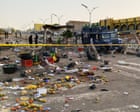
At least 23 people killed in suspected suicide attacks in north-eastern Nigeria
#suicide attacks #Nigeria #Borno #casualties #militants #bombings #security #violence
📌 Key Takeaways
- At least 23 people killed in suspected suicide attacks in north-eastern Nigeria
- Attacks occurred in the Borno state region, a frequent target of militant activity
- No group has immediately claimed responsibility for the bombings
- Incident highlights ongoing security challenges in the area despite military efforts
📖 Full Retelling
🏷️ Themes
Terrorism, Security Crisis
📚 Related People & Topics

Nigeria
Country in West Africa
Nigeria, officially the Federal Republic of Nigeria, is a country in West Africa between the Sahel to the north and the Gulf of Guinea in the Atlantic Ocean to the south. It covers an area of 923,769 square kilometres (356,669 mi2). With a population of more than 236 million, it is the most populous...
Entity Intersection Graph
No entity connections available yet for this article.
Mentioned Entities
Deep Analysis
Why It Matters
This attack represents a significant escalation of violence in a region already devastated by long-term conflict, directly affecting civilians who bear the brunt of terrorist violence. It matters because it demonstrates the persistent threat posed by extremist groups in Nigeria's northeast, undermining security efforts and humanitarian operations. The killings will likely trigger further displacement, exacerbate food insecurity, and strain limited healthcare resources in an area where millions already depend on aid. This violence also has regional implications, potentially destabilizing neighboring countries and requiring coordinated international security responses.
Context & Background
- Boko Haram launched its insurgency in 2009 aiming to establish an Islamic state in northern Nigeria, leading to over 40,000 deaths and 2 million displaced people
- The Islamic State West Africa Province (ISWAP) split from Boko Haram in 2016 and has become the dominant extremist force in the Lake Chad region
- Northeastern Nigeria has experienced suicide bombings targeting markets, mosques, and displacement camps since 2011, with women and children frequently used as bombers
- The Nigerian military has conducted multiple counter-insurgency operations since 2015 with support from regional forces, yet attacks persist in rural areas
- The region faces severe humanitarian crisis with 8.4 million people needing assistance and 4.4 million facing acute food insecurity according to UN estimates
What Happens Next
The Nigerian military will likely intensify counter-terrorism operations in the affected area over the next 2-4 weeks, potentially displacing more civilians. Humanitarian organizations may temporarily suspend operations due to security concerns, worsening already dire conditions in displacement camps. Regional security meetings through the Multinational Joint Task Force will probably convene within days to coordinate responses. The Nigerian government may face increased pressure to revise its security strategy ahead of the next rainy season when militant movements typically increase.
Frequently Asked Questions
The Islamic State West Africa Province (ISWAP) is the most probable perpetrator, as they have recently intensified attacks in northeastern Nigeria using suicide bombings. However, factions of Boko Haram still operate in the region and could also be responsible, requiring investigation of specific tactics and claimed responsibility.
Extremist groups exploit the vast, difficult terrain of the Lake Chad basin and porous borders to evade military forces. They also capitalize on local grievances, poverty, and weak governance to recruit vulnerable individuals, while adapting tactics to target soft civilian locations where security is lighter.
Such attacks typically force aid organizations to suspend operations temporarily, delaying food distribution and medical services to millions. Increased insecurity also makes remote communities harder to reach, worsening malnutrition and disease outbreaks in areas already facing catastrophic food insecurity.
The United Nations coordinates humanitarian response while Western nations provide military training and intelligence support. The Multinational Joint Task Force involving Nigeria, Chad, Niger, and Cameroon conducts cross-border operations, though funding and coordination challenges persist.
Yes, extremist groups continue coercing children into carrying explosives, particularly girls who face less suspicion at checkpoints. UNICEF reports hundreds of children have been used in suicide attacks since 2014, though recent trends show increased use of adult male bombers.