
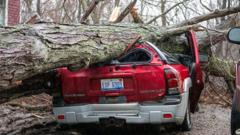
At least six dead after tornadoes sweep across Michigan and Oklahoma, officials say
#tornadoes #Michigan #Oklahoma #deaths #severe weather #damage #officials
📌 Key Takeaways
- At least six people have died due to tornadoes in Michigan and Oklahoma
- Severe weather events caused significant damage across both states
- Officials are assessing the full extent of the destruction and casualties
- Emergency response teams are actively involved in rescue and recovery efforts
📖 Full Retelling
🏷️ Themes
Natural Disasters, Emergency Response
📚 Related People & Topics

Oklahoma
U.S. state
Oklahoma ( OH-klə-HOH-mə; Choctaw: Oklahumma, pronounced [oklahómma]) is a landlocked state in the South Central and Southwestern region of the United States. It borders Texas to the south and west, Kansas to the north, Missouri to the northeast, Arkansas to the southeast, New Mexico to the west, a...

Michigan
U.S. state
Michigan ( MISH-ig-ən) is a peninsular state in the Great Lakes region of the Upper Midwestern United States. It shares water and land boundaries with Minnesota to the northwest, Wisconsin to the west, Indiana and Illinois to the southwest, Ohio to the southeast, and the Canadian province of Ontari...
Entity Intersection Graph
Connections for Oklahoma:
View full profileMentioned Entities
Deep Analysis
Why It Matters
This news matters because tornado-related fatalities represent a significant public safety concern, highlighting vulnerabilities in severe weather preparedness and warning systems. It affects residents in the impacted regions who face property damage, displacement, and trauma, while also drawing attention from emergency management agencies and policymakers nationwide. The deaths underscore the ongoing threat of extreme weather events, which may become more frequent or intense due to climate change, necessitating improved infrastructure and community resilience measures.
Context & Background
- Tornadoes are common in the central and southern U.S., with 'Tornado Alley'—including Oklahoma—experiencing frequent severe storms, particularly in spring and early summer.
- Michigan, while less prone to tornadoes than the Plains states, still sees an average of 15 tornadoes per year, often associated with severe thunderstorm outbreaks.
- The U.S. averages about 80 tornado-related fatalities annually, with most deaths caused by flying debris or structural collapse in homes and vehicles.
- Advances in Doppler radar and warning systems have reduced tornado mortality over decades, but outbreaks can still overwhelm preparedness efforts, especially in densely populated or vulnerable areas.
What Happens Next
Emergency response teams will continue search-and-rescue operations in affected areas, while damage assessments will guide federal disaster declarations and aid allocation. The National Weather Service will conduct storm surveys to rate tornado intensity and analyze warning effectiveness. In the coming weeks, affected communities may see temporary shelters, utility restoration efforts, and insurance claim processes, with longer-term rebuilding likely to take months or years.
Frequently Asked Questions
Tornadoes form from severe thunderstorms when wind shear and instability combine, often along weather fronts. Oklahoma lies in Tornado Alley, where warm, moist air from the Gulf clashes with dry air from the Rockies, while Michigan experiences tornadoes when strong storm systems sweep across the Great Lakes region.
Seek shelter immediately in a basement or interior room on the lowest floor, away from windows. If outdoors or in a vehicle, try to reach a sturdy building or lie flat in a low-lying area. Always heed weather warnings via NOAA radios, apps, or local alerts, as tornadoes can develop rapidly.
Affected individuals may access disaster relief through FEMA, the Red Cross, and state agencies, including temporary housing, financial aid, and crisis counseling. Insurance claims for property damage should be filed promptly, while community organizations often provide supplies and volunteer support for recovery efforts.
Research suggests climate change may alter tornado patterns, such as shifting activity eastward or increasing the frequency of outbreaks, but trends remain uncertain due to data limitations. Warming can enhance atmospheric instability, potentially raising the risk of severe storms, though tornado formation depends on complex factors beyond temperature alone.