
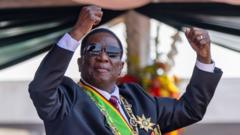
Bid launched to extend Zimbabwe president's term in office
#Zimbabwe #Emmerson Mnangagwa #Zanu-PF #term limits #constitutional amendment #Harare #presidential succession
📌 Key Takeaways
- Zanu-PF loyalists are pushing for a constitutional amendment to allow President Mnangagwa to serve beyond 2028.
- The current Zimbabwean constitution limits presidents to two five-year terms, which Mnangagwa is set to complete.
- Supporters use the '2030' slogan to justify the extension as vital for economic continuity.
- Legal hurdles exist, as the constitution currently prohibits an incumbent from benefiting from term-limit extensions.
📖 Full Retelling
Legislators and loyalists within Zimbabwe’s ruling Zanu-PF party launched a formal campaign in Harare this week to introduce a constitutional amendment that would allow President Emmerson Mnangagwa to extend his presidency beyond the current 2028 deadline. The move aims to bypass the existing two-term limit established by the 2013 constitution, with supporters arguing that the extension is necessary to ensure the completion of the administration's long-term economic development projects. If successful, the legal maneuver would effectively delay the transition of power and potentially grant the 81-year-old leader several more years at the helm of the Southern African nation.
The push for a term extension is being driven by the catchphrase "2030 vanenge vachipo," which translates to "He will still be there in 2030." This slogan has become a fixture at provincial rallies, where party structures are passing resolutions to endorse Mnangagwa’s continued rule. However, the path to a legal amendment remains complex. Under current Zimbabwean law, any constitutional change that extends a term limit cannot benefit the incumbent official holding that office. To circumvent this, legal experts suggest the government would need to either repeal that specific clause or implement a wholesale overhaul of the presidential term limit framework.
Critiques from opposition groups and civil rights organizations have intensified following the announcement, with many warning that such a move would undermine Zimbabwe's democratic progress and risk international isolation. Opponents argue that the bid mirrors the political strategies used by former leader Robert Mugabe to maintain a lifelong grip on power before his ousting in 2017. Furthermore, the proposal has reportedly sparked internal friction within Zanu-PF, as various factions vie for succession and question the legality of altering the country’s supreme law for a single individual.
President Mnangagwa, who took power following a military-assisted transition and won two subsequent elections, has sent mixed signals regarding his personal intentions to stay. While he previously claimed he would respect the constitution, the mounting pressure from his inner circle suggests a coordinated effort to test public and parliamentary appetite for a third term. The development comes at a sensitive time for Zimbabwe as it faces significant economic challenges, including hyperinflation and a fluctuating currency, which the administration claims require the steady hand of an experienced leader to resolve.
🏷️ Themes
Politics, Governance, Constitutional Law
Entity Intersection Graph
No entity connections available yet for this article.