
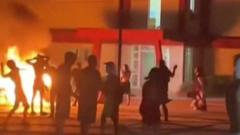
Cuban protesters ransack Communist office as energy crisis deepens
#Cuba #protests #Communist Party #energy crisis #economic hardship #social unrest #political stability
📌 Key Takeaways
- Protesters in Cuba attacked a local Communist Party office amid rising tensions.
- The incident is linked to a severe energy crisis affecting daily life on the island.
- Public frustration is growing over economic hardships and government policies.
- The event highlights increasing social unrest and challenges to political stability in Cuba.
📖 Full Retelling
🏷️ Themes
Political Unrest, Economic Crisis
📚 Related People & Topics
Communist party
Political party that promotes communist philosophy and values
A communist party is a political party that seeks to realize the socio-economic goals of communism. The term "communist party" was popularized by the title of The Manifesto of the Communist Party (1848) by Karl Marx and Friedrich Engels. As a vanguard party, the communist party guides the political ...

Cuba
Country in the Caribbean
Cuba, officially the Republic of Cuba, is an island country in the Caribbean. It comprises the eponymous main island as well as 4,195 islands, islets, and cays. Situated at the convergence of the Caribbean Sea, Gulf of Mexico, and Atlantic Ocean, Cuba is located east of the Yucatán Peninsula, south ...
Entity Intersection Graph
Connections for Communist party:
View full profileMentioned Entities
Deep Analysis
Why It Matters
This incident matters because it represents a significant escalation in public discontent in Cuba, where open protest against the Communist Party is rare and carries serious risks. It directly affects ordinary Cubans suffering through energy shortages that disrupt daily life, healthcare, and economic activity. The government faces mounting pressure as economic hardships intensify, potentially destabilizing one of the last communist states in the Western Hemisphere. International observers are watching closely as this could signal broader unrest or political change in Cuba.
Context & Background
- Cuba has been under a U.S. economic embargo since 1962, severely limiting its access to international markets and financing
- The country relies heavily on subsidized oil imports from Venezuela, which have declined due to Venezuela's own economic crisis
- Cuba's energy infrastructure is aging and inefficient, with frequent blackouts reported across the island for years
- The Communist Party has maintained one-party rule since the 1959 revolution, with limited tolerance for public dissent
- Previous protests in July 2021 were the largest in decades, leading to arrests and internet restrictions
What Happens Next
The Cuban government will likely increase security presence around party offices and may implement temporary internet restrictions to prevent protest organization. International human rights organizations will probably issue statements condemning any crackdown on protesters. If energy shortages persist, similar protests could emerge in other provinces, potentially leading to broader civil unrest by late 2024 or early 2025.
Frequently Asked Questions
Cubans are protesting due to severe energy shortages causing daily blackouts that disrupt work, cooking, refrigeration, and medical care. The crisis compounds existing economic problems including food scarcity and inflation. This represents breaking point frustration after years of deteriorating living conditions.
The government has typically responded with arrests of protest leaders and temporary internet shutdowns to limit organization. They often blame U.S. sanctions for economic problems while offering limited concessions. Security forces are deployed to maintain order while state media downplays protest size.
This protest is significant because protesters directly targeted a Communist Party office, which is a bold challenge to political authority. Previous protests focused on economic complaints, while this action has clearer political implications. The targeting of party symbols suggests deepening frustration with the political system itself.
Venezuela's economic collapse has reduced its ability to provide Cuba with subsidized oil, which Cuba depends on for about half its energy needs. This has forced Cuba to seek more expensive alternatives while dealing with its own economic limitations. The loss of this support has exacerbated Cuba's chronic energy problems.
While unlikely to immediately overthrow the government, sustained protests could force policy changes or leadership adjustments within the Communist Party. The military's loyalty will be crucial in determining outcomes. International pressure and economic support decisions will also influence potential reforms.