
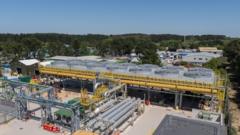
Earth's heat to power 10,000 homes in renewable energy first for UK
#geothermal energy #renewable power #UK energy #lithium extraction #Cornwall plant #clean energy #green technology #critical minerals
📌 Key Takeaways
- UK's first geothermal power plant will provide electricity for 10,000 homes and extract lithium
- The project required drilling the deepest on-shore well in the UK at a cost of £50 million
- Geothermal provides constant 24/7 power unlike intermittent renewables like wind and solar
- High drilling costs pose challenges for replicating similar projects across the UK
- The plant will also extract lithium, a critical mineral for green technology
📖 Full Retelling
Geothermal Engineering Ltd will launch the UK's first geothermal power plant in Cornwall on Thursday morning, after nearly two decades in development, using super-heated water from underground rocks to generate electricity for 10,000 homes and extract lithium for green technology. The project required drilling the deepest on-shore well in the UK at a cost of £50 million, funded through private investors and the European Development Fund. This milestone represents a significant advancement in renewable energy for the UK, providing a constant power source unlike intermittent renewables like wind and solar.
The technology works by drilling deep boreholes into granite rock formations, where water is circulated and heated by Earth's natural geothermal energy. At depths of several miles, temperatures reach nearly 200°C, hot enough to drive turbines and generate electricity. Dr. Monaghan from the British Geological Survey explains that granite is particularly effective for this technology due to its ability to hold and conduct heat efficiently. While shallow geothermal systems are already used in some parts of the UK for heating, this marks the first time deep geothermal technology has been successfully implemented for electricity generation in the country.
Despite the breakthrough, challenges remain for scaling up geothermal energy in the UK. The high drilling costs make replicating such projects difficult, and while the technology is technically feasible in other regions like Scotland and Northeast England, no approved plans currently exist. Industry leaders emphasize the need for supportive government policies to unlock investment and increase confidence in the sector. The UK government has shown growing interest, appointing Lord Whitehead as the country's first geothermal minister late last year. Additionally, the plant will extract lithium carbonate from the geothermal fluid, providing the UK's first domestic supply of this critical mineral essential for electric vehicle batteries, with plans to scale production from 100 to 18,000 tonnes annually.
🏷️ Themes
Renewable energy, Climate technology, Energy innovation
📚 Related People & Topics

Energy in the United Kingdom
Total energy consumption in the United Kingdom was 142.0 million tonnes of oil equivalent (1,651 TWh) in 2019. In 2014, the UK had an energy consumption per capita of 2.78 tonnes of oil equivalent (32.3 MWh) compared to a world average of 1.92 tonnes of oil equivalent (22.3 MWh). Demand for electric...
Entity Intersection Graph
Connections for Energy in the United Kingdom:
🌐
Labour
1 shared
🌐
Miliband
1 shared
👤
Great British Energy
1 shared
🌐
List of wars involving Iran
1 shared
Mentioned Entities
Original Source
Earth's heat to power 10,000 homes in renewable energy first for UK 30 minutes ago Share Save Esme Stallard , Climate and science reporter and Kate Stephens , Senior science journalist Share Save The UK's first geothermal power plant is set to go live, providing a completely new type of renewable electricity using hot water from underground. On Thursday morning, the Cornish plant will be switched on after nearly two decades in development which required Geothermal Engineering Ltd to drill the deepest on-shore well in the UK. The water, super-heated by rocks, will help drive turbines to generate electricity for 10,000 homes, but will also provide the UK's first domestic supply of lithium - a critical mineral used in green technology. The British Geological Survey said it was a "major step forward" for geothermal but high drilling costs could make replicating the project difficult. The Earth generates heat which can be harnessed by drilling down below the surface to provide a renewable, and continuous source of energy to heat and power our homes – known as geothermal energy. The further down you go the hotter it gets. At shallow depths the heat is enough to warm our homes and businesses. This is already done in some parts of the UK – for example, ground source heat pumps are a form of geothermal technology . At far deeper depths - at least a few miles below the surface - temperatures climb to nearly 200C, and this is enough heat to generate electricity. "You drill deep boreholes into the ground, and then fractures within the granite rock are used to circulate the water that pick up the heat [that is] used for electricity production," explained Dr Monaghan, head of geothermal at the British Geological Survey . Granite is particularly ideal for this technology as it is very effective at holding and conducting the Earth's heat. This is the first time the feat has been achieved in the UK because drilling this far down is a technically and financially costly endeavour. The...
Read full article at source