
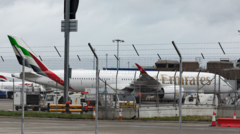
Edinburgh to Dubai flight turned back over Egypt due to airport drone attack
#Emirates #Edinburgh #Dubai #drone attack #Egypt #flight diversion #airport security
📌 Key Takeaways
- Emirates flight from Edinburgh to Dubai was forced to turn back over Egypt due to a drone attack at an Egyptian airport.
- The incident highlights the growing threat of drone attacks on civilian aviation and airport security.
- Passengers were safely returned to Edinburgh, with Emirates arranging alternative travel plans.
- Authorities are investigating the attack, which disrupted air traffic and raised security concerns in the region.
📖 Full Retelling
🏷️ Themes
Aviation Security, Drone Threats
📚 Related People & Topics

Dubai
City in the United Arab Emirates
Dubai is the most populous city in the United Arab Emirates and the capital of the Emirate of Dubai. It is on a creek on the southeastern coast of the Persian Gulf. As of 2025, its population stands at 4 million, 92% of whom are expatriates.

Edinburgh
Capital city of Scotland
Edinburgh is the capital city of Scotland and one of its 32 council areas. It is located in southeast Scotland and is bounded to the north by the Firth of Forth and to the south by the Pentland Hills. Edinburgh had a population of 506,520 in 2020, making it the second-most-populous city in Scotland ...

Egypt
Country in Northeast Africa and Southwest Asia
# Egypt **Egypt**, officially the **Arab Republic of Egypt**, is a transcontinental country spanning the northeast corner of Africa and the southwest corner of Asia via the land bridge of the Sinai Peninsula. ### Geography and Boundaries Egypt is strategically positioned at the crossroads of seve...
Entity Intersection Graph
Connections for Dubai:
Mentioned Entities
Deep Analysis
Why It Matters
This incident highlights the growing threat of drone attacks on civilian aviation, which endangers passenger safety and disrupts international travel. It affects airlines facing operational challenges, passengers experiencing significant delays and potential trauma, and governments needing to address evolving security threats. The event also demonstrates how regional conflicts can have direct consequences for global air travel far from the actual conflict zone.
Context & Background
- Drone attacks on airports and aviation infrastructure have increased globally in recent years, with notable incidents in Saudi Arabia, Iraq, and Ukraine.
- Egypt has experienced security challenges in the Sinai Peninsula and other regions, with various militant groups operating in the area.
- The aviation industry has been developing counter-drone technologies and protocols since a 2018 incident at London Gatwick Airport where drone sightings caused major disruptions.
- Commercial flights routinely avoid conflict zones, with notable examples including avoidance of Ukrainian and Syrian airspace during active conflicts.
What Happens Next
The airline will likely conduct a safety review and may temporarily adjust flight paths avoiding Egyptian airspace. Aviation authorities will investigate the incident and potentially issue new security advisories. Egyptian authorities will enhance airport security measures and possibly conduct military operations against drone operators. Passengers will experience rebooking and compensation processes, while the industry may accelerate deployment of anti-drone systems at vulnerable airports.
Frequently Asked Questions
The most fuel-efficient route between Edinburgh and Dubai typically passes over Eastern Europe, Turkey, and then across Egypt and Saudi Arabia. This great circle route follows the curvature of the Earth rather than a straight line on a map.
While still relatively rare, drone incidents affecting aviation have increased significantly in recent years. Most involve unauthorized drones near airports rather than deliberate attacks, but conflict zones have seen more targeted drone activity against aviation infrastructure.
Airlines monitor NOTAMs (Notice to Airmen) and government advisories about airspace safety. They typically avoid areas with active conflicts, but rapidly developing situations like drone attacks can create unexpected dangers that require immediate diversion.
Passengers are typically entitled to care (meals, accommodation) during extended delays and may receive compensation under EU/UK regulations if the delay exceeds certain thresholds, unless the disruption qualifies as an 'extraordinary circumstance' beyond the airline's control.
Airports use layered defenses including radar detection, radio frequency jammers, and sometimes physical interception methods. However, small commercial drones remain challenging to detect and neutralize, especially in crowded airspace.