
Finland plans to lift decades-old ban on hosting nuclear weapons
#Finland nuclear weapons ban #NATO deterrence policy #Russia-Ukraine war #European security #Finnish defense policy #NATO expansion #Nuclear weapons policy
📌 Key Takeaways
- Finland plans to lift its decades-old ban on hosting nuclear weapons
- The change aligns Finland with NATO's deterrence policy after joining the alliance
- Europe's security environment has fundamentally changed since Russia's invasion of Ukraine
- Finland shares a long border with Russia and has expressed security concerns
- The proposal requires changes to both the Nuclear Energy Act and criminal code
📖 Full Retelling
Finland's government, led by Defence Minister Antti Häkkänen, announced plans on Thursday to lift its decades-long ban on hosting nuclear weapons, citing the "fundamentally and significantly changed" security environment in Europe since Russia's full-scale invasion of Ukraine in 2022. The move would amend Finland's 1987 Nuclear Energy Act, which currently prohibits the import, manufacture, possession, and detonation of nuclear explosives on Finnish soil, even during wartime. Under the proposed changes, it would become possible to "bring a nuclear weapon into Finland, or to transport, deliver or possess one in Finland, if it is connected to the military defence of Finland," according to Häkkänen. The government argues this amendment is necessary to fully integrate with NATO's deterrence policy and collective defense framework, as Finland became the 31st member of the alliance in April 2023, abandoning its long-standing policy of military neutrality. Finland shares a 1,340km border with Russia—the longest of any EU or NATO member state—and its leaders have repeatedly warned that the security situation has deteriorated since Russia's invasion of Ukraine. The Nordic nation's accession to NATO was widely seen as a strategic setback for Russian President Vladimir Putin, who had long criticized the alliance's eastward expansion. Since joining, NATO has increased its military presence in the Arctic and Baltic regions, as well as along the eastern flank. The proposal comes amid broader European efforts to strengthen defense cooperation in response to the war in Ukraine and global instability, with neighboring Sweden also joining NATO in 2024 and indicating flexibility on its policy regarding foreign troops and nuclear weapons.
🏷️ Themes
NATO expansion, Nuclear deterrence, European security, Russia-West relations
📚 Related People & Topics
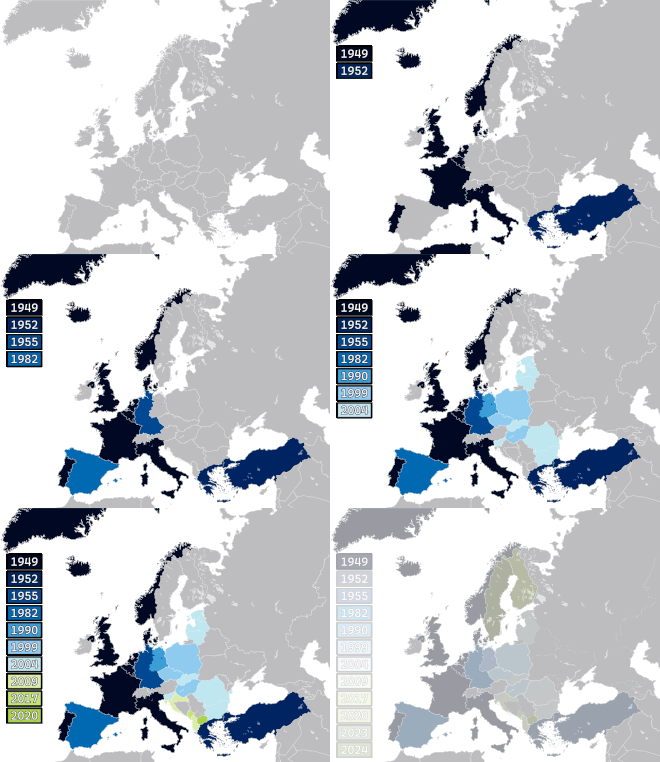
Enlargement of NATO
Collective geopolitical action by NATO states
NATO is a military alliance of thirty-two European and North American countries that constitutes a system of collective defense. The process of joining the alliance is governed by Article 10 of the North Atlantic Treaty, which allows for the invitation of "other European States" only and by subseque...
Entity Intersection Graph
No entity connections available yet for this article.
Mentioned Entities
Original Source
Finland plans to lift decades-old ban on hosting nuclear weapons Just now Share Save Jessica Rawnsley Share Save Finland plans to lift its long-standing ban on having nuclear weapons on its territory, in a move the government says would align the country more closely with Nato's deterrence policy. Defence minister Antti Häkkänen Finland and Europe's security environment had "fundamentally and significantly changed" since Russia's full-scale invasion of Ukraine began in 2022. The Nordic nation abandoned decades of military neutrality to join Nato in 2023 over mounting concerns about the threat posed by Russia. Under Finland's 1987 Nuclear Energy Act, the import, manufacture, possession and detonation of nuclear explosives is prohibited on Finnish soil - even during wartime. The government proposal would change that, making it possible to "bring a nuclear weapon into Finland, or to transport, deliver or possess one in Finland, if it is connected to the military defence of Finland", Häkkänen said. "The amendment is necessary to enable Finland's military defense as part of the alliance and to take full advantage of Nato's deterrence and collective defence," he told a news conference on Thursday. Nato's founding principle of collective defence - that an attack on one member nation would be treated as an attack on all - underpins the alliance's nuclear deterrence stategy. As it contains several nuclear powers, this means a direct attack on a member brings with it the risk of a nuclear attack. US nuclear weapons are stationed in several European nations, according to the Center for Arms Control and Non-proliferation. The Finnish government's proposal requires changes to both the country's Nuclear Energy Act and the criminal code. Its governing right-wing coalition, which holds a majority in parliament, said the proposal had been circulated for consultation until 2 April before it is formally laid out. Finland shares a 1,340km (832-mile) border with Russia - the longest of ...
Read full article at source