
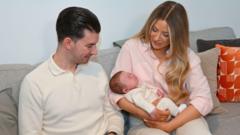
First British baby born using transplanted womb from deceased donor
#womb transplant #MRKH syndrome #deceased donor #fertility breakthrough #UK medical first #organ donation #pregnancy after transplant #Grace Bell
📌 Key Takeaways
- First British baby born using womb from deceased donor
- Mother Grace Bell has MRKH syndrome, affecting 5,000 UK women
- Part of clinical trial with 10 transplants planned
- Medical breakthrough offering hope to infertile women
- Donor family provided "incredible gift" enabling biological parenthood
📖 Full Retelling
British mother Grace Bell, who was born without a viable womb due to MRKH syndrome, gave birth to baby boy Hugo at Queen Charlotte's and Chelsea Hospital in west London just before Christmas 2025, becoming the first woman in the UK to successfully carry a child using a womb transplanted from a deceased donor. The 10-week-old baby, weighing nearly 7lbs at birth, represents a medical breakthrough that offers hope to thousands of women facing similar fertility challenges. Bell and her partner Steve Powell paid tribute to the anonymous donor's family for their "incredible gift," while also acknowledging the dedicated medical teams in Oxford and London who supported their journey to parenthood.
Bell, who is in her 30s, was diagnosed with MRKH syndrome at age 16, a condition affecting approximately 5,000 women in the UK that results in being born without a womb while maintaining normal ovarian function. The couple initially considered surrogacy as their only option until Bell received a life-changing phone call about the availability of a deceased donor's womb. The 10-hour transplant surgery took place at The Churchill Hospital in Oxford in June 2024, followed by IVF treatment and embryo transfer at The Lister Fertility Clinic in London. "I was in complete shock and really excited," Bell recalled of the moment she learned a transplant was possible, expressing daily gratitude toward the donor family "who gave me the biggest gift: the gift of life."
This groundbreaking birth is part of a UK clinical research trial involving 10 womb transplants from deceased donors, with three having been performed so far but this being the first successful pregnancy. The medical team, led by Prof Richard Smith who has researched womb transplantation for over 25 years, celebrated this achievement as a "ground-breaking moment" that could revolutionize treatment for women born without wombs. The couple honored Prof Smith by giving their son the middle name Richard, acknowledging his instrumental role in their journey. Following Hugo's birth, Bell described the experience as "simply a miracle," recalling waking up to see her newborn son's face and feeling as though she needed to "wake up from a dream."
The successful procedure adds to a growing global record of womb transplantation, with over 100 such operations worldwide resulting in more than 70 healthy births. Unlike other organ donations, womb transplantation requires special family consent beyond standard organ donation agreements. The anonymous donor's family expressed "tremendous pride" in their daughter's legacy, noting she also donated five other organs that saved four lives. The medical team, including transplant surgeon Isabel Quiroga, emphasized that this European breakthrough could become a regular treatment option for increasing numbers of women of child-bearing age without viable wombs, though the transplanted organ is typically removed after one or two births to avoid long-term immunosuppression medication.
🏷️ Themes
Medical Innovation, Fertility Treatment, Organ Donation, Reproductive Health
📚 Related People & Topics

Müllerian agenesis
Congenital malformation of female reproductive organs
Müllerian agenesis, also known as Müllerian aplasia, vaginal agenesis, or Mayer–Rokitansky–Küster–Hauser syndrome (MRKH syndrome), is a congenital malformation characterized by a failure of the Müllerian ducts to develop, resulting in a missing uterus and variable degrees of vaginal hypoplasia of it...
Entity Intersection Graph
No entity connections available yet for this article.
Mentioned Entities
Original Source
First British baby born using transplanted womb from deceased donor 7 hours ago Share Save Philippa Roxby Health reporter Share Save A baby boy has become the first child in the UK to be born using a womb transplanted from a deceased donor. Grace Bell, who is in her 30s and was born without a viable womb, says her little boy Hugo, who is now 10 weeks old, is "simply a miracle". Bell and her partner Steve Powell, from Kent, paid tribute to the "kindness and selflessness" of the donor and her family for their "incredible gift", while also thanking medical teams in Oxford and London who supported their journey. The surgeons involved said the birth was "a ground-breaking moment", which could give hope to many more women with a similar diagnosis. 'Incredible gift' Hugo was born just before Christmas 2025, weighing nearly 7lbs, at Queen Charlotte's and Chelsea Hospital in west London. Bell is one of around 5,000 women in the UK affected by a condition called MRKH syndrome, which means she was born without a womb and doesn't have periods but does have normal ovaries. At the age of 16, she was told she wouldn't be able to carry her own child. To have a baby, the couple's only option was to hope for a womb transplant or go down the route of surrogacy. When she received a phone call saying a womb had been donated and a transplant was possible, Bell remembers being "in complete shock" and "really excited". But she was also acutely aware of the donor family's "incredible gift", which would enable her to carry and give birth to her own child. "I think of my donor and her family every day and pray they find some peace in knowing their daughter gave me the biggest gift: the gift of life," Bell said. "A part of her will live on forever." Bell's womb transplant operation lasted 10 hours and took place at The Churchill Hospital in Oxford in June 2024, before the couple received IVF treatment some months later - followed by embryo transfer - at The Lister Fertility Clinic in London. W...
Read full article at source