
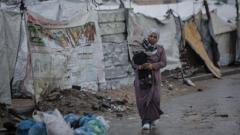
Gaza peace doubts deepen as attention shifts to Iran
#Gaza peace #Iran war #Trump peace plan #Hamas #Humanitarian crisis #Ceasefire #Disarmament #International attention
📌 Key Takeaways
- Gaza faces renewed shortages and price increases as international attention shifts to Iran
- Trump's peace plan reaches crucial stage but faces uncertainty with Hamas likely rejecting disarmament proposals
- Humanitarian conditions remain dire with infrastructure not being repaired due to Israeli restrictions
- Hamas is reasserting control in Gaza despite the ceasefire, imposing taxes and strengthening security presence
📖 Full Retelling
🏷️ Themes
Humanitarian crisis, Political uncertainty, International relations
📚 Related People & Topics

Humanitarian crisis
Large threat to the health and safety of many people
A humanitarian crisis (or sometimes humanitarian disaster) is defined as a singular event or a series of events that are threatening in terms of health, safety or well-being of a community or large group of people. It may be an internal or external conflict and usually occurs throughout a large land...
List of wars involving Iran
This is a list of wars involving the Islamic Republic of Iran and its predecessor states. It is an unfinished historical overview.
Trump peace plan
Topics referred to by the same term
Trump peace plan or Trump's peace plan may refer to:
Hamas
Islamist Palestinian political and paramilitary organization
The Islamic Resistance Movement, abbreviated Hamas (an acronym from the Arabic: حركة المقاومة الإسلامية, romanized: Ḥarakat al-Muqāwamah al-ʾIslāmiyyah), is a Sunni Islamist Palestinian nationalist political organisation with a military wing known as the al-Qassam Brigades. It has governed the Israe...
Entity Intersection Graph
Connections for Humanitarian crisis:
View full profileMentioned Entities
Deep Analysis
Why It Matters
The deepening uncertainty in Gaza comes as international attention shifts to the Iran-Israel conflict, potentially leaving millions of Palestinians without adequate support. The economic crisis is worsening with soaring prices and shortages of essential goods, while ongoing violence despite the ceasefire continues to claim civilian lives. This situation affects not only the immediate humanitarian crisis in Gaza but also the broader stability of the Middle East region and the prospects for lasting peace.
Context & Background
- Gaza has experienced multiple conflicts with Israel since 2008, with the most recent major conflict occurring in 2021
- Hamas has controlled the Gaza Strip since 2007 after winning elections and subsequently ousting Fatah forces
- Previous ceasefire agreements have often been fragile and short-lived, with frequent violations by both sides
- The Trump administration previously proposed controversial peace plans that were widely criticized by Palestinians
- International aid has been a critical lifeline for Gaza's population, which has been under blockade since 2007
- Israel has historically restricted the entry of construction materials into Gaza citing security concerns
What Happens Next
The Trump administration's 20-point peace plan will likely face continued resistance from Palestinian officials and Hamas. Economic conditions in Gaza are expected to worsen as international attention shifts to the Iran-Israel conflict, potentially leading to increased humanitarian needs. Hamas will likely reject the UN disarmament proposal, while Israel may continue selective military operations despite the ceasefire. Reconstruction efforts will remain stalled as Israel maintains restrictions on building materials, and the humanitarian crisis in overcrowded camps will likely deepen with the approaching rainy season.
Frequently Asked Questions
The ceasefire has been in place for nearly six months, but it remains fragile with ongoing Israeli air strikes that have killed dozens including children.
Regional tensions from the Iran conflict are hampering supplies from Israel to Gaza, causing renewed shortages of essential goods and doubling prices for ordinary Palestinians.
The Trump administration's 20-point peace plan is reaching a crucial implementation stage, though it faces significant hurdles as international attention shifts to other conflicts in the region.
Israel continues to block reconstruction materials over concerns they could be used by Hamas for military purposes, despite the urgent need to rebuild war-torn infrastructure in Gaza.
Hamas is reasserting control by restructuring its security apparatus and imposing heavy taxes on goods and services, which further exacerbates the economic crisis in the already devastated territory.