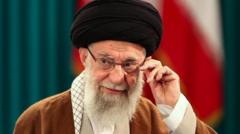
How Ayatollah Khamenei kept an iron grip on power for almost 40 years
#Ayatollah Khamenei#Iran Supreme Leader#US-Israeli strikes#Power transition#Middle East politics#Iranian leadership
📌 Key Takeaways
Ayatollah Khamenei died during US-Israeli air strikes on Iran
Khamenei ruled Iran for 34 years as Supreme Leader
He survived an assassination attempt in 1981 that left him permanently injured
His death creates uncertainty for Iran's future and regional stability
📖 Full Retelling
US President Donald Trump announced the death of Iranian Supreme Leader Ayatollah Ali Khamenei during massive US and Israeli air strikes on Iran, an event later confirmed by Iranian state television. The 86-year-old ruler, who had held Iran's highest office for nearly three decades, died amid unprecedented military action against the country's nuclear facilities and military infrastructure. Khamenei's death marks the end of an era for Iran, as he was the only supreme leader besides the revolution's founder Ayatollah Khomeini since the 1979 Islamic Revolution. Born in 1939 in Mashhad to a religious family, Khamenei rose from studying the Quran to become an effective orator opposing the Shah. He was arrested six times by the Shah's secret police, suffering torture and exile. After the Islamic revolution, Khomeini appointed him Tehran's Friday prayer leader, establishing his position in the new leadership. During the Iran-Iraq war, Khamenei served as a wartime leader, spending months on the front lines and developing his deep distrust of the West, which had backed Saddam Hussein. In 1989, despite not being considered a top religious scholar, he was selected as Khomeini's successor and spent the next 34 years building networks of loyalists across Iranian institutions while maintaining a cult of personality and suppressing opposition. His rule was characterized by brutal crackdowns on protests, restrictions on women's rights, and a foreign policy that combined anti-Western rhetoric with careful diplomacy. Khamenei survived an assassination attempt in 1981 that left him permanently injured his right arm and lungs. In recent years, he faced increasing economic challenges and international isolation, culminating in the current military confrontation that began when Israeli forces attacked Iran's nuclear program in June 2025, followed by US strikes on Iranian nuclear facilities in January 2026. Khamenei had vowed never to surrender, but his death in these circumstances heralds a new and uncertain future for Iran and the wider region.
🏷️ Themes
Power Transition, Middle East Politics, Leadership Legacy
Ali Hosseini Khamenei (born 19 April 1939) is an Iranian cleric and politician who has served as the second supreme leader of Iran since 1989. He previously served as the third president of Iran from 1981 to 1989. His tenure as supreme leader, spanning 36 years, makes him the longest-serving head of...
The Middle East is a geopolitical region encompassing the Arabian Peninsula, Egypt, Iran, Iraq, the Levant, and Turkey.
The term came into widespread usage by Western European nations in the early 20th century as a replacement of the term Near East (both were in contrast to the Far East). The term ...
Ayatollah Khamenei's iron grip on power in Iran comes to an end 10 hours ago Share Save Sam Woodhouse Share Save Ayatollah Ali Khamenei has been killed on the first day of massive US and Israeli air strikes on Iran, US President Donald Trump has announced. The death of the 86-year-old ruler of the past three decades - one of the longest in the world - was later confirmed on Iranian state TV. Iran has had only two supreme leaders since the 1979 Islamic Revolution. It's an all-powerful office - the supreme leader is head of state and commander-in-chief of the armed forces, including the elite Revolutionary Guards. Khamenei is not quite a dictator, positioned in the middle of a complex web of competing power centres, able to veto any matter of public policy and hand pick candidates for public office. Young Iranians have never experienced life without him in charge. State television has covered Khamenei's every move. His image is plastered on billboards in public spaces and his photograph is ubiquitous in shops. Abroad, successive Iranian presidents have often hogged the limelight. But, at home, it was Khamenei who pulled the strings. His death, in such violent circumstances, heralds a new and uncertain future, both in Iran and the wider region. Ali Khamenei was born in the city of Mashhad, in north-eastern Iran, in 1939. The second of eight children in a religious family, his father was a mid-ranking cleric from the Shia branch of Islam, the dominant sect in Iran. Khamenei would later romanticise his “poor but pious” childhood, saying he frequently ate nothing but “bread and raisins". His education was dominated by the study of the Quran, and he qualified as a cleric by the age of 11. But, in common with many religious leaders of the time, his work was as much political as spiritual. An effective orator, Khamenei joined the critics of the Shah of Iran: the monarch who was eventually overthrown by the Islamic revolution. For years, he lived underground or festered in ja...