
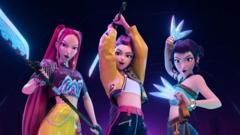
How did Oscar winner Kpop Demon Hunters win hearts the world over?
#Kpop Demon Hunters #Oscar winner #global recognition #Korean pop culture #fantasy film
📌 Key Takeaways
- Kpop Demon Hunters won an Oscar, gaining global recognition.
- The film's success is attributed to its unique blend of K-pop and fantasy elements.
- It resonated with international audiences through universal themes and engaging storytelling.
- The win highlights the growing influence of Korean pop culture worldwide.
🏷️ Themes
Cultural Impact, Entertainment Success
📚 Related People & Topics
KPop Demon Hunters
2025 Sony Pictures Animation film
KPop Demon Hunters is a 2025 American animated musical urban fantasy film co-written and directed by Maggie Kang and Chris Appelhans. It was produced by Sony Pictures Animation for Netflix and animated by Sony Pictures Imageworks. It stars the voices of Arden Cho, Ahn Hyo-seop, May Hong, Ji-young Yo...
Academy Awards
Annual awards for cinematic achievements
The Academy Awards, commonly known as the Oscars, are awards for artistic and technical merit in film. They are presented annually by the Academy of Motion Picture Arts and Sciences (AMPAS) in the United States in recognition of excellence in cinematic achievements, as assessed by the Academy's voti...
Entity Intersection Graph
Connections for KPop Demon Hunters:
Mentioned Entities
Deep Analysis
Why It Matters
This news matters because it highlights the global cultural influence of Korean entertainment, demonstrating how K-pop and Korean animation have achieved unprecedented international recognition. It affects the global entertainment industry by challenging traditional Western dominance in major awards like the Oscars, potentially opening doors for more diverse international content. The success also impacts South Korea's cultural diplomacy and soft power, boosting national pride and economic opportunities in creative industries worldwide.
Context & Background
- K-pop has grown from a regional music phenomenon to a global cultural force over the past two decades, with groups like BTS and BLACKPINK achieving worldwide fame
- South Korea's animation industry has been steadily gaining international recognition, with films like 'The King of Pigs' (2022) and 'Seoul Station' (2016) receiving critical acclaim at festivals
- The Academy Awards have historically been dominated by Western, particularly American, productions, with only a handful of non-English language films winning Best Animated Feature since the category's creation in 2001
- Korean cultural exports, known as the 'Korean Wave' or Hallyu, have become a significant economic driver for South Korea, generating billions in revenue annually
What Happens Next
Expect increased international investment in Korean animation studios and more collaborations between K-pop artists and global animation producers. The film will likely receive expanded theatrical releases worldwide throughout 2024, with streaming platforms competing for distribution rights. The success may inspire similar hybrid music-animation projects from other countries, potentially leading to new award categories recognizing cross-media entertainment at major ceremonies.
Frequently Asked Questions
The film uniquely combines K-pop musical performances with fantasy storytelling, creating a hybrid entertainment format that appeals to both music and animation fans. Its success represents the first time a Korean-produced animated feature has won the Oscar, breaking Western dominance in the category while showcasing Korea's distinctive cultural aesthetics.
This victory will likely encourage more international co-productions and diverse storytelling approaches in animation. Studios worldwide may invest more in musical-animation hybrids and explore non-Western cultural themes, potentially leading to greater representation and innovation in the industry.
The Oscar win provides K-pop with new legitimacy in mainstream Western entertainment beyond music charts. This could lead to more K-pop artists participating in film projects, expanded multimedia storytelling, and increased acceptance of Korean cultural products in traditional entertainment institutions.
This represents a major soft power achievement, demonstrating Korea's ability to excel in multiple creative fields simultaneously. The win strengthens Korea's position as a cultural exporter and may influence international perceptions of Korean creativity, potentially leading to increased cultural exchange programs and educational initiatives.