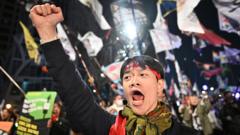
South Korean President Yoon Suk Yeol attempted to impose martial law in December 2024 but was swiftly thwarted by citizens and lawmakers.
The failed insurrection attempt led to Yoon's impeachment, arrest, and eventual life sentence for insurrection.
South Korea's democratic institutions demonstrated resilience against authoritarian overreach, setting an example globally.
The events reflect South Korea's painful history with authoritarian rule and have deepened political polarization in the country.
📖 Full Retelling
South Korean President Yoon Suk Yeol declared martial law in December 2024 claiming 'anti-state forces' had infiltrated the country, triggering a swift civilian and legislative backlash that led to his impeachment and eventual life sentence for insurrection, demonstrating the resilience of South Korea's democratic institutions against authoritarian overreach. The dramatic sequence began on December 4, 2024, when Yoon appeared on television announcing the imposition of martial law, issuing decrees that outlawed political activity and ordered military censorship of media. Within hours, thousands of citizens defied the decree to gather at the National Assembly in Seoul, while lawmakers breached police perimeters to convene and vote unanimously against the martial law bid. Despite attempts by armed soldiers to stop them, the legislators barricaded themselves inside and successfully overturned the president's power grab by early morning. The failed insurrection attempt led to Yoon's impeachment on December 14 and his arrest after he confined himself to the presidential residence for two-and-a-half weeks. The rapid response from South Korean civilians, legislators, and institutions against executive overreach has been hailed by international experts as a rare example of democratic resilience at a time when global democracy appears fragile. Gi-Wook Shin, director of the Korea program at Stanford University, noted that the Korean case demonstrates how 'democratic safeguards are robust and effective' and that democracy 'depends not only on formal rules, but on citizens and institutions willing to defend them.' This democratic resilience was further evidenced in the subsequent presidential election, where voters rejected Yoon's party by handing a decisive victory to opposition candidate Lee Jae Myung. The verdict, which came after months of protests and multiple indictments, sends a powerful message about accountability for leaders who attempt to undermine democratic processes.
🏷️ Themes
Democratic resilience, Authoritarianism, Political polarization
Democracy (from Ancient Greek: δημοκρατία, romanized: dēmokratía, from dēmos 'people' and krátos 'rule') is a form of government in which political power is vested in the people or the population of a state. Under a minimalist definition of democracy, rulers are elected through competitive elections...
Rebellion is an uprising that resists and is organized against one's government. A rebel is a person who engages in a rebellion. A rebel group is a consciously coordinated group that seeks to gain political control over an entire state or a portion of a state.
Yoon Suk Yeol (Korean: 윤석열; pronounced [jun sʰʌŋnjʌɭ]; born 18 December 1960) is a South Korean politician who served as the 13th president of South Korea from 2022 until his removal from office in 2025. A member of the People Power Party during his presidency, he had the shortest presidency as an e...
South Korea, officially the Republic of Korea (ROK), is a country in East Asia. It constitutes the southern half of the Korean Peninsula and borders North Korea along the Korean Demilitarized Zone, with the Yellow Sea to the west and the Sea of Japan to the east. South Korea claims to be the sole le...
Imposition of direct military control or suspension of civil law by a government
Martial law is the replacement of civilian government by military rule and the suspension of civilian legal processes for military powers. Martial law can continue for a specified amount of time, or indefinitely, and standard civil liberties may be suspended for as long as martial law continues. Mos...
How South Korea's democracy rallied after the president tried to impose military rule 32 minutes ago Share Save Jake Kwon , Seoul correspondent and Gavin Butler Share Save It took just over 14 months for Yoon Suk Yeol to go from South Korea's presidential residence to a life behind bars. It took South Koreans less than six hours to thwart the insurrection attempt that put him there. On 4 December, 2024, Yoon announced to the nation that he was declaring martial law – plunging South Korea into chaos and setting in motion a series of events that would precipitate his downfall. The 443 days that followed saw months-long protests, Yoon's impeachment, a string of indictments and a widening fracture that now runs through the heart of South Korean politics. On Thursday, Yoon was found guilty of masterminding an insurrection and jailed for life. Prosecutors had demanded that the 65-year-old be sentenced to death – which, in a country that has not carried out an execution since 1997, would have amounted to a life sentence. The outcome of the verdict – and the expediency with which South Koreans held their leader accountable – sends a powerful message at a time when the United Nations has warned of rising authoritarianism around the world. "At a time when global democracy appears fragile, the Korean case offers a rare example of democratic resilience," Gi-Wook Shin, director of the Korea program at Stanford University, tells the BBC. "It reminds us that democracy ultimately depends not only on formal rules, but on citizens and institutions willing to defend them." The night of insurrection It was just after 22:00 in December 2024 when Yoon appeared on television to announce he was imposing martial law, claiming "anti-state forces" had infiltrated South Korea. Shortly thereafter, he issued a list of new decrees: outlawing political activity and ordering the military to censor all media. By the time the BBC arrived at the National Assembly in central Seoul around midnight, thou...