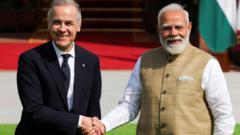
India and Canada announced a 10-year nuclear energy deal including uranium supply
Both countries agreed to finalize a free trade agreement by the end of 2026
The deal represents a significant reset in diplomatic relations that had deteriorated over the Nijjar assassination allegations
Cooperation will expand across technology, critical minerals, space, defense, and education sectors
📖 Full Retelling
Indian Prime Minister Narendra Modi and Canadian Prime Minister Mark Carney announced a host of agreements, including a 10-year nuclear energy deal, during their meeting in Delhi on February 28, 2025, as the two nations sought to reset diplomatic ties that had severely deteriorated following allegations of Indian involvement in the assassination of Sikh separatist Hardeep Singh Nijjar on Canadian soil. The landmark nuclear agreement will see Canada supply uranium to India while both countries collaborate on small modular reactors and advanced nuclear technologies. Beyond energy, the leaders struck agreements across technology, critical minerals, space, defense, and education sectors, with both expressing ambitions to reach $50 billion in bilateral trade. Carney confirmed that the two countries would conclude a comprehensive free trade deal, years in the making, by the end of 2026, as both nations seek to reduce exposure to punitive US trade tariffs. The relationship between India and Canada had reached a nadir after Justin Trudeau's government accused Indian authorities of involvement in Nijjar's killing, leading to mutual expulsions of diplomats and cancellation of visa services. Since Carney assumed office last year, however, relations have been carefully rebuilt, particularly after his government clarified that it does not believe India is currently linked to violent crimes or threats on Canadian soil. The diplomatic reset reflects pragmatic approaches from both sides as geopolitical shifts create new opportunities for cooperation, with India diversifying its energy partnerships away from Russia and Canada seeking to strengthen economic ties in the Indo-Pacific region.
🏷️ Themes
Diplomatic Relations, Nuclear Energy Cooperation, Trade Agreement, Geopolitical Strategy
Bi- or multi-lateral agreement to remove all trade barriers between signatory states
A free trade agreement (FTA) or treaty is an agreement according to international law to form a free-trade area between the cooperating states. There are two types of trade agreements: bilateral and multilateral. Bilateral trade agreements occur when two countries agree to loosen trade restrictions ...
Narendra Damodardas Modi (born 17 September 1950) is an Indian politician who has served as the prime minister of India since 2014. Modi was the chief minister of Gujarat from 2001 to 2014 and is the member of parliament (MP) for Varanasi. He is a member of the Bharatiya Janata Party (BJP) and of t...
Mark Joseph Carney (born March 16, 1965) is a Canadian politician and economist who has served as the 24th prime minister of Canada since 2025. He has also been leader of the Liberal Party and the member of Parliament (MP) for Nepean since 2025. He previously was Governor of the Bank of Canada from ...
Uranium is a chemical element; it has symbol U and atomic number 92. It is a silvery-grey metal in the actinide series of the periodic table. A uranium atom has 92 protons and 92 electrons, of which 6 are valence electrons.
India and Canada reset ties with 'landmark' nuclear energy deal 25 minutes ago Share Save Cherylann Mollan Share Save India and Canada have announced a host of agreements, including a 10-year nuclear energy deal, after their prime ministers met in Delhi to reset ties that plummeted due to diplomatic tensions. Narendra Modi and Mark Carney also struck agreement in areas such as technology, critical minerals, space, defence and education. Carney said they agreed to conclude a free trade deal, years in the making, by the end of 2026. Both countries want to reduce exposure to punitive US trade tariffs. Under Carney, the two governments are trying to repair ties that were strained when his predecessor accused Delhi of a link to the 2023 assassination of Sikh separatist Hardeep Singh Nijjar on Canadian soil. India vociferously rejected the allegation by Justin Trudeau. Trade and diplomatic relations almost came to a standstill as both sides expelled each other's diplomats and cancelled visa services. Canada hosts a huge expatriate Indian community. But since Carney took office last year, the relationship has been cautiously rebuilt - helped by the fact that his government has said it believes India is not currently linked to violent crimes or threats on Canadian soil. The case of four men charged over Nijjar's killing is still before the courts. At talks in Delhi, both Carney and Modi underscored India and Canada's long-standing relationship, mutual goals and close people-to-people ties. "In civil nuclear energy, we have reached a landmark deal for long-term uranium supply. We will also work together on small modular reactors and advanced reactors," Modi told reporters after their meeting at Hyderabad House in Delhi. He described the two countries as "natural partners in technology and innovation" and said they would enhance co-operation in AI, supercomputing and semiconductors, as well as jointly host a renewable energy summit. Carney said Canada was well positioned to c...