
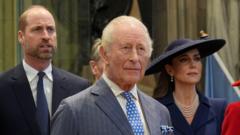
King praises Commonwealth at biggest royal gathering since Andrew arrest
#King Charles #Commonwealth #royal gathering #Prince Andrew #monarchy #public engagement #speech
📌 Key Takeaways
- King Charles III publicly praised the Commonwealth's value and unity.
- The event marked the largest royal family gathering since Prince Andrew's arrest.
- The gathering signals a return to public royal engagements after recent controversies.
- The speech emphasized the monarchy's ongoing commitment to the Commonwealth.
🏷️ Themes
Royal Family, Commonwealth
📚 Related People & Topics
Commonwealth
Political community established for common good
A commonwealth is a traditional English term for a political community founded for the common good. The noun "commonwealth", meaning "public welfare, general good or advantage", dates from the 15th century. Originally a phrase (the common-wealth or the common wealth – echoed in the modern synonym "p...

Andrew Mountbatten-Windsor
Son of Elizabeth II (born 1960)
Andrew Albert Christian Edward Mountbatten-Windsor (born 19 February 1960), formerly Prince Andrew, Duke of York, is a member of the House of Windsor and the third child and second son of Queen Elizabeth II and Prince Philip, Duke of Edinburgh, and a younger brother of King Charles III. Andrew was b...
Entity Intersection Graph
Connections for Commonwealth:
Mentioned Entities
Deep Analysis
Why It Matters
This event represents a significant moment for the British monarchy as it demonstrates King Charles III's commitment to maintaining the Commonwealth's relevance in the post-Elizabethan era. The gathering's scale—being the largest since Prince Andrew's arrest—signals a potential turning point in royal public engagements following years of controversy and family turmoil. This matters to Commonwealth member nations who rely on symbolic ties to the Crown, British citizens concerned about the monarchy's future, and royal observers tracking the institution's evolution under new leadership.
Context & Background
- The Commonwealth comprises 56 independent countries, most former British territories, with the British monarch serving as symbolic head
- Prince Andrew's 2019 arrest and subsequent settlement in a sexual abuse civil case created a major crisis for the royal family's public image
- King Charles III ascended to the throne in September 2022 following Queen Elizabeth II's 70-year reign
- The monarchy has faced multiple recent challenges including Prince Harry's departure from royal duties and ongoing debates about the Commonwealth's relevance in post-colonial contexts
What Happens Next
Expect increased diplomatic activity as King Charles prepares for his first Commonwealth Day as monarch in March 2024, with potential state visits to key member nations. The royal family will likely continue balancing traditional ceremonial roles with modernized approaches to Commonwealth engagement. Observers will monitor whether this gathering leads to concrete policy initiatives addressing climate change and youth development—key priorities Charles has emphasized for the Commonwealth.
Frequently Asked Questions
The Commonwealth represents the monarchy's largest remaining sphere of international influence, connecting 2.5 billion people across 56 nations. It provides ongoing relevance to the Crown as a diplomatic and soft power network, particularly as Britain navigates post-Brexit relationships.
Andrew's arrest and subsequent withdrawal from public duties forced the royal family to carefully manage public appearances to avoid controversy. Large-scale gatherings became more strategic, focusing on rebuilding institutional credibility rather than mere ceremonial display.
Charles is expected to emphasize climate action and sustainable development more prominently than his mother, reflecting his long-standing environmental advocacy. He may also push for more substantive partnerships beyond symbolic connections, particularly with younger Commonwealth citizens.
Views vary significantly—some nations value the historical connection and diplomatic channels, while others question the colonial legacy. Several Caribbean nations have recently considered removing the monarch as head of state, indicating evolving attitudes toward the institution.