
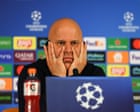
Liverpool may end up getting rid of Slot purely because they cannot think of what else to do | Jonathan Liew
#Liverpool #Arne Slot #managerial change #decision-making #football governance #Jonathan Liew #reactive management #stability
📌 Key Takeaways
- Liverpool's potential dismissal of Arne Slot stems from a lack of alternative strategies.
- The club's decision-making appears reactive rather than based on a clear long-term vision.
- Jonathan Liew critiques the club's management for possible indecision and short-term thinking.
- The situation highlights broader issues in football club governance and managerial stability.
📖 Full Retelling
🏷️ Themes
Football Management, Club Governance
📚 Related People & Topics

Arne Slot
Dutch football manager (born 1978)
Arend Martijn "Arne" Slot (Dutch pronunciation: [ˈaːrənt mɑrˈtɛin ˈɑrnə ˈslɔt]; born 17 September 1978) is a Dutch professional football manager and former player who is the head coach of Premier League club Liverpool. Slot played as a midfielder for FC Zwolle, where he won the Eerste Divisie in 200...
Jonathan Liew
Sportswriter
Jonathan Liew is a sportswriter for The Guardian. Liew has been named the sports writer of the year, and sports columnist of the year, at the annual SJA Awards.

Liverpool
City in Merseyside, England
Liverpool is a port city and metropolitan borough in Merseyside, England. It is situated on the eastern side of the Mersey Estuary, near the Irish Sea, 178 miles (286 km) north-west of London. It had a population of 508,961 in 2024 and is the administrative, cultural and economic centre of the Liver...
Entity Intersection Graph
Connections for Arne Slot:
Mentioned Entities
Deep Analysis
Why It Matters
This analysis matters because it highlights potential instability in Liverpool FC's leadership transition, which could impact the club's performance, fan confidence, and long-term strategy. It affects Liverpool supporters who expect continuity after Jürgen Klopp's successful tenure, players who need stable management, and the club's ownership facing scrutiny over their decision-making process. The commentary suggests deeper organizational issues that could undermine Liverpool's competitiveness in the Premier League and European competitions.
Context & Background
- Jürgen Klopp announced in January 2024 he would leave Liverpool after nine successful seasons, creating a major leadership vacuum
- Liverpool appointed Arne Slot from Feyenoord in May 2024 as Klopp's replacement after considering several candidates
- Slot won the Eredivisie with Feyenoord in 2022-23 and has a reputation for attacking football similar to Klopp's style
- Liverpool's ownership group Fenway Sports Group has faced criticism previously for transfer market decisions and infrastructure delays
- The club finished third in the 2023-24 Premier League season, missing out on the title to Manchester City by multiple points
What Happens Next
Liverpool will begin the 2024-25 Premier League season under Slot in August, with early results heavily scrutinized. Key player transfers during the summer window will indicate Slot's influence and backing from ownership. The first Merseyside derby against Everton and matches against top rivals will serve as early benchmarks for fan and media evaluation of Slot's suitability.
Frequently Asked Questions
Arne Slot is a Dutch manager who led Feyenoord to the Eredivisie title in 2023, known for his high-intensity attacking style. Liverpool selected him because his tactical philosophy aligns with Klopp's approach, potentially ensuring smoother transition for existing players.
Concerns include whether Slot can handle Premier League pressure after managing in the Netherlands, his lack of experience with elite clubs, and whether Liverpool's recruitment process was thorough enough. Some worry he may be a compromise choice rather than the ideal candidate.
Uncertainty around Slot's long-term future could complicate summer transfers, as players may hesitate to join without confidence in managerial stability. Slot may also need time to assess the squad before making significant recruitment decisions.
Poor early season results, visible player discontent, or significant tactical failures against top opponents could prompt early reconsideration. The article suggests ownership might lack alternative plans, making reactions potentially impulsive rather than strategic.
Unlike Manchester United's planned search for Erik ten Hag's replacement or Arsenal's deliberate process with Mikel Arteta, Liverpool's transition appears more reactive. This contrasts with Chelsea's data-driven approach despite frequent changes.