
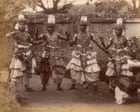
Manure dryers and devil dancers: the British empire’s attempt to use photography to control India
#British Empire #India #colonial photography #ethnography #visual anthropology #stereotypes #imperial control
📌 Key Takeaways
- British colonial authorities used photography to document and categorize Indian society for administrative control.
- The 'People of India' project aimed to create a visual taxonomy of ethnic and occupational groups.
- Photographs often reinforced colonial stereotypes by depicting subjects as exotic or primitive.
- This visual documentation served to legitimize British rule by framing Indians as needing governance.
📖 Full Retelling
🏷️ Themes
Colonialism, Photography, Social Control
📚 Related People & Topics

British Empire
Territories ruled by the United Kingdom
The British Empire comprised the dominions, colonies, protectorates, mandates, and other territories ruled or administered by the United Kingdom and its predecessor states. It began with the overseas possessions and trading posts established by England in the late 16th and early 17th centuries, and ...

India
Country in South Asia
India, officially the Republic of India, is a country in South Asia. It is the seventh-largest country by area; the most populous country since 2023; and, since its independence in 1947, the world's most populous democracy. Bounded by the Indian Ocean on the south, the Arabian Sea on the southwest,...
Entity Intersection Graph
Connections for British Empire:
Mentioned Entities
Deep Analysis
Why It Matters
This article reveals how colonial powers weaponized photography as a tool of control and propaganda, which matters because it exposes the systematic ways empires manipulated visual representation to justify domination. It affects historians, post-colonial scholars, and anyone studying media ethics, as it shows photography's role in creating racial hierarchies and 'othering' colonized peoples. Understanding this history is crucial for recognizing how visual media continues to shape perceptions of different cultures today.
Context & Background
- The British Empire ruled India from 1858 to 1947, using various methods to maintain control and justify colonial rule
- 19th-century photography emerged alongside colonial expansion, with early technologies like daguerreotypes and calotypes being used for documentation
- European anthropologists and colonial administrators often created 'racial type' photographs that categorized colonized people as primitive or exotic
- The British established institutions like the Archaeological Survey of India (1861) that used photography to document and control cultural heritage
What Happens Next
Scholars will likely continue analyzing colonial photographic archives with more critical frameworks, potentially leading to museum repatriation discussions. Digital archives may make these collections more accessible for post-colonial research. Upcoming exhibitions might recontextualize these images to highlight their oppressive origins rather than treating them as neutral historical documents.
Frequently Asked Questions
British photographers often labeled traditional Indian performers as 'devil dancers,' framing indigenous religious practices as primitive or demonic. This terminology served to justify colonial 'civilizing' missions by portraying local cultures as backward and in need of European intervention.
Photographs of agricultural technologies like manure dryers were used to showcase British 'modernization' of India. These images promoted the narrative that colonizers were bringing progress, while often ignoring existing indigenous knowledge systems and sustainable practices.
Photography provided seemingly objective 'evidence' that could be mass-produced and circulated. Colonial authorities used photographs to create taxonomies of racial types, document resources for exploitation, and produce propaganda showing colonial 'achievements' to audiences back in Britain.
Colonial photographic practices established patterns of exoticizing non-Western cultures that persist in modern media. Understanding this history helps recognize how contemporary photography and film can perpetuate similar power dynamics in representing marginalized communities.
Multiple institutions amassed colonial photographic collections including the British Museum, Royal Geographical Society, India Office, and various anthropological societies. These archives now present ethical challenges about how to display and interpret images created through oppression.