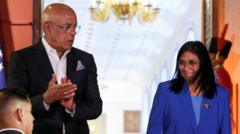
More than 1,500 Venezuelan political prisoners apply for amnesty
#Venezuela#Amnesty#Political prisoners#Nicolás Maduro#US pressure#El Helicoide#Opposition#Human rights
📌 Key Takeaways
Over 1,500 Venezuelan political prisoners have applied for amnesty under a new law
Hundreds of prisoners have already been released, with more expected soon
The amnesty law faces criticism for excluding certain prisoners, including opposition figures who called for foreign intervention
The releases come amid US pressure following the capture of former President Nicolás Maduro
📖 Full Retelling
Venezuela's National Assembly President Jorge Rodríguez announced on Saturday that 1,557 political prisoners have applied for amnesty under a new law introduced this week, amid increasing US pressure following the capture of former President Nicolás Maduro in a January 3 raid, with Rodríguez noting that hundreds of detainees have already been released and the government is processing the applications immediately. Rodríguez, brother of Venezuelan interim President Delcy Rodríguez and an ally of Maduro, revealed that the legislation would eventually extend to 11,000 prisoners, with priority given to those detained at the notorious El Helicoide prison in Caracas, where he stated releases would occur 'over the next hours.' The amnesty announcement comes after Venezuela's socialist government first declared days after Maduro's capture on January 8 that 'a significant number' of prisoners would be freed as a goodwill gesture. However, the move has faced criticism from opposition figures and human rights organizations, who have long alleged that the Maduro administration used political imprisonments to suppress dissent and silence critics. Among the released is opposition politician Juan Pablo Guanipa, who has himself criticized the amnesty law for excluding certain prisoners, particularly those who advocated for foreign armed intervention in Venezuela. According to BBC Latin America specialist Luis Fajardo, law professor Juan Carlos Apitz described this exclusion as having 'a name and surname,' specifically referring to Maria Corina Machado, the Nobel Peace Prize winner whose potential inclusion under the amnesty remains unclear. The controversial aspects of the amnesty law extend beyond political considerations, as dozens of military officers involved in rebellions against the Maduro administration over the years also appear to be excluded from its benefits. Activists have reported that family members of prisoners held at El Helicoide have resorted to hunger strikes in their demand for relatives' release, while US President Donald Trump had previously announced plans to close the facility following Maduro's capture. Currently, Maduro remains in US custody awaiting trial alongside his wife Cilia Flores, having pleaded not guilty to drugs and weapons charges while asserting his status as a 'prisoner of war.'
🏷️ Themes
Political Prisoners, International Relations, Human Rights
Amnesty (from Ancient Greek ἀμνηστία (amnēstía) 'forgetfulness, passing over') is defined as "A pardon extended by a government to a group or class of people, usually for a political offense; the act of a sovereign power officially forgiving certain classes of people who are subject to trial but ha...
El Helicoide is a building in Caracas, Venezuela, owned by the Venezuelan government and used as a facility and prison for both regular and political prisoners of the Bolivarian National Intelligence Service (SEBIN). In the shape of a three-sided pyramid, it was originally constructed as a shopping ...
Venezuela, officially the Bolivarian Republic of Venezuela, is a country on the northern coast of South America, consisting of a continental landmass and various islands and islets in the Caribbean Sea. It comprises an area of 912,050 km2 (352,140 sq mi), with a population estimated at 31.8 million ...
A political prisoner is someone imprisoned for their political activity. The political offense is not always the official reason for the prisoner's detention.
There is no internationally recognized legal definition of the concept, although numerous similar definitions have been proposed by various o...
No entity connections available yet for this article.
Original Source
More than 1,500 Venezuelan political prisoners apply for amnesty 7 hours ago Share Save Ottilie Mitchell Share Save A total of 1,557 Venezuelan political prisoners have applied for amnesty under a new law introduced on Thursday, the country's National Assembly President has said. Jorge Rodríguez, brother of Venezuelan interim President Delcy Rodríguez and an ally of former President Nicolás Maduro, also said "hundreds" of prisoners had already been released. Among them is politician Juan Pablo Guanipa, one of several opposition voices to have criticised the law for excluding certain prisoners. The US has urged Venezuela to speed up its release of political prisoners since US forces seized Maduro in a raid on 3 January. Venezuela's socialist government has always denied holding political prisoners. At a news conference on Saturday Jorge Rodríguez said 1,557 release requests were being addressed "immediately" and ultimately the legislation would extend to 11,000 prisoners. The government first announced days after Maduro's capture, on 8 January, that "a significant number" of prisoners would be freed as a goodwill gesture. Opposition and human rights groups have said the government under Maduro used detentions of political prisoners to stamp out dissent and silence critics for years. These groups have also criticised the new law. One frequently cited criticism is that it would not extend amnesty to those who called for foreign armed intervention in Venezuela, BBC Latin America specialist Luis Fajardo says. He noted that law professor Juan Carlos Apitz, of the Central University of Venezuela, told CNN Español that that part of the amnesty law "has a name and surname". "That paragraph is the Maria Corina Machado paragraph." It is not clear if the amnesty would actually cover Machado, who won last year's Nobel Peace Prize, Fajardo said. He added that other controversial aspects of the law include the apparent exclusion from amnesty benefits of dozens of military officers...