
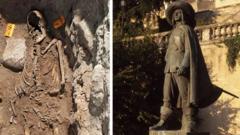
Musketeer d'Artagnan's remains believed found under Dutch church
#d'Artagnan #musketeer #remains #archaeology #Netherlands #church #historical discovery #The Three Musketeers
📌 Key Takeaways
- Archaeologists believe they have discovered the remains of d'Artagnan, the legendary musketeer, under a church in the Netherlands.
- The discovery was made during excavations at a historic church site, linking physical evidence to the famous literary and historical figure.
- This finding could provide new insights into the real-life inspiration behind Alexandre Dumas' character in 'The Three Musketeers'.
- Further analysis and verification are required to confirm the identity of the remains definitively.
📖 Full Retelling
🏷️ Themes
Archaeology, Historical Discovery
📚 Related People & Topics
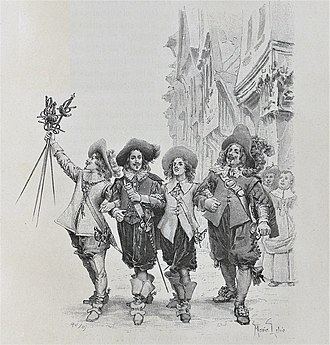
The Three Musketeers
1844 novel by Alexandre Dumas
The Three Musketeers (French: Les Trois Mousquetaires) is a French historical adventure novel written and published in 1844 by French author Alexandre Dumas. It is the first of the author's three d'Artagnan Romances. As with some of his other works, he wrote it in collaboration with ghostwriter Au...

Netherlands
Country in Northwestern Europe and the Caribbean
The Netherlands, informally Holland, is a country in Northwestern Europe, with overseas territories in the Caribbean. It is the largest of the four constituent countries of the Kingdom of the Netherlands. The Netherlands consists of twelve provinces; it borders Germany to the east and Belgium to the...
Entity Intersection Graph
No entity connections available yet for this article.
Mentioned Entities
Deep Analysis
Why It Matters
This discovery is important because it connects literary fiction to historical reality, offering tangible evidence of a figure immortalized in Alexandre Dumas' 'The Three Musketeers.' It affects historians, archaeologists, and cultural enthusiasts by potentially validating the existence of a real-life d'Artagnan, who inspired the beloved character. The find could reshape understanding of 17th-century European history and the intersection of art and fact, while also boosting local heritage tourism in the Netherlands.
Context & Background
- d'Artagnan was a real historical figure, Charles de Batz de Castelmore d'Artagnan, a French musketeer captain who served King Louis XIV in the 1600s.
- Alexandre Dumas' 1844 novel 'The Three Musketeers' fictionalized d'Artagnan's adventures, making him a pop culture icon and blurring lines between history and literature.
- Historical records indicate d'Artagnan died in 1673 during the Siege of Maastricht in the Franco-Dutch War, with his burial site previously uncertain.
- Archaeological efforts in the Netherlands have previously uncovered remains from the 17th century, but linking them to famous individuals is rare and requires forensic analysis.
What Happens Next
Forensic experts will likely conduct DNA testing, carbon dating, and historical comparisons to confirm the identity of the remains. Results may be announced in the coming months, followed by academic publications and possible museum exhibitions. If verified, the site could become a protected heritage location, with potential commemorative events or reburial ceremonies in 2024-2025.
Frequently Asked Questions
The real d'Artagnan was Charles de Batz de Castelmore d'Artagnan, a French military officer born around 1611 who served as a captain of the Musketeers of the Guard under King Louis XIV. He died in battle in 1673, and his life inspired Alexandre Dumas' fictional character in 'The Three Musketeers.'
Confirmation will involve scientific methods like DNA analysis, if comparative samples are available, along with carbon dating to determine the age of the remains. Historians will also cross-reference burial records, artifacts, and physical evidence with known details of d'Artagnan's death and location.
The remains were found in the Netherlands because d'Artagnan died during the Siege of Maastricht in 1673, part of the Franco-Dutch War. Historical accounts suggest he was buried near the battlefield, which aligns with the discovery under a church in that region.
This discovery could deepen the connection between Dumas' fiction and historical events, encouraging renewed interest in 17th-century European history. It may also lead to revised biographies of d'Artagnan and inspire cultural projects, such as documentaries or educational programs.