
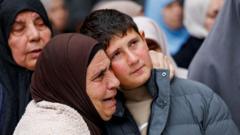
'My mother cried out one last time': Palestinian boy, 12, describes how Israeli forces killed his family in car
#Palestinian #Israeli forces #family killed #car attack #12-year-old witness #civilian casualties #Gaza conflict #human rights
📌 Key Takeaways
- A 12-year-old Palestinian boy witnessed Israeli forces kill his family members in their car
- The boy describes his mother crying out one last time during the attack
- The incident occurred while the family was traveling in their vehicle
- The boy survived the attack that killed multiple family members
- The account provides a firsthand perspective on violence affecting Palestinian civilians
📖 Full Retelling
🏷️ Themes
Israeli-Palestinian conflict, Civilian casualties, Child witnesses
Entity Intersection Graph
No entity connections available yet for this article.
Deep Analysis
Why It Matters
This incident highlights the devastating human cost of the Israeli-Palestinian conflict, particularly its impact on children who witness extreme violence. It fuels international criticism of Israeli military tactics and raises questions about compliance with international humanitarian law regarding civilian protection. The testimony could influence diplomatic pressure on Israel and affect public opinion globally, potentially impacting foreign policy decisions in supporting nations. For Palestinians, such accounts reinforce narratives of trauma and resistance, while for Israelis, they present challenges in defending military operations amid allegations of disproportionate force.
Context & Background
- The Israeli-Palestinian conflict has involved periodic military escalations since Israel's establishment in 1948, with recent major conflicts occurring in 2008-2009, 2014, 2021, and 2023-2024.
- International humanitarian law, including the Geneva Conventions, requires distinguishing between combatants and civilians and prohibits disproportionate attacks, though interpretations and compliance are frequently disputed.
- Palestinian civilian casualties have been a persistent point of contention, with organizations like UN OCHA and human rights groups documenting incidents, while Israel argues it faces threats from militants operating in civilian areas.
- The current context includes the ongoing war in Gaza following Hamas's October 7 attacks, but violence also occurs in the West Bank, where Israeli forces conduct operations against suspected militants.
- Testimonies from child witnesses have historically played roles in conflict documentation and international legal proceedings, such as at the International Criminal Court.
What Happens Next
The account will likely be investigated by human rights organizations like Amnesty International or UN bodies, potentially leading to official reports condemning the incident. It may be cited in diplomatic discussions, possibly at the UN Security Council, increasing pressure for independent investigations. If verified, it could contribute to cases at the International Criminal Court, which is already investigating the situation in Palestine. Domestically, it may inspire protests or calls for accountability within Israel and among its allies, affecting military rules of engagement debates.
Frequently Asked Questions
Israeli military policy often cites mistaken identification of threats, preemptive strikes against suspected militants, or responses to perceived imminent danger. However, critics argue such incidents reflect reckless use of force or failure to properly distinguish civilians, especially in tense environments.
Child testimony can be credible but requires careful verification through forensics, corroborating witnesses, and official records. Trauma may affect recall, but international courts often consider such accounts, especially when consistent with other evidence.
If investigated and found to violate international law, it could lead to sanctions, ICC charges against individuals, or demands for reparations. However, enforcement is challenging due to political protections and disputed jurisdictional issues.
It deepens Palestinian grievances and undermines trust, making diplomatic solutions harder. Internationally, it may increase pressure on Israel's allies to condition support, while domestically in Israel, it could polarize public opinion on military conduct.
Theoretically, yes—through stricter rules of engagement, better intelligence, and independent oversight. However, implementation is limited by operational realities, political will, and the asymmetric nature of the conflict.