
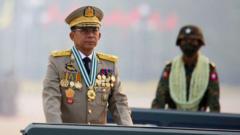
Myanmar's coup leader who set off a brutal civil war is set to become president
#Myanmar #coup leader #president #civil war #military #political crisis #conflict
📌 Key Takeaways
- Myanmar's coup leader is poised to assume the presidency.
- The coup initiated a brutal civil war in the country.
- This transition consolidates military power in Myanmar's government.
- The move likely exacerbates ongoing conflict and international tensions.
🏷️ Themes
Military Coup, Political Transition, Civil War
📚 Related People & Topics

Myanmar
Country in Southeast Asia
Myanmar, officially the Republic of the Union of Myanmar and also referred to as Burma (the official English name until 1989), is a country in northwest Southeast Asia. It is the largest country by area in Mainland Southeast Asia and has a population of about 55 million. It is bordered by India and ...
Entity Intersection Graph
Connections for Myanmar:
Mentioned Entities
Deep Analysis
Why It Matters
This development is critically important as it formalizes military rule in Myanmar, undermining democratic aspirations and likely intensifying the ongoing civil war. It affects the Myanmar people, who face increased repression and humanitarian crisis, regional neighbors dealing with refugee flows and instability, and the international community grappling with human rights and geopolitical implications. The consolidation of power by the coup leader could lead to further isolation of Myanmar and prolonged conflict, impacting global efforts to restore democracy and peace in Southeast Asia.
Context & Background
- Myanmar's military, the Tatmadaw, seized power in a coup on February 1, 2021, ousting the democratically elected government led by Aung San Suu Kyi.
- The coup triggered widespread protests and a brutal crackdown, escalating into a civil war with ethnic armed organizations and pro-democracy forces resisting military rule.
- Myanmar has a long history of military dominance since independence in 1948, with previous direct rule from 1962 to 2011 before a partial transition to democracy.
- The military-drafted 2008 constitution reserves significant political power for the military, including control of key ministries and a quarter of parliamentary seats.
- International responses have included sanctions and diplomatic pressure, but the military has maintained control with support from countries like China and Russia.
What Happens Next
In the short term, the coup leader's formal presidency may lead to increased military offensives against opposition groups, worsening humanitarian conditions. Internationally, expect heightened sanctions and diplomatic isolation, with potential UN actions. Over the next 6-12 months, the civil war could intensify, possibly fragmenting the country further, while regional actors like ASEAN may struggle to mediate, with no quick resolution in sight.
Frequently Asked Questions
The coup leader is Senior General Min Aung Hlaing, who led the 2021 military takeover. As head of the State Administration Council, he has been the de facto ruler and is now poised to assume the formal presidency under military-controlled processes, consolidating his authority.
This likely signals an escalation of the civil war, as the military solidifies its control and opposition groups may intensify resistance. It could lead to more violence, displacement, and humanitarian crises, with peace prospects diminishing as the military entrenches its position.
Many countries, including the US and EU, have imposed sanctions on the military and its leaders, while supporting pro-democracy movements. However, efforts have been limited by divisions in the UN and engagement from neighbors like China, which maintains ties with the military regime.
ASEAN has attempted mediation through a Five-Point Consensus but with limited success due to the military's non-compliance. The bloc faces internal divisions, complicating efforts to pressure Myanmar, though it remains a key regional forum for dialogue.
The economy has collapsed since the coup, with poverty rising and currency devaluation. People face severe hardships, including food insecurity, displacement, and human rights abuses, as the military prioritizes control over recovery, worsening living conditions.