
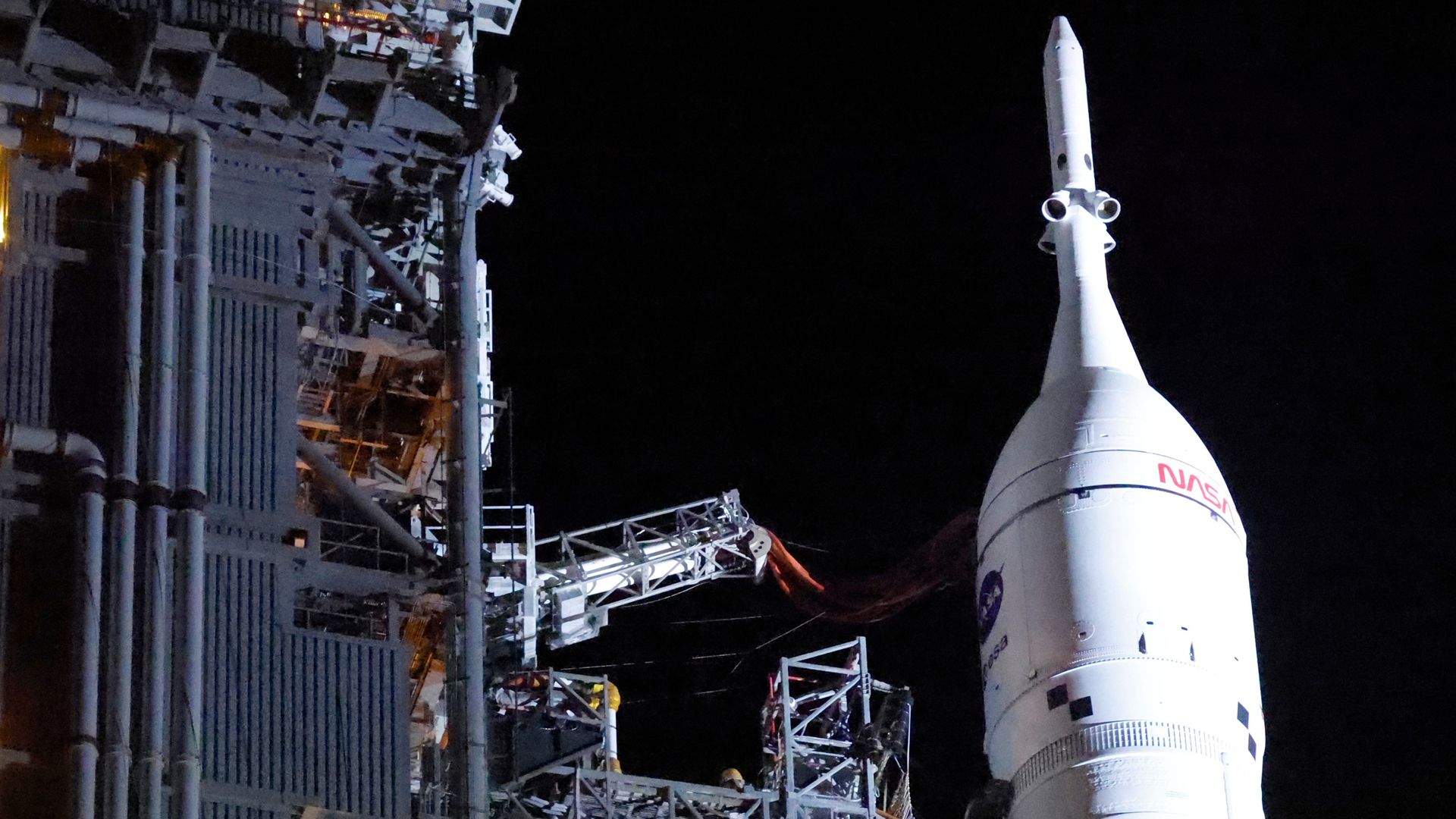
NASA's Artemis II now back on launchpad for first lunar mission in more than 50 years
#NASA #Artemis II #lunar mission #launchpad #crew #Moon #space exploration
📌 Key Takeaways
- NASA's Artemis II mission is now positioned on the launchpad for its upcoming lunar flight.
- This marks the first crewed lunar mission by NASA in over 50 years.
- The mission aims to test systems and pave the way for future lunar exploration.
- Artemis II is a critical step toward returning humans to the Moon.
📖 Full Retelling
🏷️ Themes
Space Exploration, NASA Missions
📚 Related People & Topics

NASA
American space and aeronautics agency
The National Aeronautics and Space Administration (NASA ) is an independent agency of the U.S. federal government responsible for the United States' civil space program and for research in aeronautics and space exploration. Headquartered in Washington, D.C., NASA operates ten field centers across th...

Artemis II
Artemis program's second lunar flight
Artemis II is a planned lunar spaceflight mission under the Artemis program, led by NASA. It is intended to be the second flight of the Space Launch System (SLS), and the first crewed mission of the Orion spacecraft. It is the first crewed mission around the Moon, and beyond low Earth orbit, since A...

Moon
Natural satellite orbiting Earth
The Moon is the only natural satellite of Earth. It orbits around Earth at an average distance of 384,399 kilometres (238,854 mi), a distance roughly 30 times the width of Earth. It completes an orbit (lunar month) in relation to Earth and the Sun (synodically) every 29.5 days.
Entity Intersection Graph
Connections for NASA:
Mentioned Entities
Deep Analysis
Why It Matters
This marks a critical milestone in humanity's return to lunar exploration after more than half a century, demonstrating NASA's readiness for crewed deep space missions. The Artemis program represents a $93 billion investment that affects thousands of aerospace jobs and international partnerships. This mission will test life support systems and spacecraft performance ahead of planned lunar landings, paving the way for sustainable lunar presence and eventual Mars missions. The success of Artemis II directly impacts future space exploration capabilities and international space collaboration.
Context & Background
- The last human lunar mission was Apollo 17 in December 1972, ending NASA's Apollo program after six successful landings
- Artemis I completed an uncrewed test flight around the Moon in 2022, validating the Space Launch System rocket and Orion spacecraft
- The Artemis program aims to land the first woman and first person of color on the Moon by 2026 under Artemis III
- NASA has established international partnerships including the Artemis Accords, signed by over 40 countries governing lunar exploration
- The program faces congressional scrutiny over budget concerns and schedule delays from original timelines
What Happens Next
NASA will conduct final pre-launch testing and systems checks on the launchpad through summer 2024. The four-person crew will complete final training simulations and emergency procedures. Launch is currently scheduled for September 2025, though this date may shift based on testing outcomes. Following launch, the 10-day mission will include lunar flyby and return to Earth, with splashdown in the Pacific Ocean.
Frequently Asked Questions
The crew includes NASA astronauts Reid Wiseman (commander), Victor Glover (pilot), Christina Koch (mission specialist), and Canadian Space Agency astronaut Jeremy Hansen (mission specialist). This represents the most diverse lunar crew in history, including the first woman and first person of color on a lunar mission.
Artemis uses modern technology including the Space Launch System (more powerful than Saturn V) and Orion spacecraft designed for longer missions. The program focuses on sustainable exploration with plans for lunar Gateway station and surface habitats, unlike Apollo's brief visits. Artemis also emphasizes international collaboration and commercial partnerships.
Artemis II serves as the crucial crewed test flight to validate all systems with humans aboard before attempting lunar landing. The mission will test life support, communication systems, and spacecraft performance during actual deep space conditions. This verification is essential for ensuring crew safety during the more complex Artemis III landing mission.
Primary risks include spacecraft systems failures during critical phases like launch, lunar trajectory insertion, and re-entry. Radiation exposure beyond Earth's magnetic protection poses health risks requiring careful monitoring. Any technical issues could delay subsequent missions and impact the overall Artemis timeline and budget.
The program drives technological innovations in materials, computing, and life support systems with terrestrial applications. It inspires STEM education and creates high-tech jobs across the aerospace industry. International collaboration on Artemis sets precedents for peaceful cooperation in space exploration.