
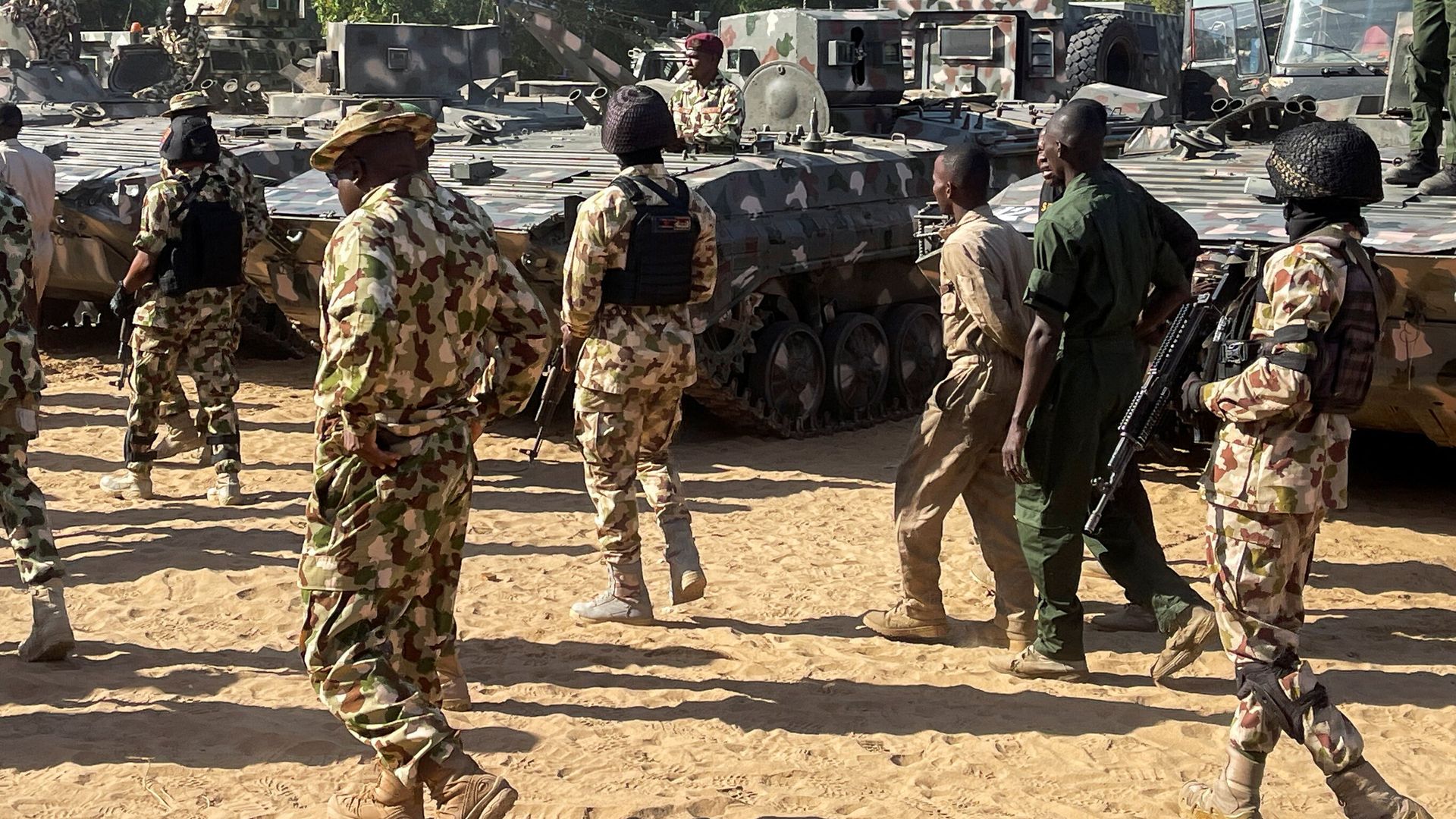
Nigerian soldiers 'kill 45 bandits' in gun battle
#Nigeria #soldiers #bandits #gun battle #casualties #security #military operation
📌 Key Takeaways
- Nigerian military engaged in a significant gun battle with armed groups referred to as 'bandits'.
- The military operation resulted in the reported death of 45 bandits.
- The incident highlights ongoing security challenges in Nigeria involving armed criminal groups.
- The report originates from military sources, indicating an official account of the clash.
📖 Full Retelling
🏷️ Themes
Military Conflict, Security Crisis
📚 Related People & Topics

Nigeria
Country in West Africa
Nigeria, officially the Federal Republic of Nigeria, is a country in West Africa between the Sahel to the north and the Gulf of Guinea in the Atlantic Ocean to the south. It covers an area of 923,769 square kilometres (356,669 mi2). With a population of more than 236 million, it is the most populous...
Entity Intersection Graph
Connections for Nigeria:
Mentioned Entities
Deep Analysis
Why It Matters
This military engagement is significant because it represents a major blow against armed criminal groups that have terrorized northwestern Nigeria for years, disrupting agriculture, displacing communities, and undermining state authority. The operation directly affects local populations who have suffered from kidnappings, killings, and economic devastation at the hands of these bandits. It also matters to Nigeria's federal government, which faces mounting pressure to demonstrate security progress amid widespread criticism of its counterinsurgency strategies. The outcome could influence both military morale and public confidence in state security forces during an election year.
Context & Background
- Armed banditry has plagued Nigeria's northwestern states (Zamfara, Katsina, Kaduna, Sokoto) since around 2011, initially emerging from farmer-herder conflicts but evolving into organized criminal kidnapping and ransom operations
- These bandits operate from forest hideouts across state boundaries, often using motorcycles and sophisticated weapons, with some groups having loose affiliations with jihadist elements in the northeast
- The Nigerian military has conducted multiple operations including 'Operation Hadarin Daji' and 'Operation Safe Haven' since 2019, with mixed results and frequent accusations of human rights violations
- Bandit attacks have displaced over 1 million people in northwest Nigeria since 2020, creating a humanitarian crisis and devastating agricultural production in the region
- The Nigerian government has alternated between military campaigns and controversial amnesty/peace deal approaches, with the current administration favoring kinetic operations since 2022
What Happens Next
Military analysts expect intensified operations in the coming weeks as Nigeria's armed forces attempt to capitalize on this tactical success, potentially targeting identified bandit camps and supply routes. Local communities will likely face retaliatory attacks from surviving bandit factions, necessitating increased security for vulnerable villages. The incident may prompt renewed political debates about security strategy ahead of Nigeria's 2023 elections, with opposition candidates likely criticizing the government's overall security record despite this specific victory. International partners including the UK and US may review their security assistance programs based on this operational outcome.
Frequently Asked Questions
They are armed criminal groups primarily operating in northwestern Nigeria who engage in mass kidnappings for ransom, cattle rustling, and village raids. While some have ethnic Fulani backgrounds, they are distinct from pastoralist communities and have evolved into sophisticated criminal networks with possible connections to wider regional instability.
Multiple factors complicate counter-banditry operations including vast ungoverned forest territories, corruption within security agencies, limited intelligence capabilities, and the bandits' mobility across state boundaries. Additionally, socioeconomic factors like poverty, unemployment, and climate change-driven resource competition create recruitment pools for criminal networks.
Communities face constant threat of kidnapping (particularly targeting school children), destruction of livelihoods through cattle theft and farm destruction, and displacement from ancestral homes. This has created a humanitarian crisis with food insecurity, disrupted education, and psychological trauma across multiple states.
While both pose security threats, Boko Haram is an Islamist insurgent group with ideological goals of establishing a caliphate, primarily operating in northeast Nigeria. Bandits are generally criminal enterprises focused on economic gain through kidnapping and theft, though concerns exist about growing ideological convergence between some factions.
Results have been inconsistent with temporary successes often followed by bandit regrouping. Challenges include inadequate equipment, intelligence gaps, and the difficulty of securing civilian populations across vast rural areas. Some operations have displaced bandits to new areas rather than eliminating the threat entirely.