
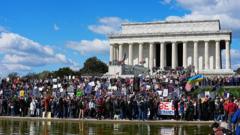
No Kings protests across the US rally against Donald Trump
#No Kings protests #Donald Trump #Political demonstrations #US politics #Immigration enforcement #War in Iran #Presidential power #Civil disobedience
📌 Key Takeaways
- No Kings protests spanning multiple US cities and international locations
- Protesters opposing Trump's policies on war, immigration, and economy
- Previous October rally drew nearly seven million participants
- Trump administration's expansion of presidential power through executive orders
📖 Full Retelling
🏷️ Themes
Political protest, Presidential power, Civil unrest
📚 Related People & Topics

Politics of the United States
In the United States, politics functions within a framework of a constitutional federal republic with a presidential system. The three distinct branches share powers: Congress, which forms the legislative branch, a bicameral legislative body comprising the House of Representatives and the Senate; th...

Donald Trump
President of the United States (2017–2021; since 2025)
Donald John Trump (born June 14, 1946) is an American politician, media personality, and businessman who is the 47th president of the United States. A member of the Republican Party, he served as the 45th president from 2017 to 2021. Born into a wealthy New York City family, Trump graduated from the...
Entity Intersection Graph
Connections for No Kings:
Mentioned Entities
Deep Analysis
Why It Matters
These protests represent significant civil dissent against President Trump's policies and exercise of power, demonstrating widespread opposition to his administration's approach to foreign policy, immigration, and economic issues. The international nature of the protests shows that Trump's policies are affecting global perceptions of the United States. With millions previously participating, these demonstrations indicate a substantial portion of the population that feels their government is overstepping its authority and acting in a tyrannical manner.
Context & Background
- The 'No Kings' protests are the third iteration of demonstrations against Trump's administration
- Previous rallies have drawn millions of participants across major US cities
- Trump's second term has seen significant expansion of presidential authority through executive orders
- Controversial immigration enforcement actions resulted in deaths of two US citizens in Minneapolis
- Protesters characterize Trump's governance as tyrannical, with slogans like 'power belongs to the people'
- American expatriates are organizing solidarity protests in Paris, London, and Lisbon
- The protests specifically target Trump's policies on Iran, immigration enforcement, and living costs
What Happens Next
Given this is the third iteration of these protests, they may become a regular feature of Trump's presidency. We can expect continued civil unrest as long as controversial policies continue. The protests may influence public discourse and potentially impact policy decisions. There may be counter-protests from Trump supporters, and the international attention could affect US diplomatic relations. Legal challenges to executive orders may continue to work their way through the court system.
Frequently Asked Questions
The protests target Trump's policies on the war in Iran, federal immigration enforcement, and rising living costs. Protesters characterize his governance as tyrannical, arguing that power should belong to the people rather than what they call 'wannabe kings or their billionaire cronies.'
Previous iterations of these rallies have drawn millions of participants, indicating significant public opposition to Trump's policies and governance style across the United States.
No, American expatriates have organized solidarity protests in Paris, London, and Lisbon, showing international concern about Trump's policies and their global impact on US relations.
Trump's second term has seen significant expansion of presidential authority through executive orders and controversial immigration enforcement actions, including actions that resulted in the deaths of two US citizens in Minneapolis.
The name reflects protesters' belief that Trump is acting like a monarch rather than a democratically elected president, with organizers declaring that 'power belongs to the people - not to wannabe kings or their billionaire cronies.'
The protests could influence public discourse, potentially impact policy decisions, and may embolden further civil disobedience. They could also affect Trump's base support and influence upcoming elections.