
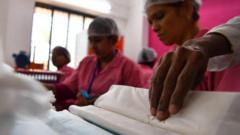
'No-one will hire women' - India's top court rejects menstrual leave petition
#India #Supreme Court #menstrual leave #petition #workplace #women #employment #legislation
📌 Key Takeaways
- India's Supreme Court rejected a petition for mandatory menstrual leave nationwide.
- The court expressed concern that such a policy could discourage employers from hiring women.
- It suggested the issue should be debated and legislated by Parliament, not the judiciary.
- The ruling highlights the ongoing debate over workplace equality and women's health in India.
📖 Full Retelling
🏷️ Themes
Labor Rights, Gender Equality
📚 Related People & Topics

India
Country in South Asia
India, officially the Republic of India, is a country in South Asia. It is the seventh-largest country by area; the most populous country since 2023; and, since its independence in 1947, the world's most populous democracy. Bounded by the Indian Ocean on the south, the Arabian Sea on the southwest,...
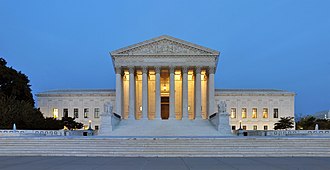
Supreme court
Highest court in a jurisdiction
In most legal jurisdictions, a supreme court, also known as a court of last resort, apex court, high (or final) court of appeal, and court of final appeal, is the highest court within the hierarchy of courts. Broadly speaking, the decisions of a supreme court are binding on all other courts in a nat...
Entity Intersection Graph
Connections for India:
Mentioned Entities
Deep Analysis
Why It Matters
This ruling has significant implications for gender equality and workplace rights in India, affecting millions of working women and employers. It highlights the tension between accommodating biological realities and preventing potential discrimination in hiring practices. The decision maintains the status quo where menstrual leave policies remain at employers' discretion rather than being mandated by law, potentially impacting women's health and productivity in workplaces without such accommodations.
Context & Background
- India currently has no national law mandating menstrual leave, though some states like Bihar and Kerala have implemented limited policies
- The petition argued that menstrual pain and discomfort constitute a valid health concern requiring workplace accommodation similar to other medical conditions
- Several countries including Japan, South Korea, Indonesia, and Zambia have implemented various forms of menstrual leave policies
- The court's concern about potential hiring discrimination reflects ongoing debates about whether protective policies for women might inadvertently disadvantage them in employment markets
- India's female labor force participation remains low at around 24%, with workplace conditions frequently cited as a contributing factor
What Happens Next
The ruling likely shifts focus to state-level legislation and corporate policies rather than national mandates. Individual companies may continue implementing voluntary menstrual leave policies as part of their diversity initiatives. Advocacy groups may pursue legislative routes in state assemblies rather than judicial approaches. The debate may resurface when similar petitions are filed or when specific cases of menstrual discrimination reach lower courts.
Frequently Asked Questions
The court expressed concern that mandating menstrual leave could lead employers to discriminate against women in hiring, potentially reducing female employment opportunities. They suggested such policies should be implemented through legislation rather than judicial mandate.
Bihar has allowed two days of menstrual leave per month for government employees since 1992. Kerala introduced menstrual leave for students in state universities in 2023. Some private companies like Zomato and Swiggy have also implemented voluntary policies.
Japan has allowed menstrual leave since 1947, Indonesia provides two days per month, and Zambia offers one day per month called 'Mother's Day.' South Korea and Taiwan also have various menstrual leave provisions, though implementation varies widely.
The court recommended that menstrual leave policies should be established through legislative processes rather than judicial orders. They also suggested that employers could voluntarily implement such policies as part of their workplace wellness programs.
Women in workplaces without menstrual accommodations may continue facing productivity challenges and health issues during periods. However, the ruling aims to prevent potential hiring discrimination that could occur if employers viewed mandatory leave as an additional cost of hiring women.