
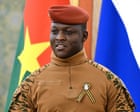
People of Burkina Faso should forget about democracy, says military ruler
#Burkina Faso #democracy #military ruler #governance #political crisis
📌 Key Takeaways
- Burkina Faso's military ruler publicly dismisses democracy as a viable system for the country.
- The statement signals a rejection of democratic governance and a consolidation of military authority.
- The declaration likely reflects ongoing political instability and conflict in the region.
- This stance may impact international relations and support for Burkina Faso.
📖 Full Retelling
🏷️ Themes
Political Instability, Military Rule
📚 Related People & Topics

Burkina Faso
Country in West Africa
Burkina Faso is a landlocked country in West Africa. It is bordered by Mali to the northwest, Niger to the northeast, Benin to the southeast, Togo and Ghana to the south, and Ivory Coast to the southwest. It covers an area of 274,223 km2 (105,878 sq mi).
Entity Intersection Graph
Connections for Burkina Faso:
View full profileMentioned Entities
Deep Analysis
Why It Matters
This statement from Burkina Faso's military ruler represents a significant rejection of democratic governance in a country already struggling with political instability and jihadist violence. It matters because it signals a potential permanent shift toward authoritarian rule, affecting Burkina Faso's 22 million citizens who have experienced two coups since 2022. The declaration undermines regional democratic norms in West Africa and could influence similar military regimes in neighboring Mali and Niger. This development also complicates international relations with Western partners who typically condition aid on democratic progress.
Context & Background
- Burkina Faso experienced two military coups in 2022, first in January led by Paul-Henri Sandaogo Damiba, then again in September when Captain Ibrahim Traoré seized power
- The country has been battling Islamist insurgencies linked to al-Qaeda and ISIS since 2015, with violence displacing over 2 million people
- Burkina Faso was previously considered a relatively stable democracy in West Africa, with democratic elections held from 2015-2020 after the 2014 uprising ousted long-time president Blaise Compaoré
- The current military government has increasingly aligned with Russia while distancing from former colonial power France, expelling French troops and diplomats in early 2023
- West Africa's regional bloc ECOWAS has suspended Burkina Faso along with Mali and Niger following their coups, creating a 'coup belt' in the Sahel region
What Happens Next
The military government will likely formalize its authoritarian rule through constitutional changes or indefinite postponement of elections originally promised for July 2024. Increased alignment with Russia and other authoritarian states will continue, potentially including security agreements and resource deals. Regional tensions may escalate as ECOWAS considers further sanctions, though the bloc's influence has diminished following Niger's 2023 coup. The security situation will remain dire as jihadist groups exploit political instability, possibly leading to further humanitarian crisis with food insecurity affecting millions.
Frequently Asked Questions
Captain Ibrahim Traoré leads the military junta that seized power in September 2022. At 35, he became the world's youngest head of state and has consolidated power while fighting Islamist insurgents and distancing the country from Western influence.
Democracy has collapsed primarily due to the government's failure to contain jihadist violence that has killed thousands and displaced millions since 2015. The military capitalized on public frustration with insecurity and economic hardship to justify seizing power, claiming civilian leaders were ineffective.
Western nations like France and the United States have condemned democratic backsliding but maintain limited leverage. Regional African organizations like ECOWAS have suspended Burkina Faso but face diminished influence after multiple Sahel coups. Russia has increased engagement, providing military support through Wagner Group mercenaries.
Citizens face deteriorating security with ongoing jihadist attacks, economic hardship from sanctions and disrupted trade, and reduced political freedoms. Humanitarian conditions are worsening with nearly a quarter of the population needing assistance and widespread food insecurity affecting vulnerable communities.
The military government previously promised July 2024 elections but has now explicitly rejected democracy. Any future voting would likely be tightly controlled to maintain military dominance rather than represent genuine democratic transition, possibly following models seen in other authoritarian states.