
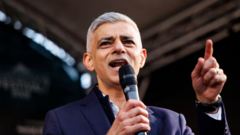
Sadiq Khan says Labour should pledge to rejoin EU
#Sadiq Khan #Labour Party #rejoin EU #Brexit #political pledge
📌 Key Takeaways
- Sadiq Khan advocates for Labour to commit to rejoining the EU
- The statement reflects internal party debate on post-Brexit policy
- Khan's position contrasts with current Labour leadership stance
- This could influence Labour's manifesto and voter appeal
📖 Full Retelling
🏷️ Themes
Brexit, Labour Party
📚 Related People & Topics

Sadiq Khan
Mayor of London since 2016
Sir Sadiq Aman Khan (born 8 October 1970) is a British politician serving as the third and current mayor of London since 2016. He was previously the Member of Parliament (MP) for Tooting from 2005 until 2016. A member of the Labour Party, Khan is on the party's soft left and has been ideologically c...
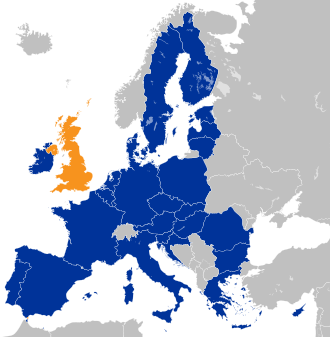
Brexit
Withdrawal of the UK from the EU
Brexit (; a portmanteau of "Britain" and "Exit") was the withdrawal of the United Kingdom (UK) from the European Union (EU). Brexit took place at 23:00 GMT on 31 January 2020 (00:00 1 February 2020 CET). The UK, which joined the EU precursor, the European Communities (EC), on 1 January 1973, is the ...
Labour Party
Topics referred to by the same term
Labour Party or Labor Party is a name used by many political parties. These political parties are generally left-wing or centre-left, usually with nominal commitments to social democracy and/or democratic socialism.
Entity Intersection Graph
Connections for Sadiq Khan:
Mentioned Entities
Deep Analysis
Why It Matters
This statement matters because it represents a significant shift in Labour's post-Brexit positioning and could reshape UK-EU relations. It directly affects British businesses, citizens living in EU countries, and the UK's economic future. The proposal challenges the current political consensus on Brexit and could influence Labour's electoral prospects in upcoming elections. If adopted, it would trigger complex negotiations with the EU and require public support through a referendum.
Context & Background
- The UK officially left the European Union on January 31, 2020, following the 2016 Brexit referendum where 52% voted to leave
- Labour under Keir Starmer has previously maintained a position of accepting Brexit while seeking to improve the UK-EU trade relationship
- Sadiq Khan, as Mayor of London, represents a city that voted overwhelmingly (60%) to remain in the EU in 2016
- Current polling shows growing public dissatisfaction with Brexit outcomes, particularly regarding economic impacts and trade barriers
- The UK currently operates under the EU-UK Trade and Cooperation Agreement signed in December 2020
What Happens Next
Labour will likely face internal debate about adopting this position ahead of their next party conference. The proposal may be discussed in Labour's National Policy Forum meetings scheduled for autumn 2024. If Labour wins the next general election (expected by January 2025), rejoining discussions could begin in 2025-2026, though any re-entry would require negotiations and likely another referendum. The EU would need to formally consider any UK application under Article 49 of the Treaty on European Union.
Frequently Asked Questions
No, rejoining would be a lengthy process requiring formal application, negotiations on terms, and likely a UK referendum. The EU would need unanimous approval from all 27 member states, and the UK would probably need to adopt the euro and Schengen requirements.
Rejoining would likely reduce trade barriers and restore access to EU programs, potentially boosting economic growth. However, it would require accepting EU regulations and budget contributions, and the transition period could create temporary economic disruption.
Labour currently accepts Brexit while seeking closer alignment through improved trade agreements. Khan's proposal represents a more radical shift toward full EU membership, which would reverse the fundamental outcome of the 2016 referendum.
Full EU membership would require accepting freedom of movement principles, allowing EU citizens to live and work in the UK without visas. This would represent a significant reversal of post-Brexit immigration controls.
Currently unlikely in the short term, as Keir Starmer has consistently rejected rejoining. However, pressure may grow if public opinion continues shifting against Brexit, particularly among younger voters and in urban areas.