
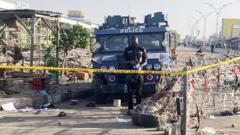
Suspected suicide attacks kill at least 23 in north-east Nigeria
#suicide attacks #Nigeria #casualties #Boko Haram #violence #north-east #bombings #security
📌 Key Takeaways
- At least 23 people killed in suspected suicide attacks in north-east Nigeria
- Attacks occurred in a region frequently targeted by militant groups
- No immediate claim of responsibility for the bombings
- Incident highlights ongoing security challenges in the area
🏷️ Themes
Terrorism, Security Crisis
📚 Related People & Topics

Boko Haram
African jihadist organisation
Boko Haram, officially known as Jama'at Ahl al-Sunna li al-Da'wa wa al-Jihad (JAS, Arabic: جماعة أهل السنة للدعوة والجهاد, romanised: Jamā'at Ahl as-Sunnah lid-Da'wah wa'l-Jihād, lit. 'Group of the People of Sunnah for Dawah and Jihad') and sometimes referred to as its state name Daular Musulunci, i...

Nigeria
Country in West Africa
Nigeria, officially the Federal Republic of Nigeria, is a country in West Africa between the Sahel to the north and the Gulf of Guinea in the Atlantic Ocean to the south. It covers an area of 923,769 square kilometres (356,669 mi2). With a population of more than 236 million, it is the most populous...
Entity Intersection Graph
Connections for Boko Haram:
Mentioned Entities
Deep Analysis
Why It Matters
This attack represents a significant escalation of violence in a region already devastated by long-term conflict, directly affecting civilians who bear the brunt of insurgent violence. It matters because it demonstrates the persistent threat posed by extremist groups in Nigeria's northeast, undermining government claims of improved security and complicating humanitarian efforts. The attack impacts displaced populations, local communities, and international aid organizations operating in the region, while raising concerns about the effectiveness of counter-terrorism measures.
Context & Background
- Boko Haram and its splinter group Islamic State West Africa Province (ISWAP) have been active in northeastern Nigeria since 2009, causing over 35,000 deaths and displacing more than 2 million people
- The region has experienced numerous suicide attacks targeting markets, mosques, displacement camps, and security forces, with women and children often used as bombers
- Nigeria's military has claimed significant progress against insurgents in recent years, but periodic large-scale attacks continue to occur
- The Lake Chad basin region where these attacks typically occur borders Nigeria, Niger, Chad, and Cameroon, with violence frequently spilling across borders
- International forces including the Multinational Joint Task Force have been operating in the region since 2015 to combat extremist groups
What Happens Next
Security forces will likely increase patrols and checkpoints in the affected area while investigating the attack's perpetrators. Humanitarian organizations may temporarily suspend operations due to security concerns, exacerbating existing crises in displacement camps. The Nigerian government will face renewed pressure to address security failures ahead of upcoming elections, potentially leading to military reshuffles or strategy changes. Regional coordination through the Multinational Joint Task Force may intensify in response to the attack.
Frequently Asked Questions
Boko Haram or its splinter group Islamic State West Africa Province (ISWAP) are the primary suspects, as both have long histories of conducting suicide attacks in northeastern Nigeria. These groups frequently target civilian gatherings to maximize casualties and demonstrate their continued operational capability despite military counter-terrorism efforts.
Northeastern Nigeria suffers from complex factors including poverty, weak governance, ethnic tensions, and the presence of extremist ideologies. The region's remote geography and porous borders facilitate insurgent movements, while historical marginalization has created grievances that extremist groups exploit for recruitment and support.
Such attacks force humanitarian organizations to suspend or limit operations, delaying critical aid delivery to millions of displaced people. Increased security measures raise operational costs and reduce access to vulnerable populations, worsening already dire conditions in displacement camps and conflict-affected communities.
Nigeria employs a combination of military operations, regional cooperation through the Multinational Joint Task Force, and deradicalization programs. However, critics argue the strategy overemphasizes military solutions while underinvesting in addressing root causes like poverty, education gaps, and governance failures that enable extremist recruitment.
Attacks in northeastern Nigeria often trigger cross-border security responses and can spill violence into neighboring countries like Niger, Chad, and Cameroon. This destabilizes the entire Lake Chad basin region, disrupts trade routes, increases refugee flows, and strains regional security cooperation mechanisms.