
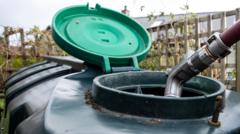
Swinney tells UK government to 'get a move on' with heating oil support
#Swinney #heating oil #UK government #energy support #cost of living #household bills #Scotland
📌 Key Takeaways
- John Swinney urges UK government to expedite heating oil support for households
- Heating oil users face high costs and need immediate financial assistance
- Swinney criticizes delays in implementing promised support measures
- The call highlights pressure on UK government to address energy affordability
📖 Full Retelling
🏷️ Themes
Energy Policy, Government Accountability
📚 Related People & Topics

Scotland
Country within the United Kingdom
Scotland is a country that is part of the United Kingdom. It contains nearly one-third of the United Kingdom's land area, consisting of the northern part of the island of Great Britain and more than 790 adjacent islands, principally in the archipelagos of the Hebrides and the Northern Isles. In 2022...
Government of the United Kingdom
His Majesty's Government, abbreviated to HM Government or otherwise the UK Government, is the central executive authority of the United Kingdom of Great Britain and Northern Ireland. The government is led by the prime minister (Sir Keir Starmer since 5 July 2024) who advises the monarch on the appoi...
Entity Intersection Graph
Connections for Swinney:
View full profileMentioned Entities
Deep Analysis
Why It Matters
This news matters because it highlights a critical energy affordability issue affecting rural households across Scotland and other UK regions that rely on heating oil. With winter approaching and energy prices remaining high, vulnerable populations face severe financial strain and potential health risks from inadequate heating. The political tension between Scottish and UK governments demonstrates how devolution creates complex accountability challenges for essential support programs. This affects approximately 1.5 million UK households, primarily in off-grid rural areas without access to gas networks.
Context & Background
- Heating oil is used by about 4% of UK households, concentrated in rural Scotland, Northern Ireland, and parts of England where gas networks don't reach
- The UK government previously provided heating oil support through schemes like the Energy Price Guarantee, but these have been phased out or reduced
- Scotland has devolved powers over some energy matters but relies on UK government for broader energy policy and funding decisions
- Energy prices have increased dramatically since 2021, with heating oil prices approximately 50% higher than pre-crisis levels
- Previous support schemes faced criticism for being slow to reach heating oil users compared to those on mains gas or electricity
What Happens Next
The UK government will likely face increasing pressure to announce specific heating oil support measures before winter 2024-2025. Scottish Parliament may consider using devolved powers to create supplementary support if UK action is insufficient. Energy regulator Ofgem may be called to review pricing mechanisms for off-grid fuels. Local authorities will prepare emergency cold weather plans anticipating increased fuel poverty cases.
Frequently Asked Questions
Heating oil is primarily used in rural areas where extending the natural gas network is economically unfeasible. These off-grid properties typically use oil-fired boilers with storage tanks that require periodic deliveries, creating different pricing and supply challenges compared to mains-connected energy.
While the article doesn't specify exact measures, typical requests include direct financial assistance, price caps or subsidies for heating oil purchases, and inclusion in broader energy support schemes. The urgency suggests immediate action is needed before winter when consumption and prices typically peak.
This creates tension as Scotland seeks faster action on a devolved matter affecting vulnerable constituents, while the UK government controls broader energy policy and funding. It exemplifies ongoing debates about which level of government should address cross-border issues like energy affordability.
This varies significantly - while some are affluent rural homeowners, many are low-income households in remote areas with limited housing options. Research shows heating oil users often face higher energy costs per unit and fewer switching options, disproportionately impacting those already in fuel poverty.
Alternatives include heat pumps (though expensive to install), biomass boilers, LPG systems, or electric heating. However, transition costs are substantial, and many rural properties lack adequate insulation, making immediate alternatives impractical for most households facing current price pressures.