
SP
BravenNow
Tariffs ruling is major blow to Trump's second-term agenda
| United Kingdom | world | ✓ Verified - bbc.com

Tariffs ruling is major blow to Trump's second-term agenda

#Supreme Court #Tariffs #Donald Trump #Executive Authority #Trade Policy #Congress #Economic Power #State of the Union

📌 Key Takeaways

  • Supreme Court ruled that only Congress has tariff authority, not the president
  • Trump responded with criticism and promised to use other presidential powers to reimpose tariffs
  • The decision weakens Trump's negotiating position with international trading partners
  • Trump's tariff options are now more limited and require longer lead-in times

📖 Full Retelling

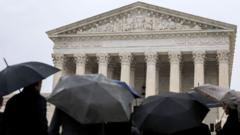
The Supreme Court delivered a significant rebuke to President Donald Trump on Friday by ruling that only Congress has the constitutional authority to impose tariffs, not the president under the Emergency Economic Powers Act of 1977. This decision directly undermines one of the key pillars of Trump's second-term agenda, which has relied heavily on his ability to unilaterally impose tariffs as leverage in international trade negotiations. Trump, who had previously warned such a ruling would be an 'economic and national security disaster,' responded with characteristic fury, lashing out at the justices in a hastily arranged press conference and promising to reimpose tariffs using other presidential authorities including a new temporary 10% global tariff. The ruling represents a rare instance of the current Supreme Court checking Trump's expansive use of executive power, which has generally been permitted on issues like immigration and federal government reshaping. While the justices left the question of tariff revenue collection for lower courts to decide, Justice Brett Kavanaugh warned in his dissent that this process would likely be a 'mess.' The decision emboldens America's trading partners and weakens Trump's negotiating position internationally, as his ability to threaten or enact sweeping tariffs with minimal process has been significantly curtailed. Trump's administration now faces the prospect of either implementing more limited tariffs through detailed agency processes or seeking explicit congressional authorization, which seems unlikely given narrow Republican majorities and upcoming midterm elections. The ruling creates an awkward political dynamic for Trump's upcoming State of the Union Address, where he will likely come face-to-face with the justices who limited his authority.

🏷️ Themes

Executive Power, Trade Policy, Checks and Balances

📚 Related People & Topics
Supreme court

Supreme court

Highest court in a jurisdiction

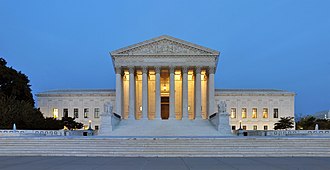
In most legal jurisdictions, a supreme court, also known as a court of last resort, apex court, high (or final) court of appeal, and court of final appeal, is the highest court within the hierarchy of courts. Broadly speaking, the decisions of a supreme court are binding on all other courts in a nat...

View Profile → Wikipedia ↗
Tariff

Tariff

Goods import or export tax

A tariff or import tax is a duty imposed by a national government, customs territory, or supranational union on imports of goods and is paid by the importer. Exceptionally, an export tax may be levied on exports of goods or raw materials and is paid by the exporter. Besides being a source of revenue...

View Profile → Wikipedia ↗
Donald Trump

Donald Trump

President of the United States (2017–2021; since 2025)

Donald John Trump (born June 14, 1946) is an American politician, media personality, and businessman who is the 47th president of the United States. A member of the Republican Party, he served as the 45th president from 2017 to 2021. Born into a wealthy New York City family, Trump graduated from the...

View Profile → Wikipedia ↗

Entity Intersection Graph

Connections for Supreme court:

👤 Donald Trump 19 shared
🌐 Tariff 15 shared
🌐 Tariffs in the Trump administration 12 shared
🌐 International Emergency Economic Powers Act 7 shared
🌐 Commercial policy 5 shared
View full profile

Deep Analysis

Why It Matters

The Supreme Court decision limits President Trump's ability to impose tariffs, undermining a key tool of his trade policy and signaling a judicial check on executive power.

Context & Background

  • The Court ruled that tariff authority lies with Congress, not the President, under the Emergency Economic Powers Act
  • Trump had used tariffs to pressure trading partners and had warned of a catastrophic outcome if the Court struck them down
  • The ruling is part of a broader trend of judicial scrutiny over executive actions such as immigration and federal appointments

What Happens Next

Trump may seek Congressional authorization for new tariffs, but the narrow Republican majorities and upcoming midterms make this unlikely. The decision may embolden trading partners to push back and could force a refund of tariff revenue.

Frequently Asked Questions

What does the ruling mean for Trump's tariff policy?

It restricts the President's unilateral ability to impose tariffs, requiring Congressional approval for future tariff actions.

Can Trump still impose tariffs using other laws?

He can use limited statutory authorities, but they are more restrictive and require detailed justification.

Will this affect the State of the Union address?

The decision may create a tense moment when Trump delivers the address, as Supreme Court justices will be present.

Original Source
Tariffs ruling is major blow to Trump's second-term agenda 8 hours ago Share Save Anthony Zurcher North America correspondent Share Save Donald Trump had been warning for months that a Supreme Court decision like this would be catastrophic. If the court curtailed his ability to impose these tariffs, he had said, it would be an "economic and national security disaster". A six-justice majority of the Supreme Court, in ruling against the president on Friday, didn't care much about his concerns. Congress, not the president, has the power to impose tariffs, the justices ruled. And nothing in the law that the president based his tariffs on, the Emergency Economic Powers Act of 1977, delegated such sweeping powers to Trump. Trump, in a hastily arranged press conference on Friday afternoon, lashed out at the justices who ruled against him. He said he was "ashamed" of the three conservatives who struck down his tariffs and called the three liberals on the court a "disgrace". Trump then promised to reimpose tariffs using presidential authority available under other laws, including a new temporary 10% global tariff that he said he would sign on Friday. The court's decision represents a rare check on this president's broad use of executive authority. A majority of the justices over the past year have shown a willingness to allow Trump to press ahead with his agenda, particularly on immigration and reshaping the federal government, even as legal challenges work their way through the court system. Follow reaction to ruling as it happens Trump tariffs ripped up global trade order. What now? This case, which was fast-tracked through the court system as an emergency, slams the door on one such expansive use of presidential authority. With several other major cases involving controversial uses of executive power, such as efforts to end birthright citizenship and to dismiss a Federal Reserve governor based on alleged improprieties, this may not be Trump's only setback in the coming mo...
Read full article at source

Source

bbc.com

More from United Kingdom

News from Other Countries

🇺🇸 USA

🇺🇦 Ukraine