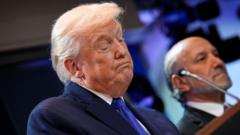
Trump announced 15% global tariffs after Supreme Court limited his tariff authority
Existing tariff deals with countries like UK and Australia are now in question
Businesses face increased costs and uncertainty, with UK exporters potentially facing £2-3bn in additional costs
Consumers may bear much of the tariff burden through higher prices
Concerns remain about potential additional tariffs on specific sectors
📖 Full Retelling
US President Donald Trump's announcement of a 15% global tariff has created significant uncertainty for businesses and consumers worldwide, following a Supreme Court ruling that limited his tariff authority. After the Supreme Court ruled on Friday that Trump could not use a 1977 law to levy taxes on imports from nearly every country, the president signed a proclamation on Saturday using Section 122 of the 1974 Trade Act, initially setting a 10% tariff before increasing it to 15% via social media. This sudden policy shift has left countries like the UK and Australia, which had previously negotiated 10% tariff deals, facing renewed uncertainty about their trade relationships with the US. Industry experts warn that the constant changes in tariff policy are creating confusion for businesses trying to plan their pricing strategies and market strategies in the world's largest economy. Businesses across multiple sectors, including food and drink, textiles, industrial goods, and electrical goods, are particularly concerned about the overnight increase in export costs to the US market. The British Chambers of Commerce estimates that the higher 15% tariff rate could increase tariff costs on UK goods exported to the US by between £2-3bn ($2.7-4bn), affecting approximately 40,000 UK companies. Meanwhile, economists suggest that much of these additional costs will ultimately be passed on to US consumers through higher prices, potentially exacerbating inflationary pressures in the economy.
🏷️ Themes
Trade Policy, Economic Uncertainty, Consumer Impact, International Relations
An economic impact analysis (EIA) examines the effect of an event on the economy in a specified area, ranging from a single neighborhood to the entire globe. It usually measures changes in business revenue, business profits, personal wages, and/or jobs. The economic event analyzed can include imple...
International trade is the exchange of capital, goods, and services across international borders or territories because there is a need or want of goods or services.
In most countries, such trade represents a significant share of gross domestic product (GDP). While international trade has existed t...
The uncertainties facing businesses and consumers after Trump's tariff changes 5 hours ago Share Save Rachel Clun Business reporter Share Save US President Donald Trump's latest tariff changes have heightened uncertainty for businesses and consumers, industry experts and economists say. The changes followed a Supreme Court ruling on Friday that Trump could not use a 1977 law - the International Emergency Economic Powers Act - to levy taxes on imports from nearly every country in the world. On Saturday, Trump signed a proclamation using an alternative law, Section 122 of 1974's Trade Act, that would let him put a new 10% temporary tariff on goods from all countries. Then on Saturday he posted on social media that he would be increasing these tariffs to 15%. The latest announcement raises uncertainties for countries, including the UK and Australia who had previously negotiated 10% tariff deals with the US. While other comments from Trump have heightened fears that new levies could be imposed on goods that have been exempted until now. Many questions about what might happen next remain unanswered, said William Bain, head of trade policy at the British Chambers of Commerce . "There is a weariness about the constant changes, the lack of any clarity and certainty in terms of tariffs, and therefore the prices that companies can charge for the goods in terms of customers in the US," he said. " are frustrated and exasperated at the constant changes in policy." Here are some of the remaining issues businesses and consumers face following Trump's latest announcement. Clarity needed on existing tariff deals After Trump first announced his "Liberation Day" tariffs last year , many countries have worked to negotiate lower levies on their exports to the US, including the UK which was able to secure a deal for a 10% levy on goods sent to America . But on Friday, an official said countries that previously reached trade deals would face the Section 122 global tariff, rather than the ...