
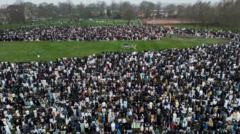
Thousands attend Europe's biggest Eid celebration
#Eid al-Fitr #Birmingham #Muslim community #Europe #celebration #cultural integration #festival
📌 Key Takeaways
- Thousands gathered in Birmingham for Europe's largest Eid al-Fitr celebration
- The event featured prayers, food stalls, and family activities
- It highlighted the UK's diverse Muslim community and cultural integration
- Local authorities supported the event to promote community cohesion
🏷️ Themes
Religious celebration, Community event
📚 Related People & Topics

Birmingham
City in the West Midlands, England
Birmingham ( BUR-ming-əm) is a city and metropolitan borough in the metropolitan county of West Midlands, within the wider West Midlands region, in England. It is the largest local authority district in England by population and the second-largest city in Britain – commonly referred to as the secon...

Ummah
Arabic term used to refer to the collective nation of Muslim people
Ummah (; Arabic: أُمَّة [ˈʊm.mæ]) is an Arabic word meaning Muslim identity, nation, religious community, or the concept of a commonwealth of the Muslim believers (أمة المؤمنين ummat al-muʼminīn). It is a synonym for ummat al-Islām (أمّةْ الإِسْلَامُ, lit. 'the Islamic nation'); it is commonly used ...

Europe
Continent
Europe is a continent located entirely in the Northern Hemisphere and mostly in the Eastern Hemisphere. It is bordered by the Arctic Ocean to the north, the Atlantic Ocean to the west, the Mediterranean Sea to the south, and Asia to the east. Europe shares the landmass of Eurasia with Asia, and of A...
Entity Intersection Graph
Connections for Birmingham:
Mentioned Entities
Deep Analysis
Why It Matters
This event demonstrates the growing visibility and integration of Muslim communities in Europe, showcasing cultural diversity and religious freedom. It matters to European Muslims seeking public recognition of their traditions, to policymakers addressing multiculturalism, and to societies navigating religious coexistence. The celebration's scale signals both community vitality and potential discussions about public space usage and interfaith relations in increasingly diverse European cities.
Context & Background
- Eid al-Fitr marks the end of Ramadan, the Islamic holy month of fasting, and is one of two major Islamic holidays celebrated worldwide.
- Muslim populations in Europe have grown significantly through immigration and natural increase since the mid-20th century, with estimates suggesting 25-30 million Muslims now live in EU countries.
- Public Eid celebrations in European cities have expanded from private gatherings to large-scale public events over recent decades, reflecting both community growth and increased societal acceptance.
- Previous large Eid gatherings in Europe have sometimes sparked debates about multiculturalism, integration policies, and the use of public spaces for religious observances.
What Happens Next
Local authorities will likely assess the event's logistics and community impact, potentially influencing future permits for similar gatherings. Community organizations may use the successful celebration momentum to advocate for greater recognition of Islamic holidays in public calendars. Media coverage could spark broader discussions about religious accommodation in European societies, possibly leading to policy reviews in various municipalities regarding public space allocation for religious events.
Frequently Asked Questions
Eid al-Fitr is the 'Festival of Breaking the Fast' that marks the end of Ramadan, the Islamic holy month of dawn-to-sunset fasting. Muslims celebrate with prayers, feasting, charity, and community gatherings to express gratitude to God and strengthen social bonds after a month of spiritual reflection and self-discipline.
While the article doesn't specify the location, Europe's largest Eid celebrations typically occur in major cities with significant Muslim populations such as London, Birmingham, Paris, or Berlin. These events often take place in large parks or convention centers to accommodate thousands of attendees.
Public Eid celebrations represent the visible presence and integration of Muslim communities in European societies. They demonstrate religious freedom in secular democracies while providing opportunities for intercultural exchange and challenging stereotypes about Islam in Western contexts.
Cities generally provide permits for park use, arrange temporary prayer facilities, implement traffic management plans, and coordinate with community organizers on security and sanitation. Some cities also provide public transportation adjustments and cultural sensitivity training for staff involved in event management.