
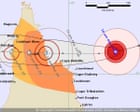
Tropical Cyclone Narelle to make landfall in far north Qld on Friday as category four storm, bringing 200km/h winds
#Tropical Cyclone Narelle #Queensland #category four #landfall #200km/h winds #storm #weather warning
📌 Key Takeaways
- Tropical Cyclone Narelle is forecast to make landfall in far north Queensland on Friday
- The cyclone is classified as a category four storm
- It is expected to bring winds of up to 200km/h
- Residents in the affected area should prepare for severe weather conditions
📖 Full Retelling
🏷️ Themes
Weather, Emergency
Entity Intersection Graph
No entity connections available yet for this article.
Deep Analysis
Why It Matters
This news matters because Tropical Cyclone Narelle poses a severe threat to life and property in far north Queensland as a powerful Category 4 storm with destructive 200km/h winds. It affects residents who must evacuate or shelter, emergency services coordinating response efforts, and local economies facing infrastructure damage and business disruption. The storm's intensity requires urgent community preparedness and government resource allocation to minimize casualties and recovery costs.
Context & Background
- Australia's cyclone season typically runs from November to April, with most activity occurring between January and March
- Category 4 cyclones on Australia's scale can cause significant structural damage, dangerous airborne debris, and widespread power failures
- Far north Queensland is historically vulnerable to tropical cyclones, with notable past events including Cyclone Yasi (2011) and Cyclone Larry (2006)
- The Bureau of Meteorology uses a five-category severity scale where Category 4 involves very destructive winds of 225-279 km/h
- Coastal communities in this region have established cyclone preparedness plans and building codes designed for wind resilience
What Happens Next
Emergency services will activate response plans on Thursday with possible mandatory evacuations in low-lying areas. The cyclone will make landfall Friday with peak intensity, causing power outages, road closures, and structural damage. Recovery operations will begin Saturday with damage assessments, while the system weakens to a tropical low as it moves inland over the weekend.
Frequently Asked Questions
Coastal communities in far north Queensland between Cooktown and Cardwell face the highest risk, particularly low-lying areas vulnerable to storm surge. Inland regions may experience heavy rainfall and flooding as the system weakens after landfall.
Residents should secure outdoor items, prepare emergency kits with supplies for 3 days, and identify the strongest room in their home for shelter. They should monitor official warnings from the Bureau of Meteorology and follow evacuation orders if issued by local authorities.
Category 4 cyclones have very destructive winds (225-279 km/h) that can cause significant structural damage and dangerous debris. Category 5 cyclones (winds over 280 km/h) are the most severe, causing widespread destruction and making most buildings uninhabitable for weeks.
Modern forecasting provides good accuracy for landfall timing within 24 hours, but the exact location can vary by 50-100km. Intensity predictions are less certain as cyclones can rapidly intensify or weaken based on atmospheric conditions.
The system will weaken as it moves inland due to friction and loss of warm ocean energy, typically becoming a tropical low within 24-48 hours. However, it can still produce heavy rainfall causing flash flooding hundreds of kilometers inland.