
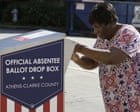
Trump signs order to restrict mail-in ballots in probably unconstitutional move
#Trump #mail-in ballots #executive order #unconstitutional #voting rights #election integrity #legal challenge
📌 Key Takeaways
- President Trump signed an executive order to restrict mail-in voting methods.
- The order is likely to face legal challenges over its constitutionality.
- The move could impact voter access and election procedures.
- It reflects ongoing political debates over election integrity and security.
📖 Full Retelling
🏷️ Themes
Election Policy, Legal Controversy
📚 Related People & Topics

Donald Trump
President of the United States (2017–2021; since 2025)
Donald John Trump (born June 14, 1946) is an American politician, media personality, and businessman who is the 47th president of the United States. A member of the Republican Party, he served as the 45th president from 2017 to 2021. Born into a wealthy New York City family, Trump graduated from the...
Entity Intersection Graph
Connections for Donald Trump:
Mentioned Entities
Deep Analysis
Why It Matters
This news matters because it directly impacts voting rights and election accessibility for millions of Americans, particularly those who rely on mail-in voting due to health concerns, disabilities, or logistical challenges. It raises constitutional questions about presidential authority versus state election administration, potentially setting up legal battles that could affect the 2024 election. The move also reflects ongoing partisan tensions over election security versus voting access, with significant implications for democratic participation and trust in electoral systems.
Context & Background
- Mail-in voting expanded dramatically during the COVID-19 pandemic, with 46% of voters casting ballots by mail in the 2020 election according to the Census Bureau
- Former President Trump has repeatedly claimed without evidence that mail-in voting leads to widespread fraud, despite numerous studies showing it is secure
- The Constitution grants states primary authority over election administration under Article I, Section 4, though Congress can override certain state regulations
- Legal challenges to voting restrictions have increased in recent years, with courts often striking down measures that disproportionately affect minority voters
- The 2020 election saw record mail-in voting, with both parties utilizing the method though Democrats used it more extensively according to Pew Research
What Happens Next
Legal challenges from voting rights groups and Democratic-led states are likely to be filed within days, potentially reaching federal courts quickly. State election officials will need to determine whether to comply with the order or challenge it, creating potential confusion in election administration. Congressional Democrats may introduce legislation to counter the order, though passage would be unlikely without bipartisan support. The Supreme Court may eventually need to rule on the constitutionality of such executive actions regarding election procedures.
Frequently Asked Questions
The article doesn't specify the exact restrictions, but such orders typically target ballot request deadlines, witness requirements, drop box availability, or signature verification processes. These restrictions often make voting more difficult for certain populations while purportedly addressing security concerns.
It's considered potentially unconstitutional because the Constitution grants states primary authority over election administration, not the executive branch. Previous court rulings have limited federal intervention in state election procedures unless there's clear constitutional authority or congressional legislation supporting such actions.
If implemented, it could reduce mail-in voting participation, potentially affecting election outcomes in close races. It may also increase voting lines and create confusion among voters about proper procedures, possibly suppressing turnout among populations that rely heavily on mail-in options.
Elderly voters, people with disabilities, rural residents, military personnel overseas, and low-income workers who cannot easily take time off to vote in person would be disproportionately affected. Studies show these restrictions often have greater impact on minority communities and Democratic-leaning voters.
States may challenge the order in court or assert their constitutional authority over election administration. However, ignoring a valid executive order could lead to federal lawsuits or other enforcement actions, creating legal uncertainty for state election officials.
Previous presidents have used executive orders on voting rights, but typically to expand access rather than restrict it. Courts have generally been skeptical of unilateral executive actions that significantly alter election procedures without clear statutory authority from Congress.