
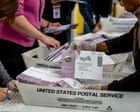
US supreme court hears arguments in mail-in ballots case ahead of midterms
#Supreme Court #mail-in ballots #midterm elections #voting rights #legal arguments
📌 Key Takeaways
- The US Supreme Court is hearing arguments on a case related to mail-in ballots.
- The case's timing is significant as it precedes the upcoming midterm elections.
- The outcome could impact voting procedures and access for the elections.
- Legal debates center on the validity and handling of mail-in ballots.
📖 Full Retelling
🏷️ Themes
Election Law, Supreme Court
📚 Related People & Topics
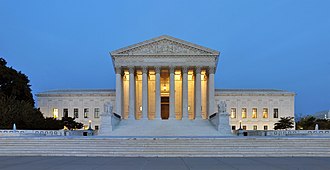
Supreme court
Highest court in a jurisdiction
In most legal jurisdictions, a supreme court, also known as a court of last resort, apex court, high (or final) court of appeal, and court of final appeal, is the highest court within the hierarchy of courts. Broadly speaking, the decisions of a supreme court are binding on all other courts in a nat...
Entity Intersection Graph
Connections for Supreme court:
Mentioned Entities
Deep Analysis
Why It Matters
This case directly impacts voting access for millions of Americans who rely on mail-in ballots, particularly elderly, disabled, and rural voters. The Supreme Court's ruling could determine whether states can impose stricter requirements on mail-in voting ahead of the midterm elections. The decision will influence election administration nationwide and could affect election outcomes in closely contested races. This case represents another major test of voting rights following recent Supreme Court decisions that have reshaped election law.
Context & Background
- Mail-in voting expanded dramatically during the 2020 pandemic, with over 65 million Americans voting by mail
- The Supreme Court has previously ruled on multiple election-related cases, including Shelby County v. Holder (2013) which weakened the Voting Rights Act
- State legislatures have introduced hundreds of bills since 2020 seeking to modify voting rules and procedures
- The current conservative 6-3 majority on the Court has shown willingness to reconsider established voting rights precedents
- Previous Supreme Court decisions have allowed states to implement voter ID laws and other restrictions
What Happens Next
The Supreme Court will likely issue its ruling by late June or early July 2023, before the 2024 election cycle begins in earnest. State election officials will need to adjust their procedures based on the ruling, potentially requiring legislative action in some states. The decision may trigger further litigation in lower courts regarding specific state implementation. Political parties and voting rights organizations will mobilize around the ruling as they prepare for the 2024 presidential election.
Frequently Asked Questions
The Court is examining whether states can impose additional requirements on mail-in ballots beyond what federal law mandates, particularly regarding witness signatures, notarization, and ballot receipt deadlines. The case tests the balance between state authority to regulate elections and federal protections for voting access.
The ruling could either make mail-in voting more accessible or allow states to implement stricter requirements, potentially affecting turnout among certain demographic groups. Election administrators would need to quickly implement any changes to voting procedures, creating logistical challenges close to the election.
States with recently passed voting laws that conflict with the ruling would need to make immediate adjustments. States that expanded mail-in voting during the pandemic but lack permanent statutory authorization would face particular uncertainty about their voting procedures.
This continues a pattern of the Court reconsidering established voting rights precedents and granting states more authority over election procedures. The decision may further clarify the Court's approach to balancing state election authority against constitutional voting protections.
The ruling could advantage one political party over another depending on which demographic groups are most affected by changes to mail-in voting procedures. The decision may also influence voter confidence in election integrity and administration ahead of crucial elections.