
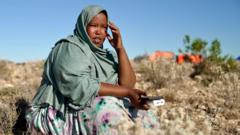
'We will go wherever they hide': Rooting out IS in Somalia
#Somalia #Islamic State #IS #militants #hideouts #security #counter-terrorism #operations
📌 Key Takeaways
- Somali forces are intensifying operations against Islamic State (IS) militants in the country.
- The campaign involves pursuing IS fighters into their hideouts and strongholds.
- The effort is part of a broader strategy to eliminate the IS threat in Somalia.
- The operation reflects ongoing security challenges and counter-terrorism measures in the region.
📖 Full Retelling
🏷️ Themes
Counter-terrorism, Security operations
📚 Related People & Topics

Somalia
Country in the Horn of Africa
Somalia, officially the Federal Republic of Somalia, is the easternmost country in continental Africa. Stretching across the Horn of Africa, it borders Ethiopia to the west, Djibouti to the northwest, Kenya to the southwest, the Gulf of Aden to the north, and the Indian Ocean to the east. Somalia ha...

Islamic State
Salafi jihadist militant organisation
The Islamic State (IS), also known as the Islamic State of Iraq and the Levant (ISIL), the Islamic State of Iraq and Syria (ISIS), and the Daesh, is a transnational Salafi jihadist militant organisation and a former unrecognised quasi-state. IS occupied significant territory in Iraq and Syria in 201...
Entity Intersection Graph
Connections for Somalia:
Mentioned Entities
Deep Analysis
Why It Matters
This news matters because it highlights ongoing counterterrorism operations against ISIS affiliates in Somalia, which affects regional stability in East Africa. It impacts Somalia's security forces, civilians caught in conflict zones, and international partners like the U.S. and African Union who support these missions. Successful operations could weaken ISIS's foothold in Africa, while failures might embolden the group and increase regional insecurity.
Context & Background
- ISIS established a presence in Somalia around 2015-2016 through defectors from al-Shabaab and local recruitment
- Somalia has faced decades of conflict involving clan militias, al-Shabaab (affiliated with al-Qaeda), and now ISIS-Somalia (ISS)
- The U.S. has conducted airstrikes and special operations in Somalia since the early 2000s, with increased activity against ISIS targets in recent years
- ISS controls limited territory primarily in Puntland's mountainous regions but poses an ideological threat beyond its numbers
- African Union Transition Mission in Somalia (ATMIS) has been gradually withdrawing, shifting more security responsibility to Somali forces
What Happens Next
Somali forces will likely intensify ground operations in Puntland's Galgala mountains and other ISIS strongholds in coming months. The U.S. may increase drone surveillance and targeted strikes if intelligence indicates senior ISIS leaders are present. Regional coordination with Kenya and Ethiopia might strengthen to prevent cross-border movement of militants. Civilian displacement from conflict zones is expected to rise temporarily during offensive operations.
Frequently Asked Questions
ISIS in Somalia (ISS) is a smaller splinter group that broke from al-Shabaab over ideological differences, pledging allegiance to ISIS's global caliphate rather than al-Qaeda. While al-Shabaab controls more territory and has greater numbers, ISS represents the competing ISIS brand of extremism in the region, sometimes clashing with al-Shabaab fighters.
Puntland's remote Galgala mountains provide natural fortifications that make military operations difficult. The region's relative isolation from central government control has allowed ISS to establish training camps and hideouts. Additionally, Puntland's coastline offers potential smuggling routes for weapons and fighters.
The U.S. provides intelligence, drone surveillance, and occasional airstrikes, while Turkey and UAE offer military training and equipment to Somali forces. The African Union contributes troops through ATMIS, though their drawdown is shifting primary responsibility to Somali national and regional forces.
Civilians face displacement, disrupted livelihoods, and collateral damage during military operations. Humanitarian access often becomes restricted in active conflict zones, potentially worsening food insecurity. Some communities may face retaliation from militants if suspected of cooperating with government forces.
Long-term challenges include the group's ability to blend into local populations, ongoing recruitment from marginalized communities, and the difficult mountainous terrain. Even if military operations succeed temporarily, without addressing governance gaps and economic opportunities, new extremist groups may emerge to fill the vacuum.