
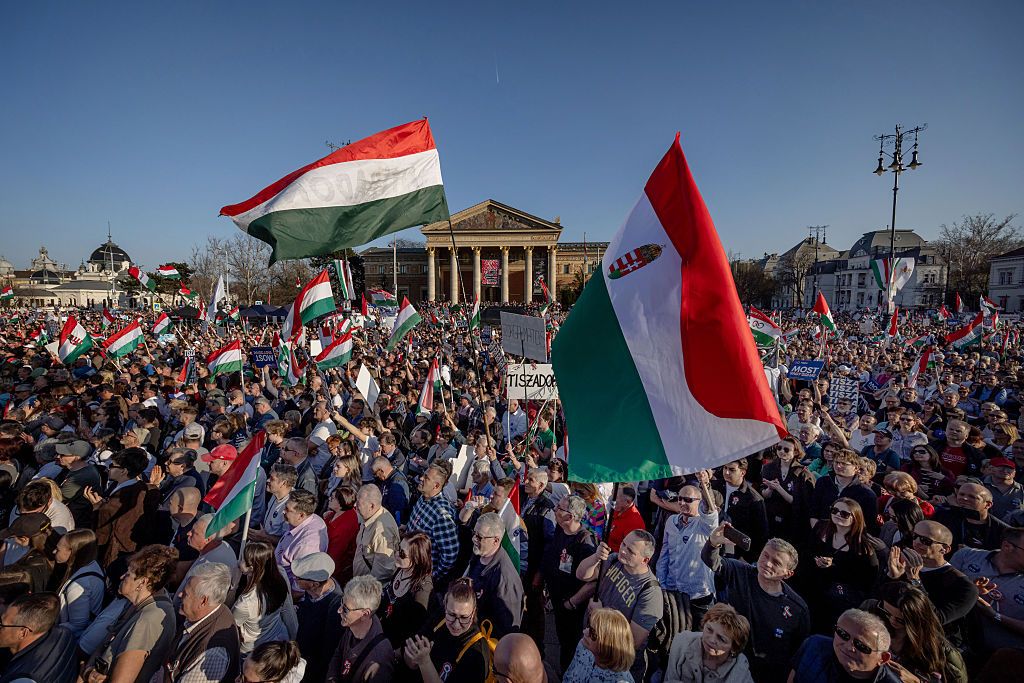
Budapest rallies highlight Hungary’s divide over Ukraine, Europe before April vote
#Hungary #Budapest rallies #Ukraine #European Union #April elections #Viktor Orbán #political divide
📌 Key Takeaways
- Massive rallies in Budapest reflect deep political divisions in Hungary ahead of April elections.
- The protests center on Hungary's stance toward Ukraine and its relationship with the European Union.
- Pro-government and opposition groups are mobilizing supporters, highlighting polarized views on foreign policy and national identity.
- The upcoming vote is seen as a critical test for Prime Minister Viktor Orbán's leadership and Hungary's future direction in Europe.
📖 Full Retelling
🏷️ Themes
Political polarization, Foreign policy
📚 Related People & Topics

Ukraine
Country in Eastern Europe
# Ukraine **Ukraine** is a country located in Eastern Europe. It is the second-largest country in Europe by area, after Russia. Known for its extensive fertile plains, the nation serves as a critical global exporter of grain and is considered a middle power in international affairs. ## Geography a...

European Union
Supranational political and economic union
The European Union (EU) is a supranational political and economic union of 27 member states that are located primarily in Europe. The union has a total area of 4,233,255 km2 (1,634,469 sq mi) and an estimated population of more than 450 million as of 2025. The EU is often described as a sui generis ...

Hungary
Country in Central Europe
Hungary is a landlocked country in Central Europe. Spanning much of the Carpathian Basin, it is bordered by Slovakia to the north, Ukraine to the northeast, Romania to the east and southeast, Serbia to the south, Croatia and Slovenia to the southwest, and Austria to the west. Hungary lies within the...
Entity Intersection Graph
Connections for Ukraine:
Mentioned Entities
Deep Analysis
Why It Matters
This news matters because it reveals deep political and ideological divisions within Hungary that could influence the country's foreign policy direction and European Union alignment. The upcoming April vote will determine whether Hungary continues its current trajectory of Euroscepticism and close ties with Russia or shifts toward stronger EU integration and support for Ukraine. The outcome affects not only Hungary's 9.7 million citizens but also EU unity, NATO's eastern flank security, and Ukraine's ability to withstand Russian aggression. These divisions highlight the broader struggle between nationalist sovereignty movements and pan-European cooperation across the continent.
Context & Background
- Hungary has been governed by Prime Minister Viktor Orbán and his Fidesz party since 2010, pursuing what Orbán calls 'illiberal democracy'
- Hungary has maintained closer ties with Russia than most EU/NATO members, blocking or delaying EU aid to Ukraine and opposing sanctions against Russia
- Hungary joined the European Union in 2004 but has frequently clashed with EU institutions over rule of law, migration, and democratic standards
- The country receives significant EU funding (approximately 5% of GDP annually) while criticizing EU policies and institutions
- Previous Hungarian elections in 2018 and 2022 resulted in Fidesz supermajorities, though opposition parties united in 2022 to present a stronger challenge
What Happens Next
The April 2024 parliamentary elections will determine Hungary's political direction for the next four years. If Fidesz maintains power, expect continued tensions with EU institutions, potential withholding of EU funds, and sustained resistance to Ukraine support measures. If opposition parties gain power, anticipate rapid policy shifts toward EU alignment, support for Ukraine, and attempts to unlock frozen EU recovery funds. Post-election, either outcome will trigger immediate reactions from Brussels regarding rule of law conditionality and from Kyiv regarding diplomatic relations.
Frequently Asked Questions
Hungary's stance matters because EU decisions often require unanimity on foreign policy matters, allowing Hungary to block or delay crucial aid packages and sanctions against Russia. As a NATO member on Ukraine's western border, Hungary's cooperation is essential for military and humanitarian support logistics. The country's position also influences other EU members with similar reservations about supporting Ukraine.
Voters are divided between nationalist sovereignty versus European integration, economic dependence on EU funds versus political independence, and maintaining energy ties with Russia versus supporting Ukraine. Urban-rural divides are significant, with Budapest typically more pro-European while rural areas strongly support Orbán's nationalist agenda. Younger voters also show different priorities than older generations who lived under communist rule.
A Fidesz victory would likely continue current tensions, with the EU possibly implementing further financial restrictions and Article 7 proceedings regarding rule of law violations. An opposition victory would prompt rapid normalization, with Hungary likely regaining access to frozen EU funds and becoming more cooperative on EU-wide initiatives. Either outcome will significantly impact the EU's internal cohesion and ability to respond collectively to external challenges.
The rallies serve as visible demonstrations of political mobilization, energizing both government supporters and opposition voters ahead of the election. They provide media coverage that shapes public perception of which side has momentum and popular support. The rallies also internationalize Hungary's political debate, drawing attention from European and global media to the country's political divisions.
International observers have expressed concerns about electoral fairness due to government control over media, electoral law changes favoring the ruling party, and uneven campaign resource distribution. While voting procedures themselves are generally properly conducted, the pre-election environment is criticized as not providing equal opportunity for all parties. These concerns have led to tensions with EU institutions monitoring democratic standards.