📖 Full Retelling
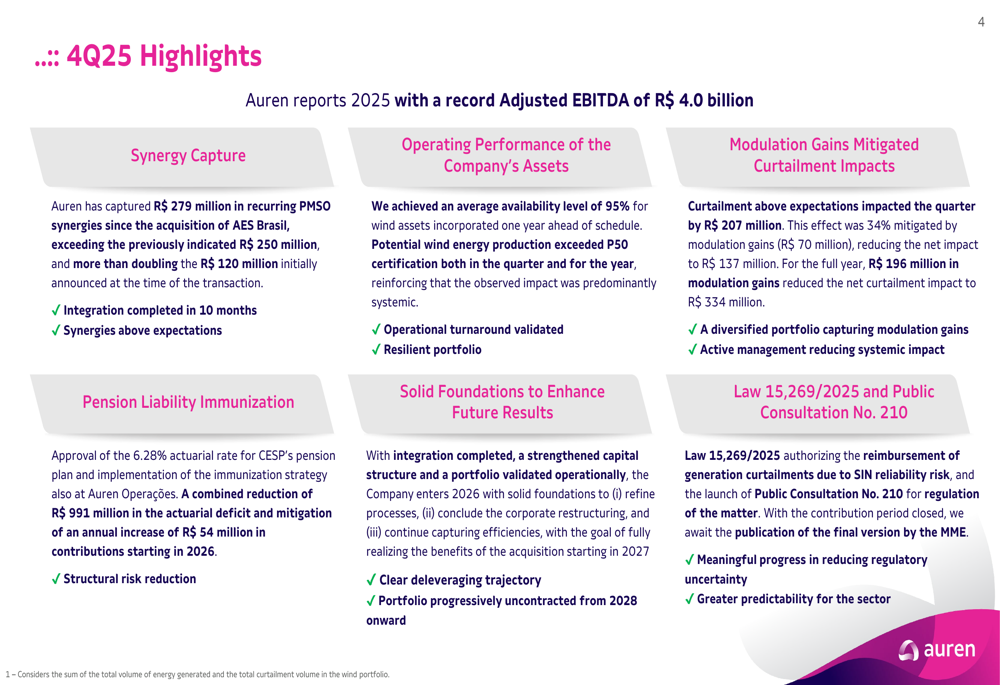
Auren Energia SA (BVMF:AURE3), the Brazilian power generator, presented its fourth quarter 2025 results on March 4, 2026, showcasing a record adjusted EBITDA of R$ 4.0 billion for the full year despite challenging market conditions and adverse hydrological conditions affecting Brazil's National Interconnected System. The company's stock rose 3.37% to R$ 11.56 following the announcement as investors responded positively to operational achievements and accelerated deleveraging. Auren highlighted the successful completion of the AES Brasil integration in just 10 months, capturing R$ 279 million in recurring synergies—exceeding the initial R$ 250 million target by 11.6%. This performance came against a backdrop of Brazil's National Interconnected System experiencing its third-worst quarterly performance on record due to unfavorable hydrological conditions. In the fourth quarter specifically, Auren reported adjusted EBITDA of R$ 1.0 billion, representing a 13% increase compared to the same period in 2024. Net revenue reached R$ 3.8 billion in the generation segment, up 6% year-over-year, while the commercialization segment posted R$ 1.0 billion, a 13% increase. For the full year 2025, generation revenue totaled R$ 13.2 billion (+17%) and commercialization reached R$ 4.0 billion (+20%). The company achieved a significant milestone in wind asset performance, reaching an average availability level of 95% for assets acquired from AES Brasil—one year ahead of schedule, representing an 11 percentage point improvement compared to the 2024 average. Auren's diversified asset portfolio demonstrated resilience during the challenging quarter, with a composition of 57% hydro, 37% wind, and 6% solar providing strategic flexibility. Hydroelectric assets maintained 95% availability versus ANEEL's 93% reference, though dispatch declined 11% due to unfavorable conditions. Wind assets achieved 94% availability (up from 92% in 4Q24), with potential production reaching 102% of P50 certification. Despite strong operational performance, the company faced significant curtailment challenges, with wind power curtailment reaching 23% and solar 22% across the National Interconnected System. The impact on Auren totaled R$ 207 million in the quarter, though the company's diversified portfolio enabled R$ 70 million in modulation gains, reducing the net curtailment impact to R$ 137 million (34% mitigation). Financially, Auren made substantial progress on balance sheet optimization, with net debt-to-EBITDA leverage improving from 5.7x in December 2024 to 4.8x in December 2025—a 0.9x reduction. Gross debt declined from R$ 27.0 billion to R$ 24.5 billion over the same period, while the cost of debt improved significantly to CDI-2.8%, a 210 basis point reduction. Looking ahead, Auren entered 2026 with 89% of its generation portfolio contracted, declining to 68% by 2030 as existing contracts expire, positioning the company to benefit from higher expected energy prices. The company is pursuing strategic initiatives including corporate structure simplification, pension liability immunization, and Zero-Based Budgeting processes to maintain growth in recurring expenses below inflation, while expecting regulatory resolution in 2026 to provide greater market predictability.
📚 Related People & Topics
Accounting measure of a company's profitability
Earnings before interest, taxes, depreciation, and amortization, commonly known as EBITDA ( EE-bit-dah, EB-it-dah), is a measure of a company's profitability of the operating business only, thus before any effects of indebtedness, state-mandated payments, and costs required to maintain its asset bas...

Obligation to pay borrowed money
Debt is an obligation that requires one party, the debtor, to pay money borrowed or otherwise withheld from another party, the creditor. Debt may be owed by a sovereign state or country, local government, company, or an individual. Commercial debt is generally subject to contractual terms regarding ...