
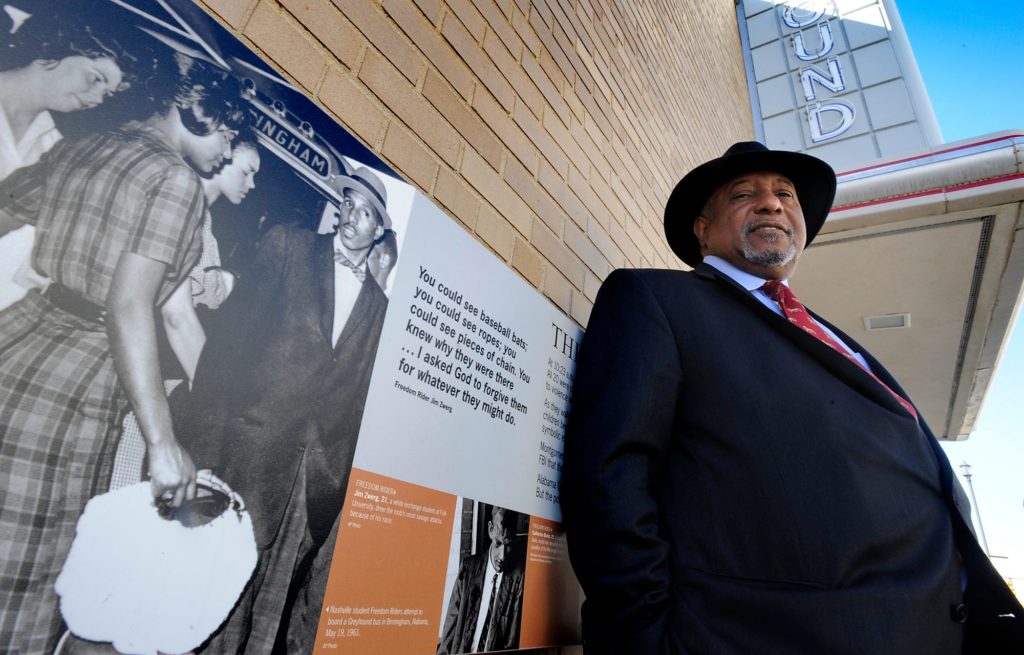
Bernard LaFayette, Freedom Rider and Selma voting rights organizer, dies at 85
#Bernard LaFayette #Freedom Rider #Selma #voting rights #civil rights #nonviolence #activist #obituary
📌 Key Takeaways
- Bernard LaFayette, a prominent civil rights activist, has died at age 85.
- He was a Freedom Rider, participating in nonviolent protests against segregation in the 1960s.
- LaFayette played a key role in organizing the Selma voting rights movement in Alabama.
- His work contributed significantly to the passage of the Voting Rights Act of 1965.
- He continued advocating for social justice and nonviolence throughout his life.
📖 Full Retelling
🏷️ Themes
Civil Rights, Activism, History
📚 Related People & Topics

Freedom Riders
American civil rights activists of the 1960s
Freedom Riders were civil rights activists who rode interstate buses into the segregated Southern United States in 1961 and subsequent years to challenge the non-enforcement of the United States Supreme Court decisions Morgan v. Virginia (1946) and Boynton v. Virginia (1960), which ruled that segreg...

Bernard Lafayette
American civil rights activist (1940–2026)
Bernard Lafayette (or LaFayette) Jr. (; July 29, 1940 – March 5, 2026) is an American civil rights activist, organizer, and Baptist minister, who was a leader in the Civil Rights Movement. He played a leading role in early organizing of the Selma Voting Rights Movement; was a member of the Nashville...
Entity Intersection Graph
Connections for Selma:
Mentioned Entities
Deep Analysis
Why It Matters
Bernard LaFayette’s death marks the passing of a pivotal figure whose quiet but strategic leadership laid the foundation for landmark civil rights victories like the Voting Rights Act of 1965. His role in Selma and broader activism underscores the enduring legacy of nonviolent resistance in dismantling systemic oppression, making his contributions essential to understanding modern democratic progress and ongoing struggles for racial justice.
Context & Background
- LaFayette’s early work as a Freedom Rider (1960–1961) demonstrated how grassroots organizing could force compliance with federal desegregation mandates despite violent backlash.
- His leadership in Alabama’s voter registration campaign (1963–1965), despite extreme risks like assassination attempts, built local capacity to sustain political pressure for voting rights reforms.
- The Selma-to-Montgomery marches—particularly Bloody Sunday (March 7, 1965)—were catalyzers, but LaFayette’s pre-marche groundwork in Selma ensured the movement’s momentum persisted beyond symbolic events.
- Beyond civil rights, his later work in Chicago and Latin America expanded nonviolent strategies to address poverty, tenant rights, and systemic inequality through institutionalized activism.
What Happens Next
LaFayette’s death will prompt commemorations at sites tied to his activism—such as Selma’s Edmund Pettus Bridge, the Lorraine Motel (where MLK was assassinated), and Nashville’s civil rights landmarks. His memoir *In Peace and Freedom* remains a critical resource for scholars studying nonviolent resistance, likely inspiring future activists in voting rights and social justice movements.
Frequently Asked Questions
LaFayette was the advance organizer for SNCC’s voter registration campaign in Selma, Alabama. He identified risks, recruited local leaders, and navigated hostile environments—including assassination plots—to build momentum that sustained the movement until Bloody Sunday and Congress’s passage of the Voting Rights Act.
His childhood witnessing racial violence (e.g., his grandmother’s trolley incident) and later Freedom Ride beatings instilled an internalized commitment to nonviolence as a tool for moral persuasion. He wrote that confronting attackers’ eyes ‘won that person over,’ prioritizing spiritual transformation over physical retaliation.
After King’s assassination, he coordinated the Poor People’s Campaign (1968), later served as a global nonviolence trainer in Africa and Latin America, and helped establish lead-poisoning screening programs in Chicago. His focus expanded from civil rights to economic justice, tenant protections, and institutionalizing nonviolent strategies.
His work highlights how decentralized organizing—often behind the scenes—can outlast media-driven events. His emphasis on local leadership and nonviolence remains relevant in debates over voting rights erosion (e.g., post-* Shelby County v. Holder*), voter suppression, and systemic inequality.