
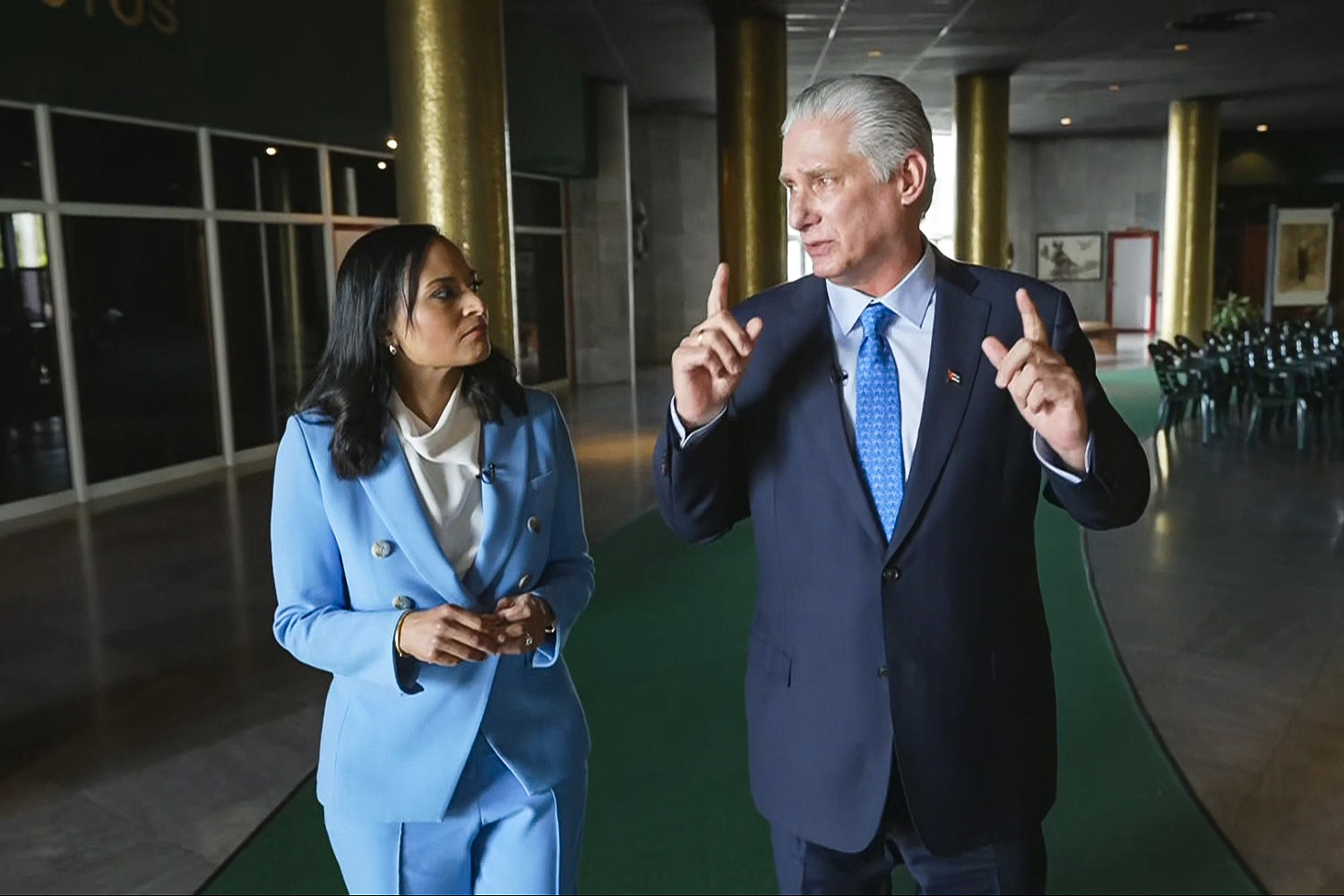
Cuba's president says he's 'not stepping down' under U.S. pressure
#Cuba #Miguel Díaz-Canel #US-Cuba relations #sanctions #sovereignty #NBC News #Havana
📌 Key Takeaways
- Cuban President Díaz-Canel publicly refuses to resign under U.S. pressure.
- The statement was made during an interview with NBC News in Havana.
- He positions the refusal as a defense of national sovereignty.
- The remarks come amid ongoing economic crisis and U.S. sanctions on Cuba.
📖 Full Retelling
🏷️ Themes
Geopolitics, Sovereignty, Diplomacy
📚 Related People & Topics

Cuba
Country in the Caribbean
Cuba, officially the Republic of Cuba, is an island country in the Caribbean. It comprises the eponymous main island as well as 4,195 islands, islets, and cays. Situated at the convergence of the Caribbean Sea, Gulf of Mexico, and Atlantic Ocean, Cuba is located east of the Yucatán Peninsula, south ...

Havana
Capital and largest city of Cuba
Havana (, US also ; Spanish: La Habana [la‿aˈβana] ) is the capital and largest city of Cuba. The heart of La Habana Province, Havana is the country's main port and commercial center. It is the most populous city, the largest by area, and the second-largest metropolitan area in the Caribbean region.

NBC News
News division of NBCUniversal
# NBC News **NBC News** is the news division of the American terrestrial broadcast television network **NBC**. Headquartered at 30 Rockefeller Plaza in New York City, it is a primary arm of the **NBCUniversal News Group**, a subsidiary of **Comcast**. ## Corporate Overview NBC News operates under ...
Entity Intersection Graph
Connections for Cuba:
Mentioned Entities
Deep Analysis
Why It Matters
This declaration underscores the deep-seated ideological deadlock between the U.S. and Cuba, suggesting that the current approach of sanctions and criticism is unlikely to result in regime change or policy shifts. It matters directly to the Cuban population, who continue to face severe economic shortages and mass migration, as the government's refusal to yield to external pressure means the status quo will likely persist. Furthermore, it signals to the international community that Cuba remains steadfast in its sovereignty despite internal turmoil, complicating future diplomatic engagement efforts.
Context & Background
- The U.S. has maintained a trade embargo against Cuba since the early 1960s, which the Cuban government refers to as a 'blockade'.
- Diplomatic relations were restored under the Obama administration in 2015 but deteriorated significantly under the Trump administration.
- Miguel Díaz-Canel became president in 2018, marking the first time since the 1959 revolution that a non-Castro led the country.
- Cuba is currently facing its worst economic crisis in decades, driven by the COVID-19 pandemic, inflation, and tightened U.S. sanctions.
- Recent years have seen record levels of emigration from Cuba to the United States, straining resources at the U.S.-Mexico border.
What Happens Next
The diplomatic stalemate is expected to continue, with the U.S. maintaining sanctions and Cuba blaming the U.S. for its economic failures. Migration flows from Cuba to the U.S. will likely remain high as the economic situation on the island shows no signs of immediate improvement. Significant policy changes from either side are unlikely before the upcoming U.S. presidential election.
Frequently Asked Questions
He likely sought to push back against U.S. criticism and reinforce his government's legitimacy amidst a severe economic crisis. By addressing a U.S. audience directly, he aims to shift the narrative regarding the causes of the island's hardships.
Relations remain tense and stagnant, with the U.S. maintaining the embargo and criticizing Cuba's human rights record. The Biden administration has kept many of the hardline policies put in place by the previous administration.
He blamed external factors, specifically the U.S. 'blockade' and political hostility, for the shortages of basic goods and the economic downturn. He rejected the idea that internal policy or the single-party system is responsible.