
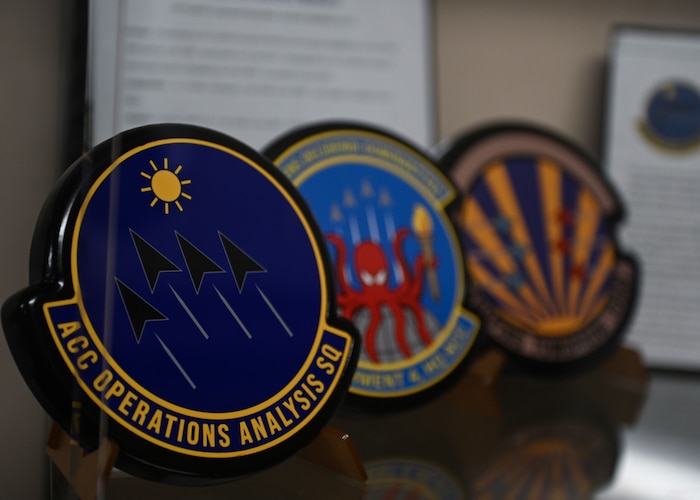
Decision advantages formed by ACC’s Operations Analysis Squadron
#ACC #Operations Analysis Squadron #decision advantages #data analysis #Air Combat Command #strategic planning #military operations
📌 Key Takeaways
- The ACC's Operations Analysis Squadron develops decision advantages through data analysis.
- The squadron focuses on enhancing operational effectiveness and strategic planning.
- It employs advanced analytical techniques to support Air Combat Command missions.
- The unit's work aims to provide commanders with actionable insights for decision-making.
📖 Full Retelling
🏷️ Themes
Military Analysis, Operational Strategy
📚 Related People & Topics

Air Combat Command
Major command of the US Air Force
The Air Combat Command (ACC) is one of nine major commands (MAJCOMs) in the United States Air Force, reporting to Headquarters, United States Air Force (HAF) at the Pentagon. It is the primary provider of air combat forces for the Air Force, and it is the direct successor to Tactical Air Command. Ai...
Entity Intersection Graph
No entity connections available yet for this article.
Mentioned Entities
Deep Analysis
Why It Matters
This news matters because it highlights how the U.S. Air Combat Command (ACC) is enhancing its operational effectiveness through data-driven decision-making, which directly impacts national security and military readiness. It affects military strategists, defense analysts, and allied forces who rely on accurate intelligence and predictive analytics for mission planning. The development of decision advantages through specialized squadrons could influence future combat operations, resource allocation, and technological investments in defense systems.
Context & Background
- The U.S. Air Combat Command (ACC) is responsible for organizing, training, and equipping combat-ready forces for air, space, and cyberspace operations.
- Operations Analysis Squadrons (OAS) have historically played a key role in military strategy by using statistical and mathematical models to evaluate combat effectiveness and optimize resources.
- The concept of 'decision advantage' refers to the ability to make faster, more informed decisions than adversaries, a critical element in modern warfare where information superiority is paramount.
- Recent advancements in artificial intelligence, big data analytics, and machine learning have transformed how military operations are analyzed and planned.
- The ACC has been increasingly focusing on integrating data analytics into its command and control structures to maintain a competitive edge against near-peer adversaries like China and Russia.
What Happens Next
The ACC will likely expand the role of its Operations Analysis Squadron, integrating more advanced AI and machine learning tools into its decision-making processes. Upcoming developments may include increased collaboration with private-sector tech companies, joint exercises with allied forces to test new analytical models, and potential congressional hearings on funding for advanced military analytics programs. The squadron's findings could influence future procurement decisions for next-generation aircraft and defense systems.
Frequently Asked Questions
An Operations Analysis Squadron is a specialized military unit that uses mathematical, statistical, and computational methods to analyze combat operations, optimize resource allocation, and improve decision-making processes. It helps commanders evaluate the effectiveness of strategies and technologies in simulated and real-world scenarios.
Decision advantage allows military forces to process information faster and more accurately than adversaries, enabling quicker responses to threats and more effective mission planning. This capability is crucial in high-stakes environments where delays or errors in judgment can have significant strategic consequences.
The ACC is emphasizing data-driven decision-making to maintain a competitive edge against technologically advanced adversaries like China and Russia. With the increasing complexity of modern warfare, leveraging analytics and AI helps optimize operations, reduce risks, and enhance overall combat readiness.
The squadron likely employs advanced technologies such as artificial intelligence, machine learning algorithms, big data analytics, and simulation software. These tools help model combat scenarios, predict outcomes, and identify optimal strategies for mission success.
This development could lead to increased scrutiny from rival nations, who may accelerate their own analytics programs to keep pace. It may also foster deeper collaboration with allied forces, as shared data and analytical frameworks could enhance joint operations and strategic coordination.