
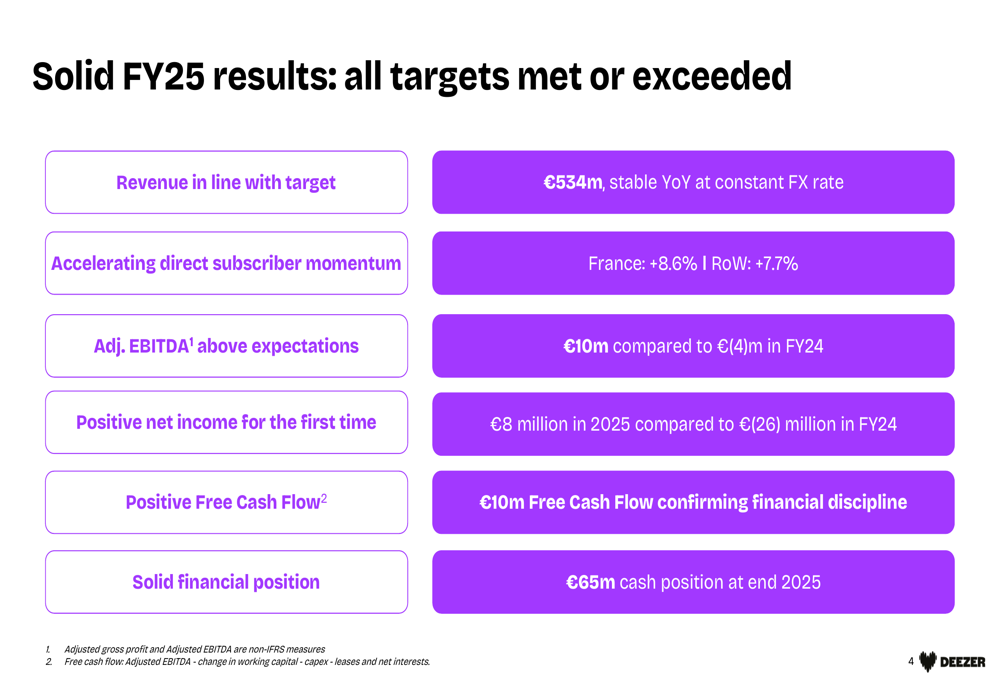
Deezer FY 2025 slides: first profitable year with AI focus
#Deezer #FY 2025 #profitable #AI #financial slides #streaming #earnings
📌 Key Takeaways
- Deezer achieved its first profitable year in FY 2025.
- The company's financial success is linked to a strategic focus on AI.
- AI initiatives played a key role in driving profitability.
- The results were highlighted in Deezer's FY 2025 financial slides.
🏷️ Themes
Profitability, AI Strategy
📚 Related People & Topics

Artificial intelligence
Intelligence of machines
# Artificial Intelligence (AI) **Artificial Intelligence (AI)** is a specialized field of computer science dedicated to the development and study of computational systems capable of performing tasks typically associated with human intelligence. These tasks include learning, reasoning, problem-solvi...
Deezer
French audio streaming service
Deezer is a French music streaming service and media service provider founded in 2007 that provides users with access to a vast library of music tracks, podcasts, and radio stations. It offers streaming services in over 180 countries and features a catalog of more than 120 million licensed tracks, w...
Entity Intersection Graph
Connections for Artificial intelligence:
Mentioned Entities
Deep Analysis
Why It Matters
Deezer achieving its first profitable year marks a significant milestone in the competitive music streaming industry, demonstrating that smaller platforms can reach financial sustainability against giants like Spotify and Apple Music. This matters to investors and the broader tech sector as it shows AI-driven strategies can deliver tangible business results beyond user growth metrics. For artists and labels, Deezer's success with AI curation could influence how streaming platforms develop discovery algorithms and revenue distribution models. Consumers may benefit from more personalized music experiences if Deezer's AI innovations prove successful and are adopted industry-wide.
Context & Background
- Deezer was founded in 2007 and has historically operated at a loss while competing in a market dominated by Spotify (45% market share) and Apple Music
- The music streaming industry has seen consolidation with smaller players like Tidal being acquired and Pandora restructuring, making independent profitability rare
- Deezer previously attempted a public listing in 2015 but withdrew, then went public via SPAC merger in 2022 amid challenging market conditions
- The company has invested heavily in AI and machine learning for music recommendation since at least 2018 with their 'Flow' feature
- Streaming platforms face pressure from artists and labels demanding better compensation models, with Deezer implementing 'artist-centric' payment systems in 2023
What Happens Next
Deezer will likely expand its AI-powered features throughout 2025, potentially launching new subscription tiers or bundled services. The company may pursue strategic partnerships or acquisitions to strengthen its AI capabilities and market position. Investors will watch Q1 2026 earnings closely to see if profitability is sustainable, which could influence stock performance and potential M&A activity. Competitors like Spotify and YouTube Music may accelerate their own AI investments in response to Deezer's demonstrated success.
Frequently Asked Questions
Deezer's profitability likely resulted from combining AI-driven cost optimization with strategic pricing adjustments and operational efficiencies. Their focus on high-margin markets and reduced customer acquisition costs through better retention algorithms contributed significantly. The 'artist-centric' payment model may have also improved relationships with content providers while controlling royalty expenses.
Deezer's 'Flow' personalized radio and AI recommendation engine likely increased user engagement and reduced churn, lowering customer acquisition costs. AI-powered content moderation and curation reduced operational expenses while improving user experience. Their machine learning algorithms for royalty calculation and fraud detection probably helped optimize payment flows to rights holders.
Deezer may maintain current pricing while introducing premium AI features at higher tiers rather than across-the-board price increases. The profitability could actually stabilize pricing by reducing pressure to constantly raise rates to cover losses. However, if competitors follow Deezer's AI investments, industry-wide price adjustments for enhanced features are possible in 2026.
Profitability gives Deezer stronger negotiating power with investors and content partners, though it remains significantly smaller in user base. The AI success could position Deezer as an innovation leader in personalization rather than competing on scale alone. This may attract niche audiences dissatisfied with mainstream platforms' recommendation algorithms.
Deezer must maintain its AI advantage as larger competitors invest heavily in similar technologies with greater resources. Changing royalty structures and regulatory pressures in key markets like Europe could impact their cost structure. The company remains vulnerable to economic downturns that might reduce discretionary spending on entertainment subscriptions.