
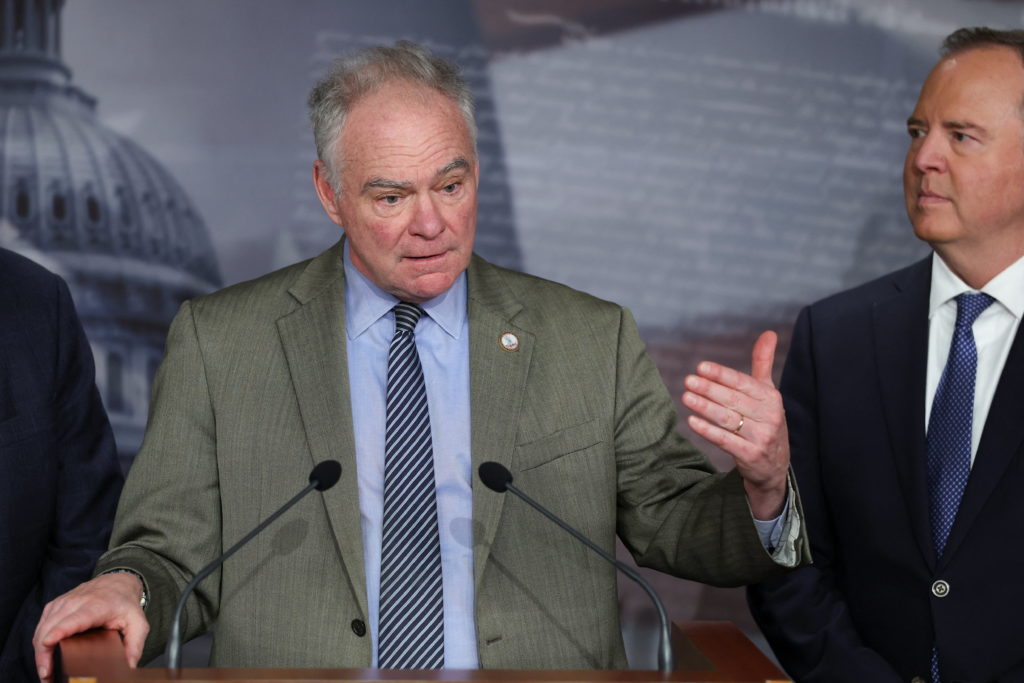
Democratic senators file war powers resolution to check Trump on Cuba
#Democratic senators #war powers resolution #Trump #Cuba #military actions #congressional oversight #foreign policy
📌 Key Takeaways
- Democratic senators introduced a war powers resolution to limit President Trump's military actions in Cuba.
- The resolution aims to prevent unauthorized escalation of military involvement in Cuba.
- It reflects ongoing congressional efforts to assert oversight over executive war powers.
- The move is part of broader tensions between Congress and the Trump administration on foreign policy.
📖 Full Retelling
🏷️ Themes
War Powers, Cuba Policy
📚 Related People & Topics

Cuba
Country in the Caribbean
Cuba, officially the Republic of Cuba, is an island country in the Caribbean. It comprises the eponymous main island as well as 4,195 islands, islets, and cays. Situated at the convergence of the Caribbean Sea, Gulf of Mexico, and Atlantic Ocean, Cuba is located east of the Yucatán Peninsula, south ...

Donald Trump
President of the United States (2017–2021; since 2025)
Donald John Trump (born June 14, 1946) is an American politician, media personality, and businessman who is the 47th president of the United States. A member of the Republican Party, he served as the 45th president from 2017 to 2021. Born into a wealthy New York City family, Trump graduated from the...
Entity Intersection Graph
Connections for Cuba:
Mentioned Entities
Deep Analysis
Why It Matters
This resolution matters because it represents a significant legislative challenge to presidential authority over military actions, specifically regarding Cuba policy. It affects U.S.-Cuba relations, military families who could be deployed, and Cuban citizens who might face consequences of escalated tensions. The move highlights ongoing congressional efforts to reclaim war powers authority that has shifted to the executive branch over decades, potentially setting important precedents for future administrations.
Context & Background
- The War Powers Resolution of 1973 was passed to check presidential power after controversial military actions in Vietnam and Cambodia without congressional approval.
- U.S.-Cuba relations have been strained since the 1959 Cuban Revolution, with periods of heightened tension including the 1961 Bay of Pigs invasion and 1962 Cuban Missile Crisis.
- The Trump administration reversed Obama-era normalization efforts, reinstating travel restrictions and sanctions against Cuba in 2017-2019.
- Congress has been increasingly asserting war powers authority in recent years, with similar resolutions regarding Yemen, Iran, and Syria.
What Happens Next
The resolution will move through committee hearings where administration officials will likely testify. A Senate vote could occur within weeks, though passage faces challenges in the Republican-controlled chamber. Regardless of outcome, this will influence ongoing negotiations over the National Defense Authorization Act and may prompt similar House resolutions. The debate will likely intensify as the 2020 election approaches.
Frequently Asked Questions
The resolution would require the president to seek congressional authorization before taking military action against Cuba, except in cases of immediate national emergency. It represents a legislative check on executive war-making powers specifically regarding Cuba policy.
Cuba represents a longstanding foreign policy challenge where presidential authority has historically been expansive. Democrats are concerned about escalating rhetoric and actions from the Trump administration that could lead to military confrontation without proper congressional oversight.
Yes, Congress passed a war powers resolution regarding Yemen in 2019 with bipartisan support, though it was vetoed by President Trump. These resolutions have gained traction as lawmakers seek to reassert constitutional authority over military engagements.
The resolution faces significant hurdles in the Republican-controlled Senate and would likely face a presidential veto if passed. However, it could influence policy through political pressure and set important precedents for future congressional actions.
This affects Americans by potentially preventing unauthorized military engagements that could lead to casualties, increased defense spending, and regional instability. It also impacts Cuban-Americans with family connections to Cuba and businesses affected by Cuba policy changes.