
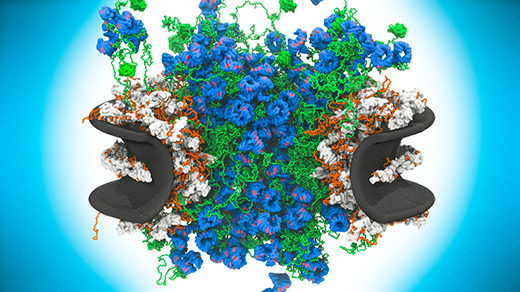
Disorder Drives One of Nature’s Most Complex Machines
#nuclear pore #DNA #evolution #microscopy #protein disorder #molecular transport #cell nucleus
📌 Key Takeaways
- Nuclear pores are complex structures that regulate molecular transport between the nucleus and cytoplasm.
- Disorder in the proteins forming nuclear pores is essential for their flexible and selective function.
- These pores evolved early in complex life to protect and manage DNA within the nucleus.
- Advanced microscopy revealed the intricate design and critical role of nuclear pores in cellular processes.
📖 Full Retelling
🏷️ Themes
Cellular Biology, Evolution
📚 Related People & Topics

DNA
Molecule that carries genetic information
Deoxyribonucleic acid (; DNA) is a polymer composed of two polynucleotide chains that coil around each other to form a double helix. The polymer carries genetic instructions for the development, functioning, growth and reproduction of all known organisms and many viruses. DNA and ribonucleic acid (R...
Entity Intersection Graph
No entity connections available yet for this article.
Mentioned Entities
Deep Analysis
Why It Matters
This research matters because it reveals fundamental principles about how life's most complex molecular machines function, challenging long-held assumptions about biological order. It affects scientists across cell biology, biophysics, and evolutionary biology who study cellular organization and transport mechanisms. The findings could influence future research into diseases related to nuclear transport defects and inspire new approaches to nanotechnology by demonstrating how disorder can enable sophisticated functionality.
Context & Background
- Nuclear pores are massive protein complexes that regulate all traffic between the nucleus and cytoplasm, controlling gene expression and cellular function
- For decades, scientists assumed these structures operated through precise, ordered arrangements of their component proteins
- The discovery challenges the paradigm that biological complexity requires precise structural order, suggesting instead that controlled disorder enables adaptability
- Nuclear pores evolved early in eukaryotic life and are conserved across all complex organisms, indicating their fundamental importance
What Happens Next
Researchers will likely investigate how this disordered organization enables specific functions like selective transport and signaling. Future studies may examine whether similar principles apply to other complex cellular machines. The findings could lead to new therapeutic approaches targeting nuclear transport in diseases like cancer and viral infections where pathogens hijack these pathways.
Frequently Asked Questions
Nuclear pores are massive protein complexes embedded in the nuclear envelope that act as gatekeepers, controlling all molecular traffic between the nucleus and cytoplasm. They allow essential molecules like RNA and proteins to move in and out while protecting DNA.
Disorder allows nuclear pores to be flexible and adaptable, enabling them to handle diverse cargo sizes and types efficiently. This controlled chaos may provide functional advantages over rigid, perfectly ordered structures in dynamic cellular environments.
It suggests evolution may favor functional disorder over perfect order in some complex systems, challenging assumptions about how biological complexity arises. This reveals new principles about how nature builds sophisticated machines from seemingly chaotic components.
Understanding nuclear pore function could lead to new treatments for diseases involving nuclear transport defects, including certain cancers and viral infections. It may also inspire new nanotechnology approaches that mimic biological systems' use of controlled disorder.
Advances in microscopy and structural biology techniques allowed scientists to observe nuclear pores at unprecedented resolution. Combined with computational modeling, these tools revealed the disordered nature that earlier, less precise methods couldn't detect.