
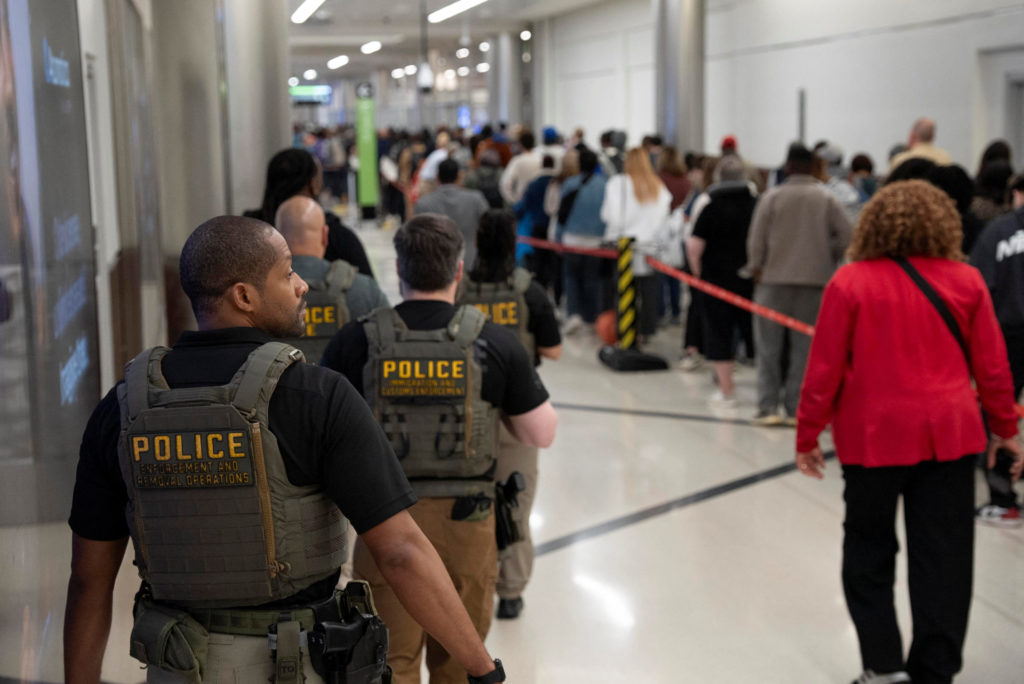
Federal immigration agents deployed to Atlanta airport during partial shutdown
#immigration agents #Atlanta airport #government shutdown #federal deployment #Hartsfield-Jackson
📌 Key Takeaways
- Federal immigration agents were deployed to Atlanta's Hartsfield-Jackson International Airport during a partial government shutdown.
- The deployment occurred amid heightened security concerns or operational needs related to immigration enforcement.
- The action highlights the prioritization of immigration enforcement activities despite the shutdown affecting other government functions.
- Atlanta's airport, a major international hub, was a focal point for this federal immigration operation.
📖 Full Retelling
🏷️ Themes
Immigration Enforcement, Government Shutdown
📚 Related People & Topics

Hartsfield–Jackson Atlanta International Airport
Airport serving Atlanta, Georgia, United States
Hartsfield–Jackson Atlanta International Airport (IATA: ATL, ICAO: KATL, FAA LID: ATL) is the primary international airport serving Atlanta and its surrounding metropolitan area in the U.S. state of Georgia. Located 10 mi (16 km; 8.7 nmi) south of the Downtown Atlanta district, it is named after for...
Entity Intersection Graph
No entity connections available yet for this article.
Mentioned Entities
Deep Analysis
Why It Matters
This deployment matters because it signals the federal government's prioritization of immigration enforcement even during a partial government shutdown, potentially affecting thousands of travelers at one of the world's busiest airports. It impacts international travelers, particularly those with immigration questions or concerns, who may face heightened scrutiny. The move also raises questions about resource allocation during budget crises and could strain local airport operations if agents lack proper coordination with airport authorities.
Context & Background
- Atlanta's Hartsfield-Jackson Airport is the world's busiest passenger airport, handling over 100 million travelers annually
- Federal immigration enforcement has been a politically divisive issue, with recent administrations taking different approaches to border security and interior enforcement
- Government shutdowns typically exempt 'essential' personnel, with law enforcement and national security functions often continuing operations
- Previous shutdowns have seen tensions between federal agencies and local authorities over enforcement priorities and resource constraints
What Happens Next
Travelers should expect increased immigration checks and potential delays at Atlanta airport terminals. Congressional negotiations will likely address funding for immigration enforcement agencies as part of broader shutdown resolution talks. Local officials may seek clarification on the scope and duration of this deployment, potentially leading to intergovernmental discussions about enforcement protocols during budget crises.
Frequently Asked Questions
Immigration enforcement is typically considered an essential government function that continues during shutdowns. The deployment reflects ongoing border security priorities and suggests that immigration enforcement remains funded through alternative mechanisms or prior appropriations.
International travelers may experience additional screening and questioning, potentially causing delays. Domestic travelers likely won't be directly affected unless they encounter secondary screening situations involving immigration status verification.
While Atlanta regularly has immigration officials for international arrivals, additional deployments during shutdowns are noteworthy. The scale and timing suggest either routine contingency planning or a specific enforcement operation targeting the airport's high traffic volume.
Agents retain their standard law enforcement authority for immigration violations. However, their activities may be limited to functions deemed 'essential' under shutdown protocols, potentially excluding certain administrative or processing tasks.
The deployment will likely continue until the partial shutdown ends or until the specific operation concludes. Duration depends on both the political resolution of budget issues and the operational needs identified by immigration authorities.