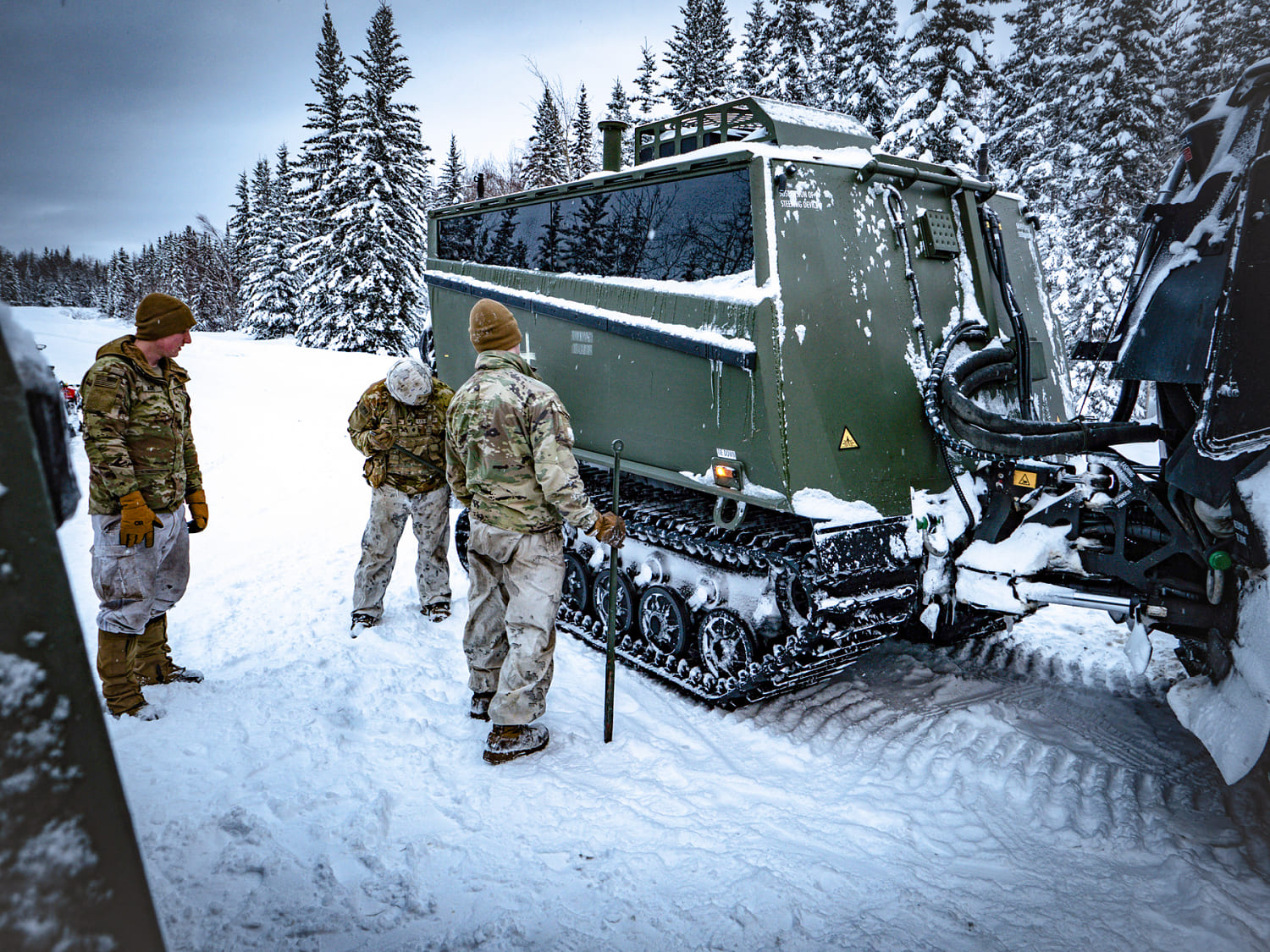
Frostbite and frozen weapons: How U.S. troops train in the Arctic
#Arctic training#11th Airborne Division#Greenland#Military strategy#Climate change#Geopolitical tensions#U.S. national security
📌 Key Takeaways
U.S. troops train in extreme Arctic conditions to prepare for emerging geopolitical threats
The Arctic is becoming a strategic battleground due to melting ice and increasing military activities
Specialized training and equipment are necessary to overcome extreme environmental challenges
U.S. senators express concern about preparedness compared to adversaries
📖 Full Retelling
The 11th Airborne Division's Arctic Angels trained in the Yukon Training Area, Alaska on February 24, 2026, preparing for potential conflicts in the Arctic as President Trump's strategic focus on Greenland and increasing Russian and Chinese military activities transform the region into a global battleground. Temperatures plummeted to 30 degrees below zero, with punishing winds and relentless snow creating an environment where survival itself is a challenge. Major General John Cogbill, commanding general of the 11th Airborne Division, emphasized that everything is harder in the Arctic, where weapons freeze, batteries die faster, and movement becomes significantly more difficult. The troops undergo specialized cold-weather training to develop the skills necessary to operate in these extreme conditions, consuming at least 5,000 calories daily to maintain body heat while constantly monitoring for frostbite, which can develop rapidly from brief skin contact with cold equipment. The U.S. military's renewed focus on Arctic operations comes decades after the Pentagon reportedly 'got amnesia about the strategic importance of Alaska,' as Senator Dan Sullivan noted, while Russia and China have quietly expanded their presence in the region. As the Arctic warms due to climate change, previously inaccessible areas become more navigable, allowing potential adversaries to increase naval and air activities near Alaska, prompting concerns from Alaskan senators like Lisa Murkowski who believe the U.S. needs to 'step up its game' to maintain strategic advantage.
🏷️ Themes
Military preparedness, Geopolitical competition, Climate change impact
Greenland is an autonomous territory of the Kingdom of Denmark and is the largest of the kingdom's three constituent parts by land area, the others being Denmark proper and the Faroe Islands. Citizens of Greenland are citizens of Denmark. They are thus citizens of the European Union (EU), although G...
Present-day climate change includes both global warming—the ongoing increase in global average temperature—and its wider effects on Earth's climate system. Climate change in a broader sense also includes previous long-term changes to Earth's climate. The modern-day rise in global temperatures is dri...
Use of force or threat of war focused for political purposes
Military strategy is a set of ideas implemented by military organizations to pursue desired strategic goals. Derived from the Greek word strategos, the term strategy, when first used during the 18th century, was seen in its narrow sense as the "art of the general", or "the art of arrangement" of tro...
Frostbite and frozen weapons: How U.S. troops train in the Arctic The 11th Airborne Division is based in a region that’s fast becoming a strategic battleground for world powers and has become a global focus as President Trump has pushed for a U.S. takeover of Greenland. Add NBC News to Google How the U.S. military is preparing for growing geopolitical tensions in the Arctic 04:16 Get more news on Share Add NBC News to Google Feb. 24, 2026, 7:04 PM EST By Courtney Kube and Mosheh Gains Listen to this article with a free account 00:00 00:00 YUKON TRAINING AREA, Alaska — Temperatures at 30 degrees below zero. Punishing winds. Relentless snow. And only a few hours of sunlight. Those are the conditions facing the U.S. troops known as the Arctic Angels, who are stationed in a region that is fast becoming a strategic battleground for global powers. President Donald Trump has made the Arctic a focus as he has threatened a U.S. takeover of Greenland, a semiautonomous Danish territory, saying it’s necessary for America’s national security. But since long before then, the U.S., Russia and China have been quietly battling for dominance on one of the world’s only remaining underdeveloped fronts. NBC News joined troops with the Army’s 11th Airborne Division as they trained to guard against possible threats and potential warfare in a remote part of Alaska, where the battle is often one of logistics. “Everything’s harder in the Arctic,” said Maj. Gen. John Cogbill, commanding general of the 11th Airborne Division. Weapons freeze, batteries die faster, and moving around takes much longer. “Just surviving up here is a challenge in and of itself,” Cogbill said. It’s a dramatically different environment from that of the deserts where most of the U.S. military has spent decades. The troops with the 11th Airborne undergo cold-weather training before they are deployed to make sure they can survive the climate. They need to eat at least 5,000 calories a day to survive and are motivated by ...