
SP
BravenNow
G8 Education 2025 slides: occupancy crisis overshadows quality gains
| USA | economy | ✓ Verified - investing.com

G8 Education 2025 slides: occupancy crisis overshadows quality gains

#G8 Education #Occupancy Crisis #Quality Improvements #Financial Results #Early Childhood Education #Market Challenges #Strategic Priorities #ASX:GEM

📌 Key Takeaways

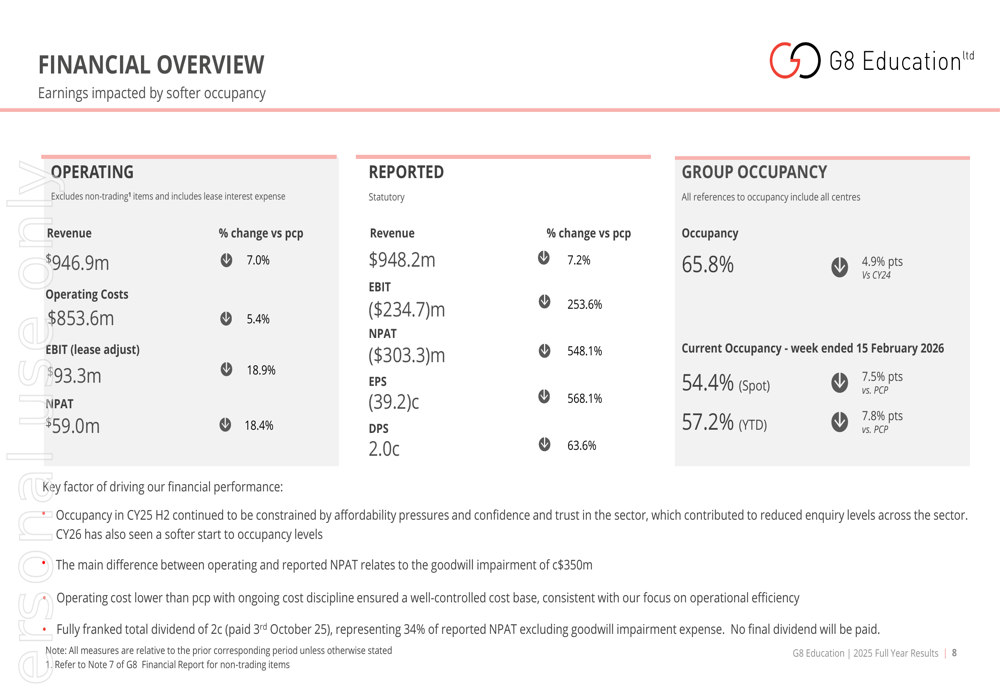
  • G8 Education reported a $303.3 million net loss due to $350 million impairment charge despite 7% revenue growth
  • Occupancy rates collapsed to 65.8%, down 4.9 percentage points year-over-year with current spot at 54.4%
  • Despite occupancy crisis, G8 achieved record Net Promoter Scores and quality ratings above sector average
  • Management focusing on safety, team development and quality education to navigate market challenges

📖 Full Retelling

G8 Education Limited (ASX:GEM), Australia's early childhood education provider, presented its full year 2025 results on February 22, 2026, revealing a company caught between operational excellence and severe market headwinds as plummeting occupancy rates overshadowed improvements in service quality and team retention. The company's stock fell 13.04% to $0.46 following the presentation, reflecting investor concerns over the occupancy crisis despite notable achievements in educational quality. Financially, G8 reported operating revenue of $946.9 million, representing 7.0% growth, while operating EBIT reached $93.3 million with a 9.9% margin. However, the company posted a statutory net loss after tax of $303.3 million, primarily due to a $350 million goodwill impairment charge reflecting deteriorated market conditions. Despite these challenges, G8 maintained strong operating cash flow at $168 million after interest and tax, declared a reduced dividend of 2 cents per share, and executed a share buyback of 38.4 million shares totaling $42.6 million. The occupancy crisis emerged as the most critical challenge facing G8, with group occupancy falling from 70.7% in 2024 to 65.8% in 2025, and current spot occupancy standing at just 54.4%. Western Australia and Victoria experienced the most severe pressures, with year-to-date occupancy declining 7.8 percentage points compared to the prior year. The company attributed this decline to economic headwinds that softened enquiry levels, with affordability pressures and confidence issues constraining families' ability to commit to permanent days. Despite these operational challenges, G8 demonstrated significant improvements in quality metrics, achieving a Net Promoter Score of 53 (up 3 points) and maintaining 95% of centers meeting or exceeding the National Quality Standard, 4 percentage points above the sector average. Team retention also improved to 79%, with Center Manager retention reaching 86% and Early Childhood Teacher retention at 78%. In response to market challenges, G8 implemented strategic measures including divesting 5 centers, surrendering or allowing 6 leases to expire, and opening zero new centers during the year. The company's environmental, social, and governance initiatives showed progress with a dedicated Safety Committee established, inaugural climate disclosure report published, and emissions reduced by 9.4%. Solar installations generated over 1.1 million kWh of power, equivalent to offsetting 758 tonnes of CO2-e. Looking ahead, G8's strategic framework focuses on safety, team development, and quality education, with management acknowledging that earnings remain affected by the operating environment. Current trading conditions continue to challenge the company, with spot occupancy of 54.4% as of February 15, 2026, suggesting persistent pressure in the near term despite the company's operational improvements and quality achievements.

🏷️ Themes

Financial Performance, Educational Quality, Market Challenges, Strategic Management

📚 Related People & Topics

Early childhood education

Early childhood education

Teaching of children from birth to age eight

Early childhood education (ECE), also known as nursery education, is a branch of education theory that relates to the teaching of children (formally and informally) from birth up to the age of eight. Traditionally, this is up to the equivalent of third grade. ECE is described as an important period ...

View Profile → Wikipedia ↗

Entity Intersection Graph

No entity connections available yet for this article.

Deep Analysis

Why It Matters

G8 Education's 2025 results highlight a critical challenge in the early childhood education sector where operational excellence is being overshadowed by severe market pressures. The company's 13% stock drop reflects investor concerns that quality improvements cannot overcome collapsing occupancy rates. This situation illustrates broader affordability issues affecting Australian families and the childcare industry's sustainability.

Context & Background

  • G8 Education Limited (ASX:GEM) reported full-year 2025 results on February 22, 2026
  • Occupancy rates fell sharply to 65.8% in 2025 from 70.7% in 2024, with spot occupancy at 54.4%
  • The company reported a statutory net loss of $303.3 million due to a ~$350 million goodwill impairment
  • Operational metrics showed strength with record Net Promoter Scores of 53 and 95% of centers meeting quality standards

What Happens Next

G8 will continue facing near-term pressure with current spot occupancy at 54.4% indicating further deterioration. The company's focus on cost management and network optimization through center divestments will aim to preserve cash flow. Recovery timing remains uncertain pending improvement in family affordability and economic conditions.

Frequently Asked Questions

What caused G8 Education's occupancy crisis?

Occupancy declined due to economic headwinds softening enquiry levels, affordability pressures limiting family commitments, and the Child Care Subsidy hourly cap impacting frequency.

How did G8 perform on quality metrics despite occupancy issues?

G8 achieved record Net Promoter Scores of 53, with 95% of centers meeting or exceeding National Quality Standards, outperforming the sector average by 4 percentage points.

What was the financial impact of the occupancy decline?

Operating revenue grew 7.0% to $946.9 million, but EBIT margin fell 1.4 percentage points to 9.9%, and a $350 million impairment charge led to a $303.3 million net loss.

Original Source
try{ var _=i o; . if(!_||_&&typeof _==="object"&&_.expiry Bitcoin slips after earlier gains amid tariff volatility Can gold rise to new highs above $5,600 in 2026? Bull vs. bear argument on Friday’s Supreme Court tariff ruling 3 key earnings reports for this week to keep the AI trade alive (South Africa Philippines Nigeria) G8 Education 2025 slides: occupancy crisis overshadows quality gains By Investing.com Company News Published 02/22/2026, 06:39 PM G8 Education 2025 slides: occupancy crisis overshadows quality gains 0 GEM -11.96% Introduction & Market Context G8 Education Limited (ASX:GEM) presented its full year 2025 results on February 22, 2026, revealing a company caught between operational excellence and severe market headwinds. The early childhood education provider’s stock fell 13.04% to $0.46 following the presentation, reflecting investor concerns over plunging occupancy rates that overshadowed improvements in service quality and team retention. The presentation highlighted a stark contrast: while G8 achieved record Net Promoter Scores and industry-leading quality ratings, occupancy collapsed to 65.8%, down 4.9 percentage points year-over-year, with current spot occupancy at just 54.4%. Financial Performance Highlights As shown in the following financial overview, G8’s earnings were significantly impacted by the occupancy decline and a substantial non-cash impairment charge. Operating revenue reached $946.9 million, representing 7.0% growth versus the prior corresponding period, while operating EBIT totaled $93.3 million with a 9.9% margin, down 1.4 percentage points. The company reported a statutory net loss after tax of $303.3 million, driven primarily by a ~$350 million goodwill impairment charge reflecting deteriorated market conditions. The company declared a fully franked total dividend of 2 cents per share, down 63.6% from the prior year, while executing a share buyback of 38.4 million shares totaling $42.6 million. Operating cash flow remained res...
Read full article at source

Source

investing.com

More from USA

News from Other Countries

🇬🇧 United Kingdom

🇺🇦 Ukraine