
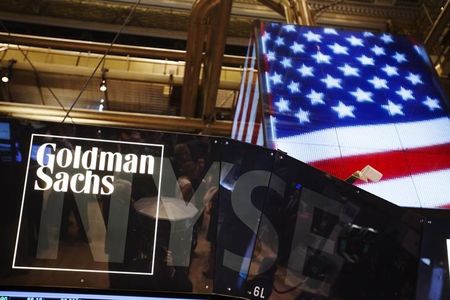
Goldman Sachs sees record algo-driven stock buying ahead
#Goldman Sachs #algorithmic trading #stock market #AI #quantitative analysis #market volatility #institutional investing
📌 Key Takeaways
- Goldman Sachs forecasts record levels of algorithmic stock buying in the near term.
- The surge is driven by AI adoption, institutional capital flows, and advanced trading infrastructure.
- Algorithmic dominance may increase efficiency but also potential systemic volatility.
- Firms with superior data and tech capabilities will gain competitive advantages.
📖 Full Retelling
🏷️ Themes
Financial Markets, Technology, Investment Strategy
📚 Related People & Topics

Goldman Sachs
American investment bank
The Goldman Sachs Group, Inc. ( SAKS) is an American multinational investment bank and financial services company. Founded in 1869, Goldman Sachs is headquartered in Lower Manhattan in New York City, with regional headquarters in many international financial centers.
Artificial intelligence
Intelligence of machines
# Artificial Intelligence (AI) **Artificial Intelligence (AI)** is a specialized field of computer science dedicated to the development and study of computational systems capable of performing tasks typically associated with human intelligence. These tasks include learning, reasoning, problem-solvi...
Entity Intersection Graph
Connections for Goldman Sachs:
Mentioned Entities
Deep Analysis
Why It Matters
This prediction signals a structural transformation in equity markets where automated systems become the primary drivers of price action. It affects institutional investors who must adapt their strategies to compete in a landscape dominated by AI and high-speed computing. Retail investors may face a market environment characterized by rapid, machine-driven price movements that are harder to predict using traditional analysis. Regulators will likely face increased pressure to monitor systemic risks posed by correlated algorithms acting simultaneously. Ultimately, the financialization of advanced technology is reshaping the competitive hierarchy of Wall Street.
Context & Background
- Algorithmic trading has been steadily increasing since the 1980s but accelerated significantly after the decimalization of U.S. markets in 2001.
- The 2010 'Flash Crash' was a critical historical event where automated trading contributed to a rapid and deep market decline, highlighting systemic risks.
- High-frequency trading (HFT) already accounts for a substantial portion of daily trading volume in U.S. equity markets.
- The rise of passive investing (ETFs and indexing) has coincided with the growth of systematic strategies, reducing the market share of traditional active stock pickers.
- Goldman Sachs has historically been a leader in financial technology and quantitative analysis, often setting trends for institutional trading practices.
- Recent breakthroughs in generative AI and large language models have provided new tools for quants to analyze unstructured data like news and social media.
What Happens Next
Over the next year to 18 months, market participants should expect a measurable spike in trading volume originating from non-discretionary strategies. Investment firms will likely engage in an 'arms race' to acquire better data feeds and more powerful computing hardware to train their AI models. Regulatory bodies may increase scrutiny of market stability mechanisms to prevent flash crashes driven by correlated algorithmic behavior. Volatility patterns may shift, potentially becoming more spike-prone during economic shocks as algorithms react instantly to new data.
Frequently Asked Questions
The rise is driven by the sophistication of AI models, increased capital allocation to quantitative hedge funds, and advancements in high-frequency trading infrastructure.
The primary risk is that during periods of market stress, correlated algorithms may execute similar sell-off strategies simultaneously, potentially exacerbating volatility.
This trend represents a move away from discretionary trading, meaning human traders will likely play a smaller role in price discovery and must adapt to working alongside or competing with machines.
Firms that possess superior data access and the computational power to process it in real-time are expected to gain a substantial competitive edge.
Goldman Sachs projects that algorithmic trading volume will reach historic highs within the next 12 to 18 months.