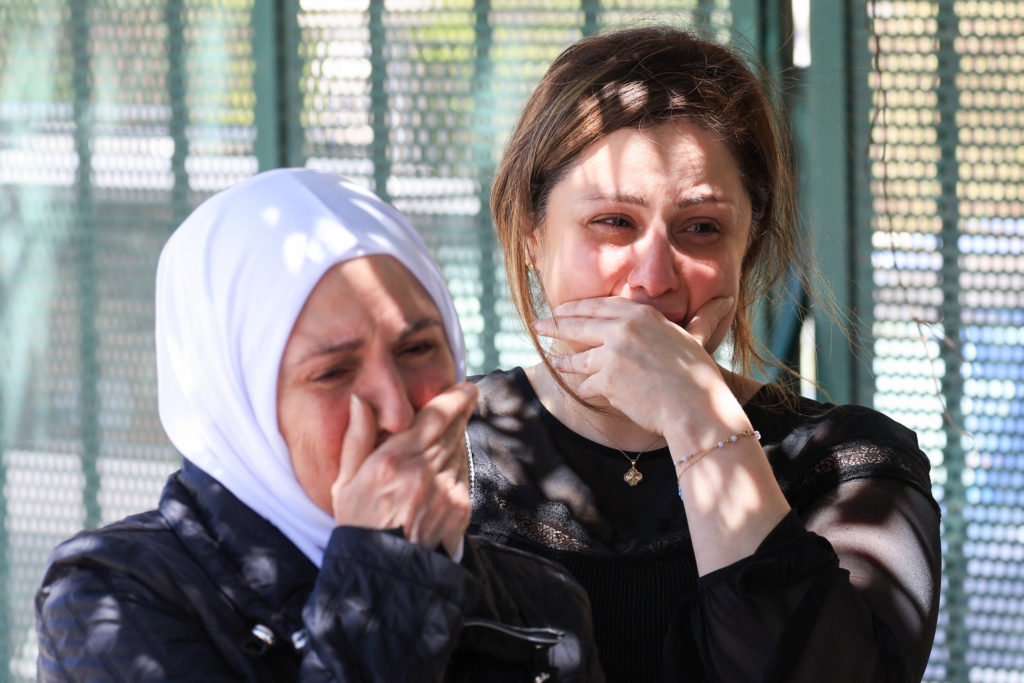
Israeli airstrikes in central Beirut killed at least 182 people, marking the deadliest day in the current Israel-Hezbollah conflict.
Israel justified the attack as a response to Hezbollah rocket fire, stating a recent truce with Iran does not cover its operations against the Lebanese group.
Hezbollah leader Hassan Nasrallah promised a severe retaliation, significantly raising the risk of a broader regional war.
The strikes caused massive civilian casualties and infrastructure damage, overwhelming Beirut's emergency services and hospitals.
The international community, including the UN, condemned the violence and called for immediate de-escalation.
📖 Full Retelling
Israeli airstrikes killed at least 182 people and wounded hundreds more in central Beirut, Lebanon, on Tuesday, in a major escalation that the Israeli military stated was a direct response to Hezbollah rocket attacks, asserting that a recent ceasefire with Iran did not apply to its conflict with the Lebanese militant group. The strikes targeted what Israel described as Hezbollah command centers and weapons depots embedded within civilian areas of the capital, resulting in catastrophic casualties and widespread destruction across several densely populated neighborhoods.
This attack represents the single deadliest day since hostilities between Israel and Hezbollah reignited following the October 7 Hamas-led attack on Israel. Lebanese authorities reported that rescue teams were still searching through rubble for survivors, with the death toll expected to rise. The strikes have plunged Beirut into a state of emergency, overwhelming hospitals and igniting fears of a broader regional war. Hezbollah leader Hassan Nasrallah vowed a 'severe and unprecedented' response in a televised address, raising the specter of further escalation.
The Israeli military's justification centered on preempting what it called an imminent large-scale Hezbollah offensive. A spokesperson clarified that the recent, separate de-escalation understanding reached with Iran—brokered by Oman—specifically concerned tensions between the two nations and did not extend to Israel's operations against Iranian proxies like Hezbollah. This distinction underscores the complex, multi-front nature of the current Middle East conflict, where bilateral agreements may not prevent violence through allied militant networks. International reactions have been swift, with the UN Secretary-General condemning the strikes and calling for an immediate cessation of hostilities, while US and European diplomats expressed grave concern and urged restraint to prevent a full-scale war between Israel and Lebanon.
🏷️ Themes
Military Escalation, Regional Conflict, Civilian Casualties
Islamist movement and militant group based in Lebanon
Hezbollah is a Shia Islamist Lebanese political party and paramilitary group. Hezbollah's paramilitary wing is the Jihad Council, and its political wing is the Loyalty to the Resistance Bloc party in the Lebanese Parliament. Its armed strength was assessed to be equivalent to that of a medium-sized ...
Israel, officially the State of Israel, is a country in the Southern Levant region of West Asia. It is bordered by Lebanon to the north, Syria to the northeast, Jordan to the east, and Egypt to the southwest. Israel occupies the West Bank and the Gaza Strip of the Palestinian territories, as well as...