
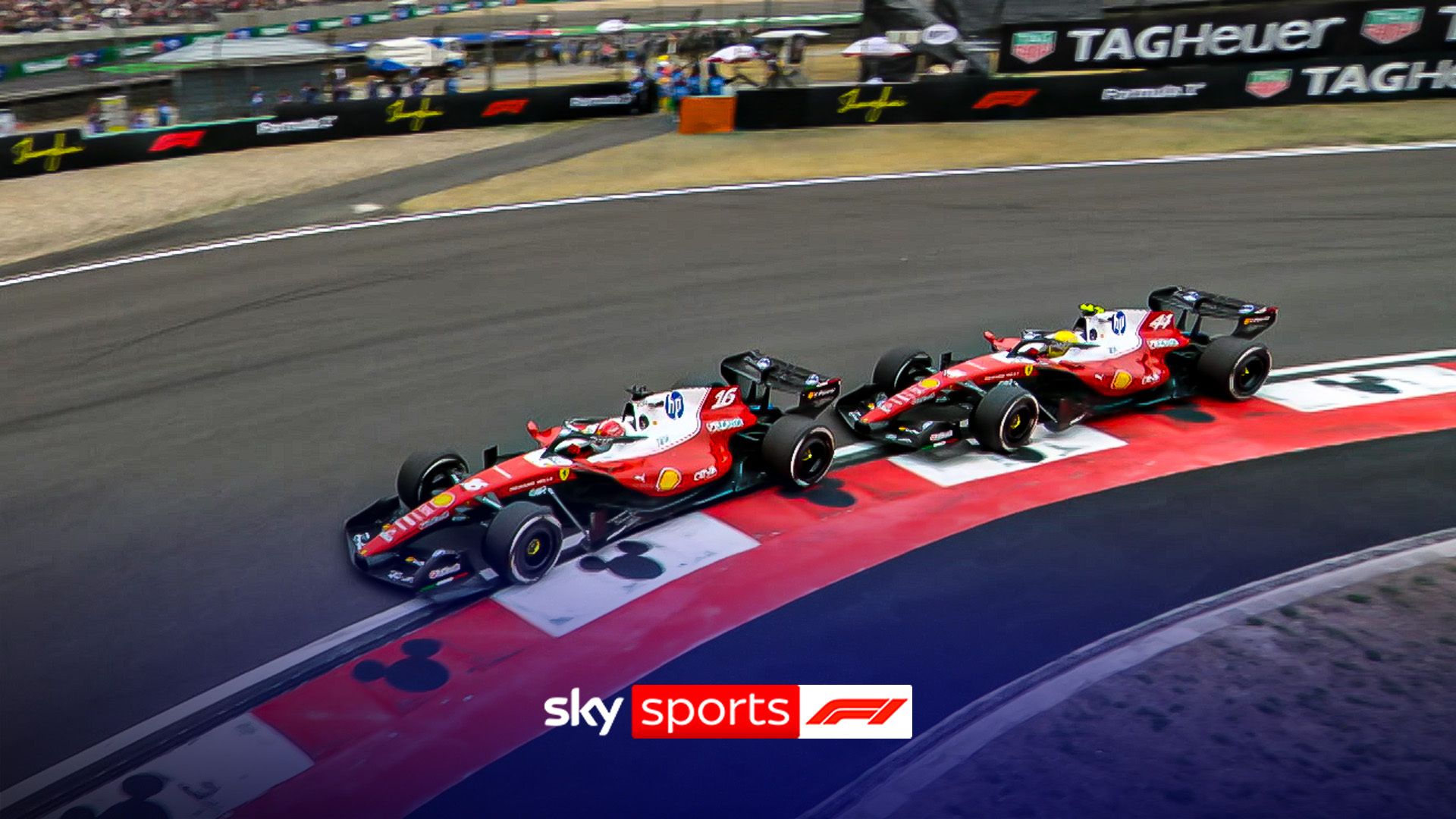
'No team orders at Ferrari' | Hamilton and Leclerc go head-to-head
#Ferrari #Lewis Hamilton #Charles Leclerc #team orders #Formula 1 #racing #competition
📌 Key Takeaways
- Ferrari will not implement team orders between Lewis Hamilton and Charles Leclerc.
- Hamilton and Leclerc are expected to compete directly against each other.
- The team emphasizes equal treatment for both drivers.
- This approach could intensify internal competition within Ferrari.
🏷️ Themes
Formula 1, Team Strategy
📚 Related People & Topics

Lewis Hamilton
British racing driver (born 1985)
Sir Lewis Carl Davidson Hamilton (born 7 January 1985) is a British racing driver who competes in Formula One for Ferrari. Hamilton has won a joint-record seven Formula One World Drivers' Championship titles—tied with Michael Schumacher—and holds the records for most wins (105), pole positions (104)...

Ferrari
Italian luxury sports car manufacturer
Ferrari S.p.A. (; Italian: [ferˈraːri]) is an Italian luxury sports car manufacturer based in Maranello. Founded in 1939 by Enzo Ferrari (1898–1988), the company built its first car in 1940, adopted its current name in 1945, and began to produce its current line of road cars in 1947. Ferrari became ...

Charles Leclerc
Monégasque racing driver (born 1997)
Charles Marc Hervé Perceval Leclerc (French pronunciation: [ʃaʁl(ə) ləklɛʁ]; born 16 October 1997) is a Monégasque racing driver who competes in Formula One for Ferrari. Leclerc was runner-up in the Formula One World Drivers' Championship in 2022 with Ferrari, and has won eight Grands Prix across ei...
Entity Intersection Graph
Connections for Lewis Hamilton:
Mentioned Entities
Deep Analysis
Why It Matters
This news matters because it signals a significant shift in Ferrari's team philosophy, moving away from their traditional preference for a clear number one driver. It affects Lewis Hamilton and Charles Leclerc directly as they'll compete on equal footing, which could create internal tension but also push both to perform at their peak. For Formula 1 fans, this promises more exciting intra-team battles and strategic complexity during races. The decision also impacts Ferrari's championship prospects, as unmanaged competition could lead to costly collisions or maximize their points potential depending on how it's handled.
Context & Background
- Ferrari has historically employed team orders, most famously with Rubens Barrichello moving aside for Michael Schumacher at the 2002 Austrian Grand Prix, which led to rule changes.
- Charles Leclerc has been Ferrari's lead driver since joining in 2019, often receiving preferential treatment over previous teammates like Sebastian Vettel and Carlos Sainz.
- Lewis Hamilton's move to Ferrari in 2025 marks one of the biggest driver transfers in F1 history, bringing a seven-time world champion to a team without an established hierarchy.
- The last time Ferrari had two clear top drivers competing equally was in the early 2000s with Schumacher and Barrichello, though that dynamic was quickly clarified in Schumacher's favor.
- Team orders remain legal in F1 but are controversial; Article 39.1 of the sporting regulations allows them if communicated clearly and not endangering safety.
What Happens Next
The first direct on-track battles between Hamilton and Leclerc will occur during 2025 pre-season testing and the opening races, where early incidents could test Ferrari's 'no orders' policy. By the European leg of the 2025 season (May-June), team dynamics will become clearer as championship positions solidify. Ferrari may revisit their stance mid-season if one driver falls significantly behind in the standings or if repeated conflicts cost the team points.
Frequently Asked Questions
Ferrari likely wants to maximize their chances by letting both drivers compete freely, especially with Hamilton's proven race-winning ability. This approach can motivate both drivers to extract maximum performance and avoid the negative publicity that often accompanies team orders. It also respects Hamilton's status as a champion who expects equal treatment.
The main risk is that Hamilton and Leclerc could collide while fighting each other, costing Ferrari valuable constructor points. Unmanaged competition might also lead to strategic conflicts during races, such as disputes over pit stop priority. Additionally, a prolonged internal battle could distract from the team's focus on beating rivals like Red Bull and McLaren.
Without team orders, Hamilton and Leclerc could split points between them, potentially allowing a driver from another team to win the championship. However, if Ferrari produces the fastest car, having two competitive drivers could actually secure more points overall. The dynamic may force both drivers to take more risks in qualifying and races to establish intra-team supremacy.
Ferrari briefly allowed competition between Alain Prost and Nigel Mansell in 1990, but tensions led to Prost's departure. More recently, Sebastian Vettel and Charles Leclerc had several on-track clashes in 2019 when both were allowed to race, prompting Ferrari to later clarify Leclerc as their priority. The Hamilton-Leclerc pairing represents their most ambitious attempt at equal status since the Schumacher era.
Yes, Ferrari's stance will likely be tested by real racing situations. If one driver establishes a clear championship lead, the team may implement strategic orders to protect that position. Similarly, if repeated conflicts occur, Ferrari might intervene to protect constructor points. The policy is most vulnerable around Monaco and Singapore, where track position is critical and team coordination matters most.