
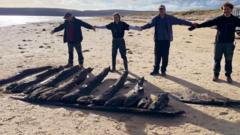
Shipwreck timbers from 17th Century appear on beach in Dorset
#Studland Beach #Dorset #Swash Channel wreck #Shipwreck #Maritime history #17th Century #Archaeology
📌 Key Takeaways
- 17th-century ship timbers were discovered at Studland Beach in Dorset following natural sand movement.
- Experts have linked the remains to the Swash Channel wreck, a Dutch merchant vessel that sank in 1631.
- The find is considered a 'missing piece' of one of the UK’s most important underwater archaeological sites.
- Conservationists are racing to protect the timbers from decay caused by exposure to oxygen and the elements.
📖 Full Retelling
Archaeologists and heritage experts have identified 17th-century shipwreck timbers discovered by beachgoers at Studland Beach in Dorset earlier this week, identifying them as missing structural components of the famous Swash Channel wreck that sank in 1631. The discovery occurred after recent winter storms and shifting sands exposed the ancient oak remains, prompting a rapid assessment by maritime historians to ensure the preservation of the fragile organic material. The timbers are believed to have detached from the main wreckage site located nearby, providing researchers with a rare opportunity to examine the craftsmanship of a high-status Dutch merchant vessel that perished nearly four centuries ago.
The Swash Channel wreck is widely regarded as one of the most significant underwater archaeological sites in British waters, originally discovered in 1990 during dredging operations near Poole Harbour. The vessel, a large armed merchantman, carried a wealth of decorative carvings and historical artifacts, but parts of its upper hull had remained missing for decades. Experts from Bournemouth University and Historic England noted that the recently surfaced timbers show distinct evidence of 17th-century carpentry techniques, including treenail holes and specific wood-shipbuilding joints common during the Dutch Golden Age.
Local authorities and conservationists are now working to document the find before the tides or natural decay further damage the wood. Because these timbers have been preserved in a low-oxygen environment beneath the sand for hundreds of years, sudden exposure to the air poses a significant risk of rapid deterioration. The discovery adds a new chapter to the ongoing study of the Swash Channel site, which has already yielded spectacular finds such as a pair of rare merman-shaped wooden carvings that once decorated the ship's stern.
🏷️ Themes
Archaeology, History, Environment
Entity Intersection Graph
No entity connections available yet for this article.
Original Source
Experts believe timbers found at Studland Beach form a missing piece of the Swash Channel wreck from 1631.
Read full article at source